As noted earlier, BMC Jones was my entry into chiefs taking care of division officers. Ensigns and even Lieutenant Junior Grades (LTJG). BMC Jones was my chief when i was an ensign and first lieutenant on the good ship Hawkins.
We had a chiseled seaman apprentice in first division, who also thought he was a good sea lawyer.
The Navy was different back then. One difference was liberty cards. Normally the ship was in three duty sections, of which one took the duty and remained on board every third day. When liberty call came, the two enlisted duty sections not on duty had been given their liberty cards, about the size of business cards, to show to the quarterdeck watch, a requirement before being allowed to leave the ship. These cards were usually passed out by the division’s leading petty officer at quarters each morning. If you didn’t get a liberty card, you didn’t go ashore.
Seaman Joe Shit the Ragman (a title we gave problem junior enlisted) had done something wrong and the LPO, BM2 Carrier, had not issued the sailor a liberty card even though he didn’t have the duty. To make it worse for Ragman — Back then, junior enlisted were addressed by their last name only. Petty Officers could be called “Petty Officer xxx,” but usually called by their last name only as well; Chiefs were called “chief,” “senior chief,” or “master chief.” Junior officers were called mister, like “Mister Jewell,” until they made commander, then they were called by their rank, as in “Commander Jewell” — it was Friday. That meant Ragman had to stay on board for the weekend. This was an unauthorized but common form of a sub-rosa justice system. Ragman, the sea lawyer, took offense.
Just before Friday liberty call, i had walked down to the first division berthing compartment in the after section of the ship. i was checking the material condition and the state of the berthing compartment. Ragman saw his chance to haul out his sea lawyer skills on a green ensign. He was ranting about the illegality of not allowing him to go on liberty. i was mulling over how to handle this situational ethics situation (even though i had no idea a term for this kind of thing even existed): i wanted to support my leading petty officer; i was sure Ragman had deserved having his liberty card “lost,” but i also was supposed to uphold justice, fairness, and adherence to regulations.
As i briefly pondered my quandary, Chief Jones, who had been looking for me, slid down the ladder to the compartment. This wiry, small man, with a cigarette hanging outside of his mouth, stopped Ragman’s rant by merely holding up his left hand toward him. Then he asked me what was going on. i responded.
BMC Jones turned, grabbed Ragman’s blue chambray shirt with his right hand, pushed the fabric he had grabbed up to Ragman’s throat, and pushed him up against the bulkhead. i swear Ragman, all 180 pounds and six feet of him was quivering.
“Listen, you little shit,” Chief Jones said evenly despite being red in the face with veins pulsing, “If you ever pull that kind of shit again, i’ll see to it you never leave this ship. Ever.”
“Got that,” the chief concluded.
Then he turned to me and said to me, “Sir, let’s go up to the main deck. i want to discuss when we are going to retile and paint the main passageway.”
He turned and quickly ascended the ladder out of the compartment.
This ensign meekly followed, shaking my head in amazement.
Of the three military branches, Army, Navy, Air Force (Sorry Marines, as good as you think you are and as good as you have been, you remain a subordinate part of the Navy and really have become an unnecessary part of the military force because you just duplicate the mission of the other services, even if you are good.), the Navy seems most unique to me.
One of my best friends, Marty Linville, an Army artillery wizard who received a well-deserved Silver Star for his heroic action in Vietnam as the commander of an artillery unit, and i have often discussed the difference between enlisted personnel and officers, Army and Navy.
The biggest difference, in which the Army’s side of this difference also includes the Navy’s Special Forces warriors, the SEALS is that the true, original Navy officers, now known as Surface Warfare officers (what a bunch of malarky) is their expertise in driving ships. Their other, equally important purpose is to lead or manage (or both) their subordinates, at least in rank. Officers in the Army and SEALS, especially the junior officers, are out in the field waging war while leading their subordinates.
Navy Chief Petty Officer insignia
Marty and i agree the differences in the historical structure comes from the differences in role. Obviously, there are some historical and tradition elements that foster the difference. The Navy, the surface warfare kind, seems to draw more distinction in the rank divisions of officer, chief petty officer, and other enlisted.
Their uniforms announce that difference. But in the Navy, it is significant, although the new Navy seems intent on wiping out any differentiation, both symbolically with uniforms and literally with less separation between the ranks. With the advances in technology and many other things, this merging may be necessary. i wouldn’t know. i’m old school. As in old.
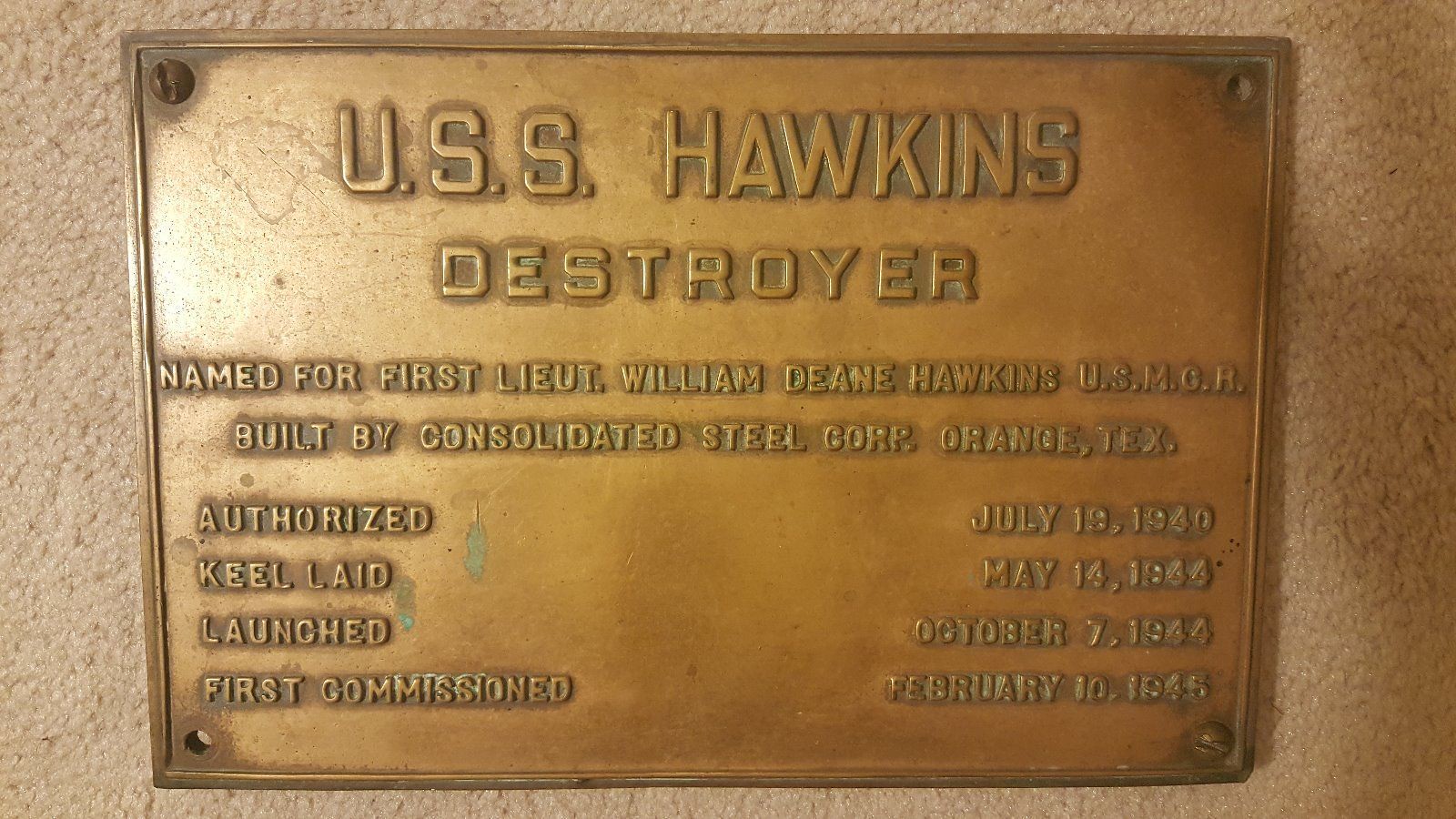
i have formed a long distance bond with a number of sailors on my first ship, the USS Hawkins (DD-873). i reported aboard in April 1968, flying from Rota to Malaga, Spain and coming aboard as she was on her way back from a nine-month Mediterranean deployment to her homeport of Newport, Rhode Island. i had completed OCS in early February, spent two months in Key West attending the Anti-Submarine Officer’s School before flying out of Charleston with my entire belongings: my uniforms, a small civilian wardrobe, and a grunch of books, all in a plywood 2 x 2 x 4 foot cruise box that weighed in the neighborhood of a ton.
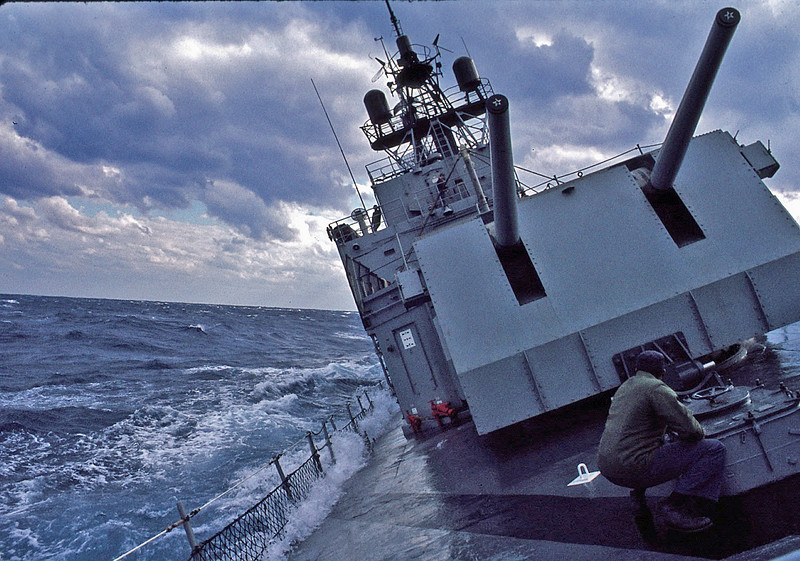
Underway: a sailor enjoying a quiet moment on the fantail of the USS Hawkins (Thanks, Gary McCaughey)
i was slated to be the ASW officer, but the resident ASWO was not leaving until early October, so i was assigned the first lieutenant’s billet for the return, the summer of minimal local operations until the September beginning of a six-month overhaul when i took over as ASW officer.
Those first six months were a crash learning course in how Navy ships at the time really worked. The “Navy way” was continually emblazoned in my head for the next twenty-two years. A great deal of that learning curve concerned the differences between the enlisted, the chiefs, and the officers. Actually, there was another division: the “leading petty officers” or “LPO’s.”
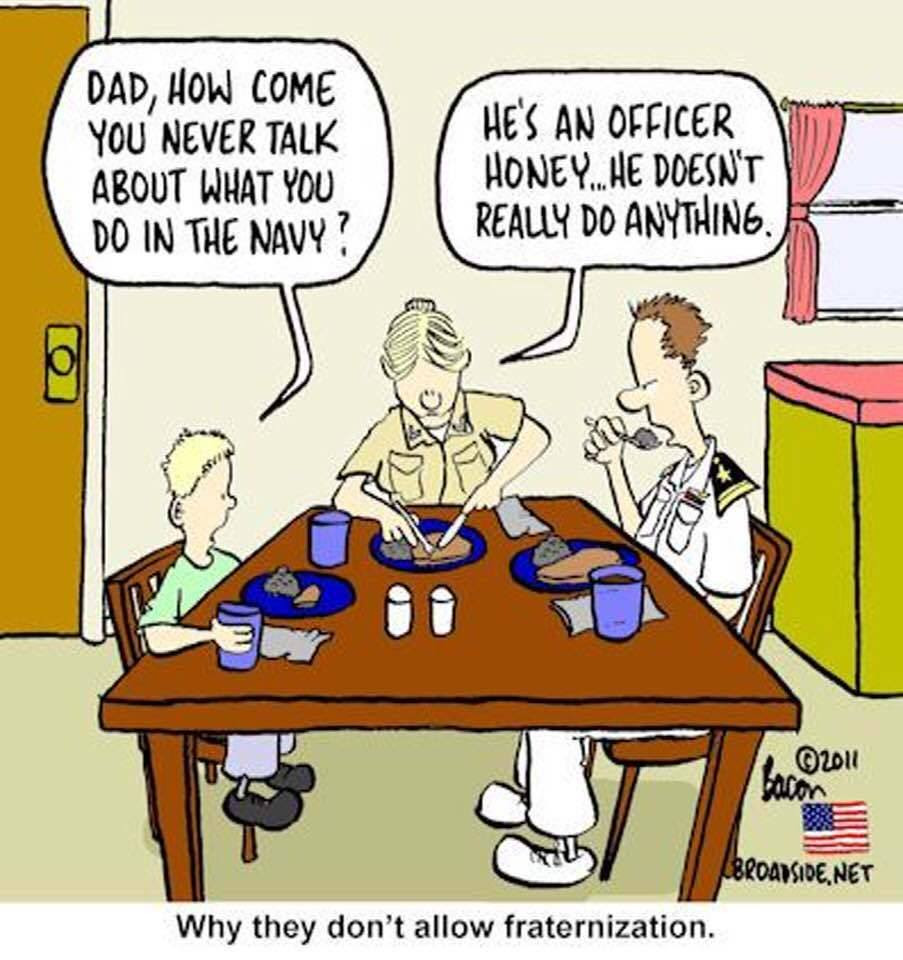
The system worked well even though the different groups made fun of the others. A great example of that is the cartoon taking a shot across the bow at officers, Norm O’Neal, a radarman (RD) at the time and now a close friend through email and social media, sent me last week:
My immediate reply was:
Norm, this one wouldn’t let me “reply to all,” the officers said this about a lot of chiefs.
To which, Norm replied, “Ouch.”
To which i added:
Actually, Norm, as it is with nearly all situations, there are good people and bad people in every level of every organization.
My first chief petty officer was the Hawkins’ BMC Jones. He saved my ass on several occasions. He was a small, thin, wiry, gnarly, old chain-smoking chief from Arkansas. After teaching this ensign the ropes, he retired the Monday after the change of command on the Hawk in August 1968 (speaking of good and bad, there was the CO who made the deployment, the screamer whose name i can’t recall right now being relieved by Max Lasell, who remains one of the top three of the CO’s under whom i served, and that’s another story).
But Chief Jones was relieved by a short, portly, old BMC with thick white hair whose name i also can’t remember. He was the first of many chiefs who worked for or with me officers called “ROADS Scholar” for Retired On Active Duty. You could tell them by the permanent crook they had in their pointer finger from holding on to their coffee cup they used while they spent about 95% of their time in the chiefs’ mess.
But that was only part of my crash education about Chief Petty Officers on the Hawk. i learned why Chief Petty Officers, a unique position in the military services, were so important. Through my remaining twenty-two years, this idea of chiefs being different was continually emphasized. For good reason.
My initial realization of the difference was from the get-go. i had wondered since i first became connected to the Navy when i began my NROTC scholarship tragedy at Vanderbilt, why senior enlisted had uniforms more like officers than the other enlisted. Although i was slowly learning why through OCS in Newport, Rhode Island, ASW school in Key West, and two weeks in Rota waiting to join my new ship, the difference slowly was becoming apparent to me.
Before chiefs taught me a thing or two or two thousand, i was a very, very green ensign.
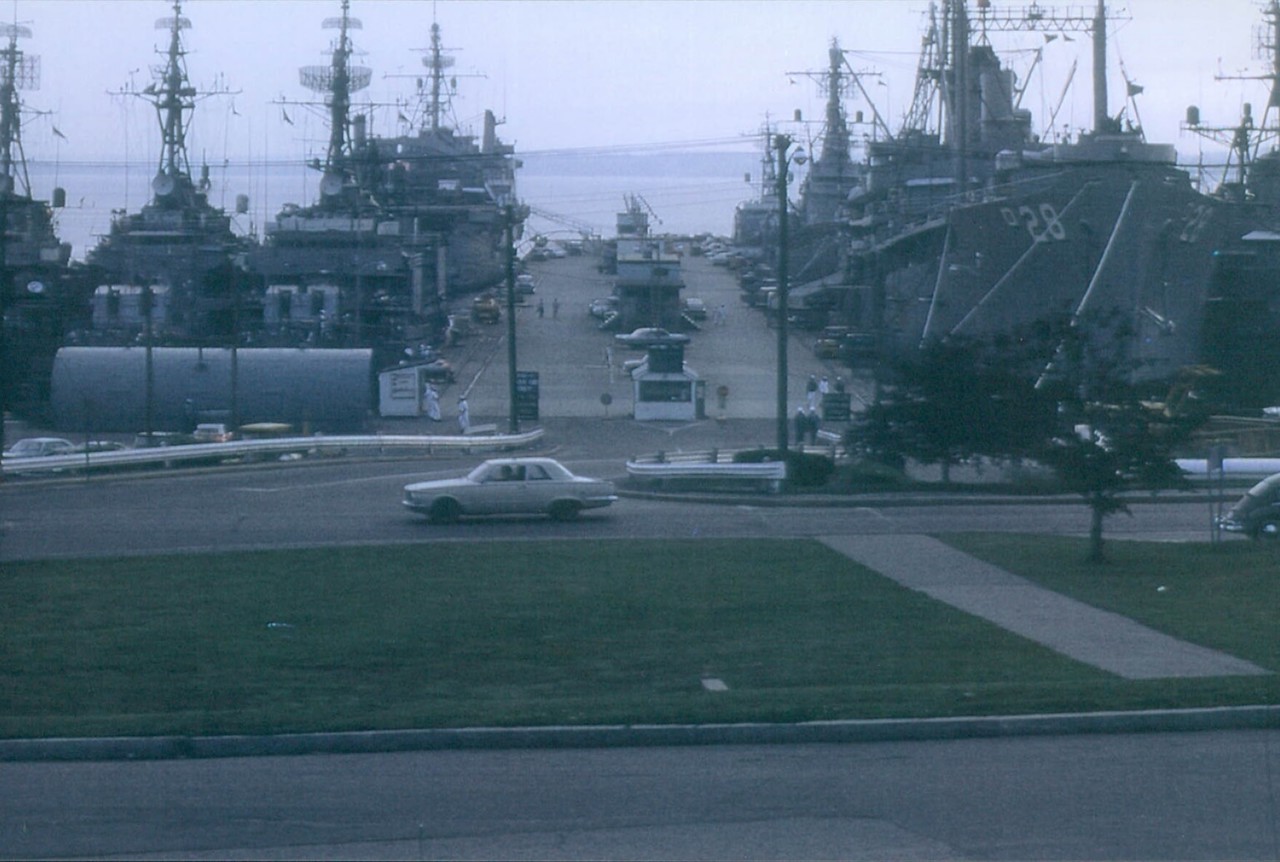
Destroyer-Submarine Piers in Newport, Rhode Island where i learned about the paint locker, circa 1968. Photo provided by RD2 Norm O’Neal. Thanks, Norm.
As an ensign, i stood duty in three sections. The qualifications for standing the OOD, Officer Of the Deck, watch in port, was not too stringent. You had to be a junior officer, chief, or very good first class petty officer. And breathe. i would add “chew gum” but that was deemed inappropriate on the good ship Hawkins or any other Navy ship at the time.i may have stood an under-instruction watch, but i don’t remember it.
i don’t remember standing many of those earlier watches, not even the first dog one particular duty day in the summer of 1968. But i most definitely remember the next watch.
It was the mid-watch. About half-way through around 0200, a third-class petty officer came back from liberty. He was lit. After saluting, he began to rant and rave and chewing me out in particular. i was not quite sure what to do. My petty officer of the watch (POOW) recognized my dilemma and called the duty Master-at-Arms.
As i was trying to tell the boozy sailor he was on report, the master-at-arms showed up on the quarterdeck. He was a first class gunner’s mate. Unfortunately, as it is in many of my recollections, i don’t remember his name. i do remember he looked like an NFL tight end. He wore his chambray shirt sleeves folded up above his elbows to show up his rather impressive biceps, even with a couple of tattoos disguising the ripples. He had a tight crew cut under his dixie cup (“hat” for land lubbers), which of course, was pushed back from his forehead. A Pell Mell dangled from his lips.
“Don’t worry, sir,” he said to me, “I’ll take care of this guy.”
Then, he grabbed the sailor by the arm, leading him off the quarterdeck and forward, telling him, “Come on son, we’re gonna have a little talk down in the paint locker.”
The paint locker was part of the boatswain’s locker on a Gearing-class destroyer. It was all the way forward on the first platform (a partial deck below the main deck), small and dark. i did not know it at the time, but it was also the location of some non-NJP discipline.
When i asked the POOW why the master-at-arms was taking the drunken sailor to the paint locker, he just said, “To help sober him up,” and then he chuckled.
i learned the next morning at quarters what the POOW really meant. The sailor who had been “sobered up” passed me as we headed for our different division musters. He looked not quite like he had been put through a meat grinder, but it was close. His face was black and blue and one eye was swollen. i don’t think he ever gave an OOD any trouble after that.
The master-at-arms had applied some discipline. Back then, that wasn’t such a bad thing. Today, all hell would have broken loose and all of us would have been plastered all over the major networks for being slightly cross-threaded with political correctness. But this type of justice kept a lot of sailors from going to captain’s mast or worse, and it straightened many of them right up.
i learned a lot.
It probably wouldn’t work today: too many sea lawyers.
The Navy was different back then. i think they continue the traditions, but those traditions, like chiefs initiations and over-the-line rituals are watered down. Political correctness, you understand. The divisions between ranks have been muddled. This may or may not be a bad thing. i am not wise enough or knowledgable enough to determine, but it is different.
And i liked the way it was.
When i was in the Navy, the lower enlisted were the work force, and boy, did they work. In fact, they were incredible workers. There are very few people in this country today who could even fathom putting in the hours at work those sailors did.
The third and second class petty officers were a transition. They too did hard labor, but their expertise and knowledge in their fields (ratings) began to give them more say in the way ships operated.
First class petty officers were escaping most of the hard labor, but they still got involved. “Leading Petty Officer” speaks of their new role in leadership.
Then there were the chiefs. Lifers. Loving the Navy. Thinking they knew as much as the old man. Some did. But as with all things, there were some really good ones and there were some who were…oh, to be nice, they weren’t quite as effective.
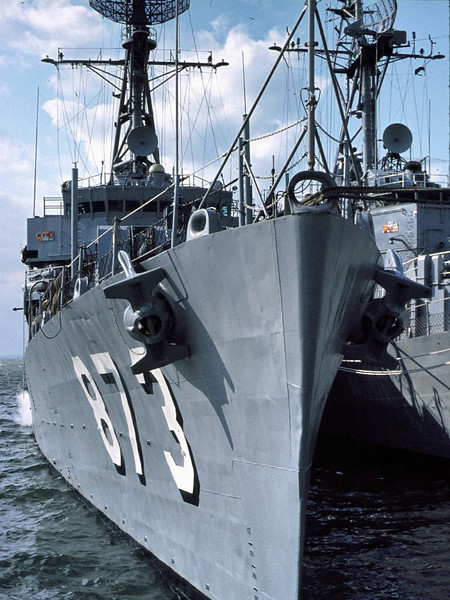
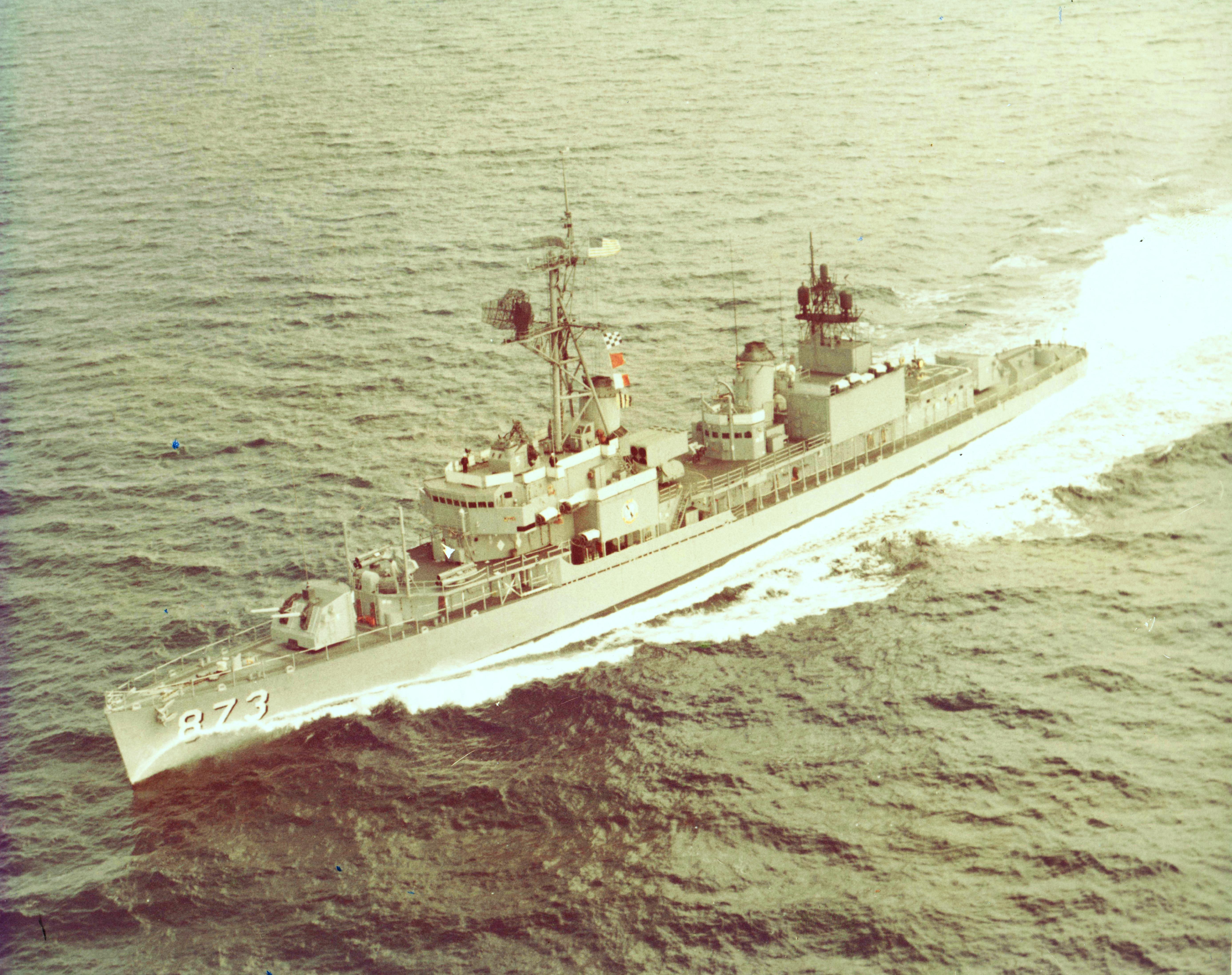
USS Hawkins (DD 873), circa 1969
An Ensign learns this quickly. i did. My first ship was the USS Hawkins (DD-873). i had completed the Anti-Submarine Warfare (ASW) Officer course in Key West when i reported aboard in Malaga, Spain in April 1968. The sitting ASW officer would not leave until October. In the interim, i was the First Lieutenant, deck officer in charge of first division, boats, davits, exterior spaces, and anything else that wasn’t specifically related to any other division or department.
BMC Jones was my introduction to the way things worked. He taught me the ropes. It still amazes me how he ran first division, taught me many things about being a division officer and deck seamanship while never appearing to be in charge, always deferring to his division officer. Green upon green me. Crazy. But it worked.
Chief Jones was from the Arkansas Ozarks. He had another four months to reach twenty years. He planned to retire on the button. Chief Jones was a chain spoking, rail thin, ruddy complexion chief boatswainmate, probably around 5-8 and 130. He was not to mess with.
After we crossed the pond and completed our deployment, arriving at our homeport of Newport, Rhode Island in early May, being on a ship was different. Back then, the crew had liberty cards. They reflected which section the sailor was in. There were usually three sections rotating the duty. The duty section remained on board for 24 hours while the other two sections had liberty. Those liberty cards were handed out by the chief or leading petty officer shortly before liberty call. It had many implications not on top of the table. Liberty cards were incredible leverage for the LPO’s and CPO’s.
We had this seaman apprentice who required leverage. He was a strapping, very fit 6’2,” 180-pound young man, and pretty smart too. Problem was he wanted to use his smarts to get away with stuff until he had completed his obligation. We called sailors like this “sea lawyers.” Chiefs and LPO’s didn’t like sea lawyers. To put them in their place, the chiefs and LPO’s used leverage. Like liberty cards.
We will call this guy Seaman Farkle. Back then, you didn’t have to be so polite. Anyone below chief was called by their last name. Period. Chiefs were called chiefs. Officers were called by their rank, e.g. “Ensign Jewell.”
It was a Friday. We were cutting the hard working folks some slack. Liberty call was at noon, not the usual 1600. i had gone down to the first division berthing to check out the material condition. Farkle was there, upset. It seems he had tried some sea lawyering out on BM2 Carrier, our LPO and a very good one. Farkle was in section 2, section 3 had the duty. But when Carrier passed out liberty cards to the division, he couldn’t find Farkle’s. That meant Farkle had to remain aboard the ship, even though it wasn’t his duty day.
Farkle decided an ensign was ripe for using his sea lawyer tactics. He approached me and began an intense tirade about abuse of his rights, how he was demeaned, how the chief and LPO were acting outside of procedure, were in violation of regulations.
He was making headway on this green ensign. i wasn’t yet wise in the ways of that Navy. He had some good points, from a sea lawyer’s perspective about rights and all that, but i wanted to back Carrier and Chief Jones.
Farkle was in my face, livid with his sea lawyering when Chief Jones slid down the ladder (forward, not climbing down backwards; that’s how true sailors descended ladders). The slender, wiry chief slid in front of me and grabbed Farkle’s shirt at the top two buttons. Then he pushed Farkle against the bulkhead and with one hand lifting the young man about six inches off the ground. Then Chief Jones read Farkle the riot act like only Boatswainmate chiefs can do. It was classic and can not be repeated here because non-that-era tincan sailors are the only people who would understand, and others will read this.
All sea lawyering disappeared from Farkle. He was a quivering mass of fear, nodding affirmatively and declaring his fealty.
Farkle stayed on board that weekend.
i learned a valuable lesson about the old Navy…and i loved it.
Commander, Amphibious Squadron Five, his staff, and his flagship, the USS Tripoli (LPH 10) had drawn Hong Kong as their liberty port over Christmas and had pulled into Fleet Landing on the Hong Kong side right next to the great Fleet exchange.
Staff officers Mike Peck, the Tactical Air Control officer; Pete Toennies, the UDT advisor; OW Wright, the admin officer, and me, the staff’s current operations officer, had become good friends and running mates since i joined them in Hobart, Tasmania in November, and we had proved we were good liberty hounds. We were ready for Christmas in Hong Kong.
Mike and i had been in this wonderful city several times before. Mentioning the name of Johnny Lee, the tailor, got us a room in the Holiday Inn on the Kowloon side, a much improved version of the chain than those in the states. In Hong Kong, it was considered a luxury hotel. Mentioning Johnny Lee gave us the large room with two queen beds for $65 US dollars a night.
There are a number of sea stories related to this liberty, but i will stick to one aspect of our port stay.
The British Navy contingent in Hong Kong had hosted a reception for the squadron the day after we arrived. Mike and i hooked up with lieutenant junior grade in the British Navy, and we had a great time swapping stories. Unfortunately, i don’t remember his name, but i do recall he was a helicopter pilot who had been retrained to drive their surface effect boats in Hong Kong with the mission of interdicting any attempts at illegal immigration. This had been a big problem for the Brits after the evacuation of Vietnam as many of those displaced were trying to get into Hong Kong.
The three of us hit it off. To show our appreciation of the new friendship, we took the Brit to Gaddi’s, one of the finest high end dining establishments in the world, housed in the famed Peninsula Hotel in Hong Kong. It was a good evening. So Pete, Mike, the Brit and i ran around for several days. The younger helicopter/surface effect boat driver invited us to Christmas Eve mess at the British Navy’s wardroom.
The HMS Tamar is the tall white building by the bay behind the Navy ships, either US or British. It was turned over to the Chinese when Hong Kong was transferred from England to China.
Now the officer’s mess in their wardroom was no ordinary place. The wardroom and the accompanying galley were not on a ship. They were on the penultimate floor of the British Navy’s Hong Kong headquarters, a thirteen story building on the waterfront. The Brits called it the HMS Tamar, as if it were a ship. The wardroom was actually two stories high and the bayside was a huge glass window looking out on Hong Kong. The city and its lights were a beautiful sight on Christmas Eve from that vantage point.
The HMS Tamar’s wardroom consisted of about one hundred officers, about a third of which were women, something US Navy officers weren’t accustomed to at the time. With shrimp cocktail appetizers and drinks, we chatted with all of the male and female officers before sitting down for the evening mess. It was a traditional British Christmas feast that seemed to have no end. Roasted goose and roasted gammon (smoked ham) were the traditional meats but the British Navy added roast beef. Then there was roasted chestnuts with Brussel sprouts, roasted potatoes, pigs in a blanket, parsnips, and swede (rutabaga), ginger bread stuffing, bread sauce, cranberry sauce, and concluding with, of course, English Christmas Bread Pudding.
All of this of course, was accompanied by continuous libations of wine, whiskey, and of course, gin. It was all very, very lovely.
After dinner, we continued our discussions with just about everyone in a Royal Navy uniform. We were like celebrities. My glass was much like the professor in “The Bishop’s Wife” when Cary Grant, the angel kept magically filling the writing professor’s glass.
Just before midnight, i was looking at Mike and Pete, thinking it was about time to say our thanks and give our hosts Christmas wishes, catch the elevator, and walk back to the ship, berthed between the HMS Tamar and the U.S.Fleet Exchange. But the group of about six junior officers insisted we attend midnight mass with them. If anything, this contingent about half men and women officers, had consumed a lot more beverage than any of us. Regardless, we agreed. Then they exited the main wardroom and started walking up the stairs. i was surprised there was another floor and asked where we were going.
“To the chapel,” they informed me.
i would like to say we filed in quietly with decorum. i think Mike, Pete, and i mustered the strength to approach some semblance of decorum. But it was a pretty raucous bunch who found seats in two rows toward the back of the small chapel that held about 150 people, if that. Our group was laughing and continuing to have fun until just before the service. Then, one of the female officers behind us, tapped me on the shoulder.
She pleaded with whispers for us to help them out. One of the male junior officers had hidden a fifth of gin and brought it into the chapel. He was also blown out of his mind and close to passing out. The young female officer asked me to take the gin and hide it through the service. She explained if the senior officers caught him our any of the English in our group with the booze, they could be booted out of the service, not the mass, the British Naval service.
We, somewhat dubious, complied with her pleas. She passed the bottle to me under our seat. With Mike and Pete’s approval, i slid it up under my sports coat and cradled it with my left arm as inconspicuously as i possibly could.
The service went on, but i was too nervous to pay much attention. Getting up and down for the liturgies and hymns was a frightening proposition. With great difficulty, i successfully maneuvered through the stand/sit requirement each time. At the conclusion, i breathed a huge sigh of relief. Pete, Mike, and i had worked out a strategy, whispering during the service. We would file to the left to the center aisle and they would move as rapidly as they could without causing attention, leading interference for me. i would continue to cradle the booze with my left arm, hopefully looking as if nothing were amiss.
i had just cleared the aisle and was headed for the exit when the plan ran afoul of what Kevin Kline’s character in “Silverado” would have called “bad luck.”
Unbeknownst to us, the commodore, Captain Jim McIntyre, also known as the “Silver Fox,” was attending the mass, sitting on the front row with the British commander and a couple of Hong Kong notables. He spotted me and my interference walking quickly toward the door. He walked more quickly, caught up with me, grabbed my left shoulder, and spun me around.
“Sure am surprised to see you three here,” the commodore laughed.
i wasn’t thinking much about the commodore yet. When he spun me around, my grasp on the bottle of gin slipped. i lurched over catching the bottom with my right hand and moving it back up into its hiding place as covertly as i could.
Reaching out with my right hand, i shook his and said, “Commodore, you don’t know the half of it,” concluding, “It’s good to see you here as well. Merry Christmas.
With that, i turned before the conversation could continue, caught up with Mike and Pete and rendezvoused with our new British friends. They were ecstatically happy with their new heroes as we returned the bottle of gin. The female officer’s whose plea we had answered kissed me on the cheek, gave me a hug, and thanked the three of us for saving their hides.
They never knew our all of our hides could have been in deep, deep trouble if i hadn’t caught that bottle on the way down.
Christmas Day was anti-climatic, quiet and spent mostly on the ship. But it had been one great Christmas Eve, one i’ll never forget, but i hope i don’t have another like it.