Category Archives: Sea Stories

Fairly self explanatory, from what I can remember that is.

Sailors, Midshipmen, and Hatteras

In a recent post on the Facebook group “US Navy Gearing Class Destroyers,” Manny Gentile wrote:

When the midshipmen came aboard for their summer cruise, we went to great lengths to torment them.

i spent time on four Gearing class destroyers, the USS Lloyd Thomas (DD 764), the USS Hawkins (DD 873), USS Waldron (DD 699), and the USS Hollister (DD 788). i also had a tour aboard the USS Stephen B. Luce (DLG 7).

The Thomas was my ship for the third class midshipman eight-week cruise in the summer of 1963.

It was on the Thomas, my first time on a Navy warship at sea where seafaring reached into my gut and captured me…forever. It was also where tormenting of midshipmen was taken to an art form, and i was one of the targets, perhaps another reason for me to forever be a pocket of resistance.

i have told part of this before, but must repeat as the beginning had something to do with my first experience of Cape Hatteras, or to be more correct at sea east of Cape Hatteras.

In the summer of 1963, i opted to ride a bus from Nashville to Newport rather than flying due to my usual lopsided logic that i could save some money and use it for other things. My family drove me to Nashville’s Union Station where i caught a Trailways Bus. It left at noon Saturday and, with one transfer in Providence RI arrived in the Newport “square,” actually a deep triangle around 6:30 Monday morning, forty-two hours on a bus with stops only for passengers and some meals in my Navy Service Dress Khaki midshipman uniform.

When we offloaded, i found my seabag with all of my clothing had not been transferred to the new bus in Providence. i was assured my seabag would be delivered to the ship before we got underway.

Driving down Thames street toward the Navy base and the destroyer piers, i recall Newport as more of a sailor’s town: rough looking bars, a working waterfront much more so than a tourist attraction. When the bus stopped at the foot of the piers, i remember the USS Yosemite (AD 19) as the first ship pier-side in its grandeur as the flagship of the Commander, Cruiser Destroyer Force, Atlantic Fleet (i was Yosemite’s XO on my last operational tour twenty years later). As i walked down the wood creosote pier, i was in awe of the gallant destroyers nested in threes on the pier. I thought it was smoggy, but the tin cans were “blowing tubes,” cleaning out the boiler tubes by blowing residue out the stack, a practice soon prohibited except at sea from environmental concerns. But that day, the acidic soot particles landed on my blouse and cover putting small black holes in the fabric.

By the time, i walked across the  brow and awkwardly saluted while reporting aboard, i smelled worse than a goat on a bad day. We had a short introduction by the XO in the wardroom before we were hustled the to the 01 torpedo deck forward of the bridge and put into formation, 18 third class midshipmen and three first class midshipmen.

As we let go all lines and got underway, i was informed my seabag did not arrive in time but would be on another ship and transferred by high line as soon as practicable.

As we stood in formation, standing out of the harbor and the Narragansett Bay in incredible weather, a gnarly, old chief emerged from the hatch underneath the port bridge wing where all the midshipmen could see him but not visible from the bridge. The chief had grabbed one of the seasick bags, small paper bags that were a poor sister to the airsick bags available in aircraft. He had gone to chiefs quarters, crumbled vanilla wafers into the bag and then filled it about half full of milk.

As he emerged onto the weather deck, he grumbled, “Every time we get underway, i have to get my sea legs.” With that, he leaned over the lifelines and gurgled and belched as if he were throwing up. When finished, he raised up and announced so we could hear him, “And there’s only one way to cure it.” He then put the seasick bag to his mouth and drink the contents with the milk and crumbs of vanilla wafers spilling down his cheek, onto his uniform and the deck.

Of the twenty-one midshipmen in formation, eighteen immediately became seasick and rushed to the life rails to copy the chief’s throwing up but for real. i was one of the three still standing. i don’t know why, but i suspect i stunk so much from almost three days in the uniform on a bus that i was numb.

After sea detail was secured, we went to our assigned berthing on the fantail. All the third class midshipmen changed into the midshipmen version of an enlisted sailor’s dungaree uniform. with Dixie Cups that had blue piping on the rim. i remained stinking in my ripe service dress khaki but discarded the blouse. We went through an orientation and were assigned watches. Afterwards, we gathered in our berthing and became acquainted.

The evening meal on the mess decks was all greasy: pork chops, pinto beans, and other things i don’t remember. As we sat down, a couple of sailors walked through the mess deck announcing they would have an appetizer before the meal. They had tied strings onto sardines and had put them back in the sardine can. They opened their cans, held the sardines by the string and appeared to swallow them. Then they pulled them out announcing they were so good they would eat them again. They repeated this several times and more midshipmen rushed to the supply of seasick bags.

i had drawn operations as my first section of duty and was assigned the mid-watch. i was still in my gabardine, by now wreaking khaki trousers and cotton dress shirt, sans the tie. The first class radarman was the CIC watch supervisor. He gave me the job of staring at a radar repeater in the forward part of the darken ship space. The only lights beside the radar repeater were red to retain our night vision, and of course the glow from the repeaters. My station at the radar repeater required me to sit facing forward, thereby making the side rolls of the ship much more difficult to handle for seasickness. My seabag arrived three weeks later by hi-line. The destroyer who received it from the bus line had transferred it to the oiler in company and eventually the oiler transferred it to the Thomas.

i was already getting queasy as the ship came into the vicinity of Cape Hatteras. By my calculations today, i’m guessing we were about one hundred miles east of Hatteras, legendary for rough seas. The seas and Hatteras mix did not disappoint. The Thomas was taking twenty-degree rolls. That was about when all of the radarmen on watch lit up cigars. They kept changing stations while i rocked monotonously at my repeater turning green. Me turning green, not the repeater scope. As the radarmen moved from one station to another, each would come by my station to check on me, of course blowing as much cigar smoke as they could into my face.

i could feel myself getting sick. A lump came into my mouth from down below. It was nasty. Green to the gills, rocking to and fro, staring at the sweep of the radar on the scope, it appeared the sailors had gotten to one of the last three midshipmen who had avoided sea sickness. But from somewhere deep inside, i decided i was not going to give in. i swallowed down that lump and whatever else had come up from below, and gutted it out. By the time, the morning watch arrived, my green had gone away. Before i hit the rack, i brushed my teeth and had a drink of water.

i was given underwear and socks from ship’s store. A third-class radarman about my size donated enough sailor gear for me to wear.  He also donated some boots he had bought in Turkey on the last deployment. They were of camel leather that had not been cured very well. In short, they stunk. But the stench was nothing compared to the khaki i had been wearing for four very long days.

i never got seasick, or even close to it again. The ordeal was a blessing in disguise.

i soon realized all of the pranks the sailors were playing on the midshipmen and naive sailors, which continued on every ship i rode during twenty-two years. About three weeks later, i rotated to engineering and was assigned watches in main control and the fire rooms. On a forenoon (0800-1200) watch in main control, the watch supervisor instructed me to go to “A” gang (auxiliary engineering) and bring back some “relative bearing grease.” i dutifully headed for the “A” gang shop where i was told they were out and i should check with the BT’s (Boiler Tenders) in the after fire room. As i left their shop, i finally realized they were pulling my leg — “relative bearing” is the term for degrees from the bow of the ship often used to describe the ship’s position relative to another ship or object ashore — and there was no such thing as “relative bearing grease.”

i decided i just go take a nap in my rack. About an hour later, one of main control watch standers woke me up demanding to know what the hell i was doing. i acted sheepish and told him i was sorry, but i kept looking for some “relative bearing grease” but no one seemed to have it. Consequently, i was too embarrassed to return to main control empty handed.

The sailors never tried to pull my leg the rest of the cruise.

The tales of sailors pulling such stunts on new sailors reporting aboard or midshipmen are legendary. My favorite was the CIC watch on the Hawkins. It was at the end of a morning watch (0400-0800). The Boatswainmate of the Watch on the bridge piped attention with his Bosun’s pipe over the 1MC speaker which went throughout the ship and then warned “Stand by for heavy rolls” as the ship approached some rough seas. The CIC watch told their new striker, an RDSA, to go down the to the galley and wait in line to get some “heavy rolls” from the cook. The poor yokel did as he was told and spent an hour in a line of one at the galley hatch before he was told he had been tricked.

Sailors were fun. More seasick stories to come.

The Gloekles

A couple of months ago, i queried several Hawkins sailors about the Gloekles. i told them i was thinking about writing a post about the Gloekles and would appreciate any input.

i may have entertained you (maybe) with some information on these Hawkins sailors before, but to make sure here’s the story:

My first ship was the USS Hawkins (DD 873). After getting my commission from OCS in early February 1968, i attended the Anti-Submarine Officer’s two-month course in Key West and then flew to Rota, Spain, on to Malaga where i joined the Hawk on her way out of the Mediterranean en route from a nine-month deployment. i immediately became the First Lieutenant in charge of First Division, the deck gang, as we crossed the Atlantic to our homeport of Newport, Rhode Island. i became the ASW Officer as we entered our ROH (regular overhaul) in Boston in September. After a six-month overhaul, we went to GITMO for refresher training (for non-Navy folks that was Guantanamo Bay where Atlantic based ships went through two-month period, getting underway every weekday for certification as operational after overhauls.

By the time we returned to Newport, i had qualified as one of four OOD’s (Officer of the Deck underway) and one of four CDO’s (Command Duty Officers, who stood twenty-four hour duties and acted as the captain’s representative, responsible for the ship when the captain and the executive officer were ashore.

The Gloekles were not some small islands in faraway sea. Nor were they some dangerous passage close to some foreign shore. i had some first hand knowledge of the Gloekle’s. They were nice, friendly, sincere young men. Twins. They were SA’s (Seaman Apprentices) when they reported aboard and were assigned to First Division, the deck division, the one headed up by the green officer, one Ensign Jewell. They were of the old Navy.

i had experienced that Navy on my Third Class Midshipmen cruise aboard the USS Lloyd Thomas (DD 764).  There were sailors on the Thomas who thought of their ship as their home, their parents, their world. They lived on board for their entire careers. There was a fireman who had made it to second class BT (boiler tender) at least three times (and then would get busted at captain’s mast) with eighteen years in service on the Thomas. There was a second class cook with 17 years of service who also lived on board, and there were more. They  would not have been considered the brightest bulbs in the light fixture, but they served that Navy well and that Navy served them well.

The Gloekle’s were not in Mensa by any stretch. But they were sincere, well meaning, and as mentioned before nice young men. From somewhere in the Midwest as i recall.

They also had a penchant for getting themselves in predicaments and at least on one occasion, dragging me with them.

In the summer of 1968 after our return from the Med, we went out to the op areas for several aerial gun shoots where our two twin gun mounts (5″ 38) fired at a aircraft-towed target sleeve. i was assigned as check sight observer for Mount 51 on the forecastle. i sat in a seat up in the left front of the mount with a sight. My job was simply for safety. Before the mount captain could fire either gun, i looked through the sight to ensure we were shooting at the right thing, the target. i would tell everyone on the JS or JP sound powered phone circuit (as best as i can remember) if the guns were aimed “on target,” “clear,” or “cease fire” if they were aimed incorrectly, like at the aircraft rather than the tow . The mount had 12 personnel cramped inside including me. It was hot and it was loud (and this was long before anyone had come up with hearing protection). i loved it although i wanted to be more a part of the action rather than as a safety observer.

The hot case man in Mount 51 was one of the Gloekles. i don’t know which one. But i well remember looking back and watching him working at his task. The hot case man squatted at the rear of the mount underneath where the mount captain stood on his raised platform. He wore his regular dungarees, a battle helmet, and large asbestos gloves. His job was to deflect the powder casings as they were ejected from each mount after firing a round to ensure they went out of the mount through the hole in the bottom of the mount and onto the forecastle deck. It was an assignment coveted by noone. But this particular Gloekle twin obviously was enthralled.

His look of concentration was beautiful to watch as he swatted the brass casings. He knew his job was important, and he was completely focused on the task at hand — after a gun shoot, another job was to “police the brass.” Any of the casings, about a yard in length with diameter of five inches, that had not rolled overboard were collected and tossed into the sea. i often wish i could have saved them all, stored them, and then sold them for the brass; i would be a rich man today; we have a three-inch brass casing used to hold dried flowers by our living room fireplace; for a long time, i had the base of a five-inch casing and used it for an ashtray. i don’t know where it went. But Gloekle was not concerned with that. He was doing his job.

At that time, the First Division chief was BMC Jones, an incredible Navy chief and a superb boatswainmate. Just before the noon mess, he and i were walking the main deck, checking on how the painting of the ship was going.

Chief Jones turned to me and asked, “Have you ever seen a one-armed Gloekle?” At first, i thought he was talking about a unique piece of equipment used in deck evolutions. Then i began to consider he was pulling my leg. Finally it dawned on me, he was talking about one of the twins.

“Yeh,” the chief continued, “Gloekle was in the mess line on the port side of the main deck and he got frustrated with something. He turned and hit one of the grates on a air duct. His fist and arm went through the grating.

“He broke his arm and the doc put in several stitches. Won’t be good for much of anything for at least a month.

“Damn one-arm Gloekles,” he mused.

The Gloekles also were known by shipmates as good guys. One struck for the radioman rating while the other was a DK (disbursing) striker while we were in the yards for overhaul. The disbursing striker didn’t make it and returned to the deck division as a seaman.

In May of 1969, Hawkins went to the Portsmouth Naval Shipyard for a month. There the fantail deck was strengthened and a special davit was installed. The ship had been designated as the Atlantic recovery ship for the Apollo 12 mission in July, a backup to the planned return in the Pacific where the aircraft carrier USS Hornet (CV 12) had the primary recovery assignment.

Taking advantage of a month in the shipyard, the deck division cleaned and repainted the paint locker. To do so, they had moved all of the paint into a large conex box on the pier. One afternoon before liberty call, the new first lieutenant came to me and said, “You aren’t going to believe this, but Gloekle locked himself in the paint locker. He was in there for about two hours until someone discovered him there just before knock off. We have no idea how he did it.”

i had been qualified as OOD (officer of the deck on the bridge watch) in late February 1969 and as CDO (Command Duty Officer, responsible for the ship during an in port 24 hour period) shortly afterwards. i had  the CDO duty one night in August while the Hawk was in a maintenance period and Hurricane Blanche was building southeast of Norfolk (in June, Hawkins’  home port had been changed from Newport to Norfolk; i was not thrilled with the change). i read the message board after eight o’clock reports and there was no radio traffic that addressed  Blanche as a threat to the Naval Base.

After making my rounds before taps, i went back to the wardroom and caught the 10:00 o’clock news. The lead story was how the ships at Norfolk Naval Base were preparing to sortie because of the approaching hurricane. i had heard nothing from higher commands. i called radio, no answer. RMSN Gloekle, the other twin, was standing the evening watch in radio  Somehow, he had locked himself out of radio and had spent a couple of hours trying to get back inside the radio shack. Finally, he woke up the duty radioman who had another set of keys.

When the dust settled, Gloekle brought me the message board again. The radio message from SOPA (Senior Officer Present Afloat) had ordered the sortie preps about two hours before and each ship was required to report if it could get underway within twenty-four hours. i called the captain and the chief engineer at their homes. The engineer confirmed the main engines were open for maintenance, requiring more than a day to button them up and get underway. The captain confirmed the radio message response i had written and i sent it out immediately, later than other ships but apparently okay with the chain of command. A disaster had been averted.

One of the best things about the draft was Navy ships were melting pots of the United States. Sailors were from everywhere in the country and with all different kinds of backgrounds. Many i have known went on to successful careers in a variety in the civilian world. Many stayed in, like moi, and had good careers. Back then, some stayed in because it was a safe place to be, like i said earlier, it was their home, their world. i enjoyed knowing all of them except for the small number of miscreants i ran into through twenty-two years.

And then there were the Gloekle’s. Sadly, i don’t know what happened to them. But i remember them fondly in spite of some problems with them locking themselves in or out of things.


FMG

i’ve written about it many times here.

It is almost a ritual.

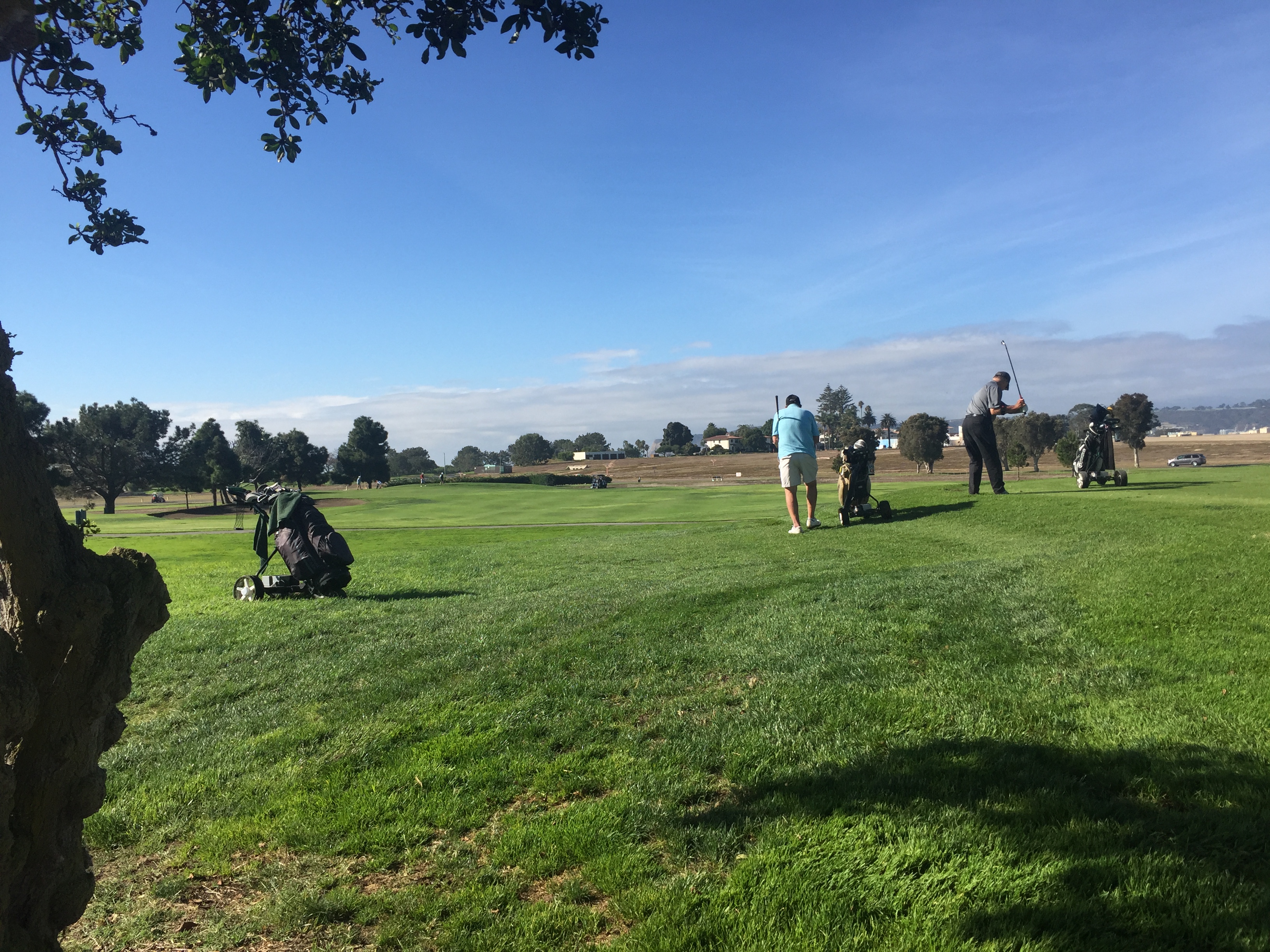
The two guys in the foreground are Marty Linville and Rod Stark. Rod is taking practice swings. The three of us began playing golf together in the mid-1980’s when we were all on our last military tours. Marty was the Army’s gift to the Navy’s Amphibious School, Coronado, taught gunfire control, and managed the big gun shooting range on San Clemente Island (about seventy miles west of San Diego). Rod was the director of amphibious training and later became the executive officer of the command. i was the director of leadership and management training for the West Coast and Pacific Rim in addition to facilitating the two-day seminar on Command Excellence for senior officers.

With a pretty rigorous schedule, the only time we could play was on weekends. It was difficult getting tee times on the four Navy courses (Sea ‘n Air on the North Island Naval Air Station, Admiral Baker North and South in the Naval Base recreation area in Mission Valley, and then Miramar, which was a Navy Air Station before the Marines took it under BRAC. One reason for our difficulties was retired folks were also getting tee times. We bitched about old farts taking up weekend tee times when they could play during the week.

So we vowed once we retired we wouldn’t play military courses on the weekend to give more tee times for active duty personnel. Except for tournaments and later Sunday rounds with Pete Toennies and our wives, we have stuck to that vow.

Then in 1991, Marty and i played a weekday round and discussed the situation. Marty had just gone to a 4/10 work week. i was mister mom. So we decided we could play Sea ‘n Air, Baker, and Miramar on Fridays. Rod, who after retiring was the golf pro for the North Course in Sun City, California, had quit that job when we ran into him at Miramar one morning in the mid-90’s. He joined our Friday bunch then. Since those first rounds in 1991, we have played golf at a local military golf course almost every Friday, teeing off early. i have actually made it understood when i worked at Scripps Consulting Group, military contractors, and Pacific Tugboat Services i would not be available to work on Friday mornings.

We call it “Friday Morning Golf.” i have shortened that to FMG. We have had as many as 16 golfers in our group and as few as two. Now, we come close to filling up two foursomes every Friday.

i have posted photographs before, nearly all on the fifteenth tee. The tee and the fairway borders the Navy beach (it used to be called “dungaree beach” for it was where sailors would escape from work when possible and loll about on the beach, but now is a big attraction for all Navy personnel, dependents, retirees, and others). The tee box gives one a great view of the majestic Point Loma, the Rosecrans Military Cemetery, and the wide expanse of the Pacific, not to mention if one turns around the iconic Hotel Del Coronado and the sprawling city of Tijuana are visible to the south. And routinely, we watch my ships, haze gray in their military splendor standing in or standing out of the channel.

But this photo is from the eleventh tee, the shorter one on the small hill rather than the longer flat one to the north. We are waiting for the group in front of us to clear the large par three green. The marine layer i often write about is hanging low over the Pacific, the brown and gray flat area from the middle to the right side of the photo is the beginning of the East to West runway for the air station. It is nearly always the flight path for landing aircraft unless a Santa Ana wind is blowing. So not only do we get to play golf in a rather idyllic setting, we also get to see FA 18’s, Ospreys, helicopters, training aircraft, others, and every once in a while even a C5 seemingly hung in the air trundling overhead like an airborne but very large snail headed for a landing. It is satisfying to know our successors are defending our country well.

Letters a While Ago Revisited

i was sitting at my desk in my home office, pretty much just wasting time and amazing myself at how it seems i always have more to do than can be done, never have enough money to do those things, and how long it takes me to get anything done.

Then i quit playing spider solitaire and decided to do something.

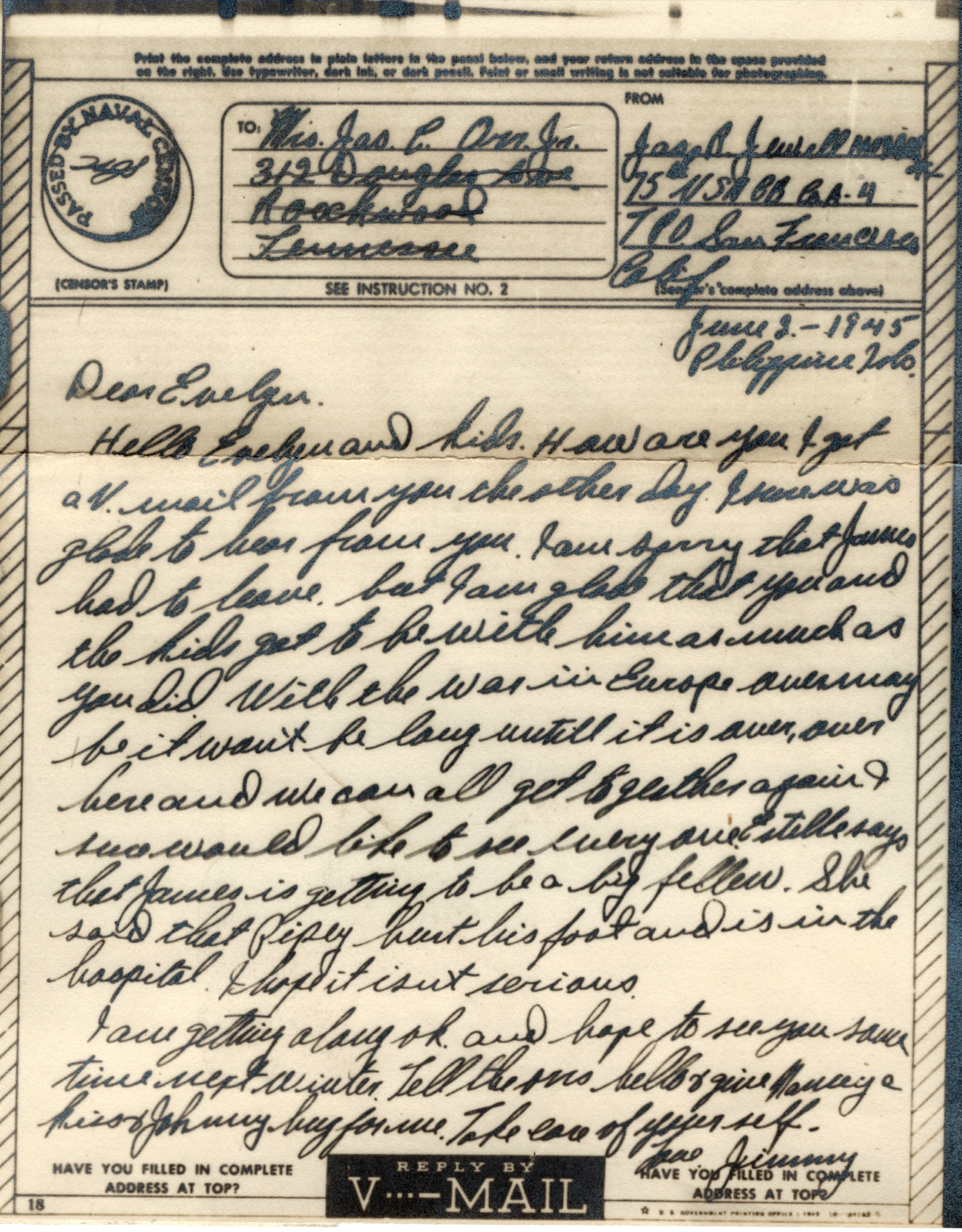
A couple of days ago, i wrote a post about V-Mails. There were six V-Mail letters i received with a nice note from my cousin, Nancy Schwarze. She always writes nice notes. The V-Mails were from my father to my aunt and uncle, Nancy’s parents. He wrote one from Gulfport, Mississippi where his 75th Seabees were waiting for a Liberty Ship to take them through the Panama Canal and on to the Southwest Pacific into the teeth of WWII (where he wrote the other five letters).

i wrote of him and some of my thoughts on him and his letters.

Today, i sent the originals to my grandson, named after my father, not me. i scanned them before i sent them because i realized the scanned letters could say more better than i ever could,  conveying a sense of time, the past, a moment in history as no writing ever could.

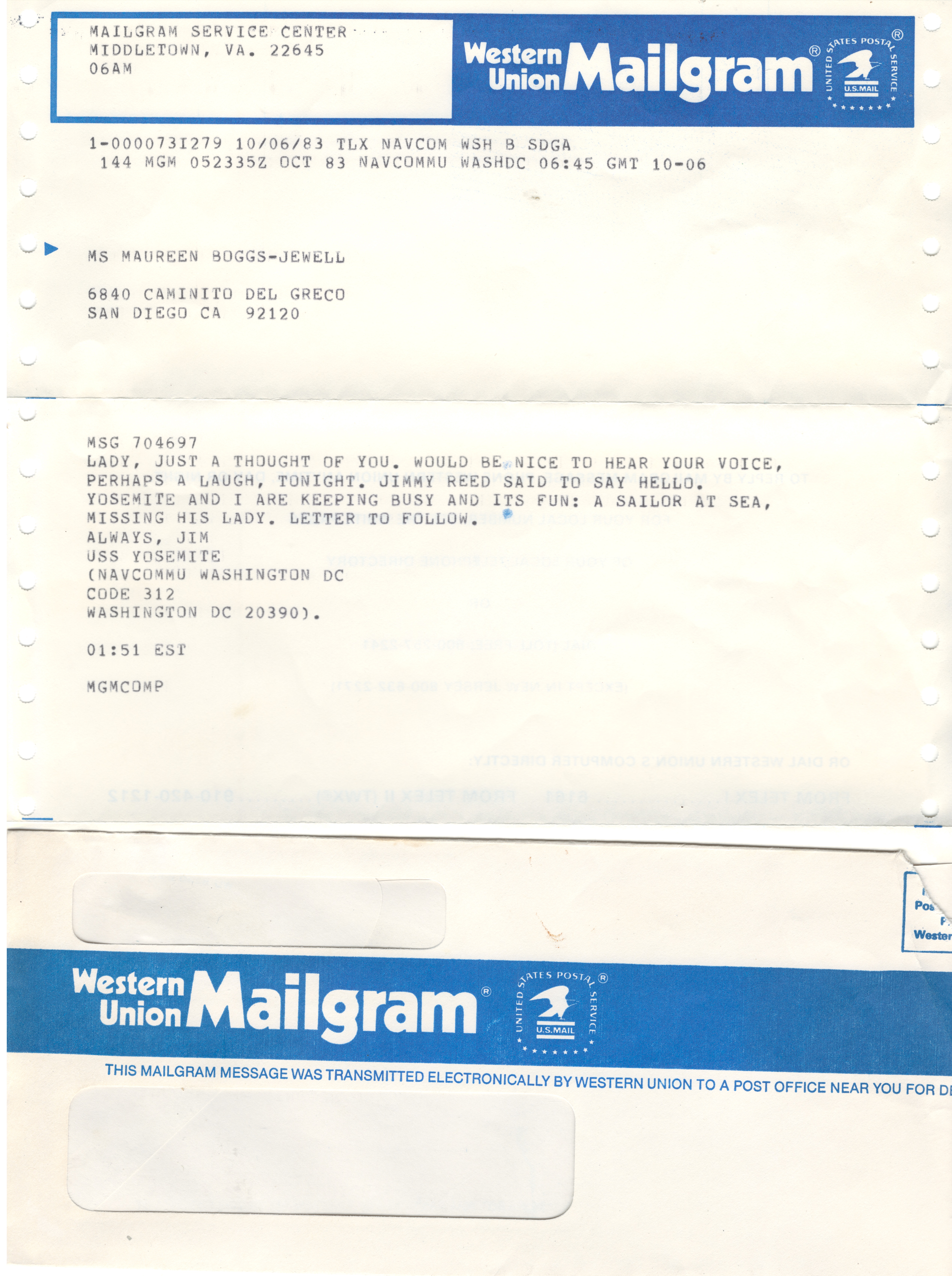
As i was doing this, i also ran across a document from my past. It is a Western Union “Mailgram” i sent it to Maureen in October 1983. i was in the Indian Ocean, on the USS Yosemite probably anchored of the Island of Masirah, Oman. We had been married three months and spent about two weeks total together before Yosemite got underway from Mayport, Florida for an eight-month deployment.

i compared my father’s V-Mails to my “telegram” morphed into a wire mail.

My father’s correspondence was received by the recipients some months after they were composed. Maureen got my note within a couple of days, maybe just one day. Now, the communication to folks back home can be instantaneous. But no less heartfelt.

My sense of father’s anxiety and loneliness is palpable to me. He was in hot humid lands of the Solomons, New Guinea, and the Philippines. i know. i have been there. Mine was in the hot, dry (even though at sea) Indian Ocean on a ship the vintage of my father’s military experience but modified to have air-conditioning, which, of course, frequently broke down. Sailors on today’s Navy ships have high-grade climate control, not for them but for all of that sophisticated electronic equipment, which cannot stand heat and must have controlled humidity to operate correctly.

My father was in the middle of it. A Japanese attack by land, sea, or air could have wiped out his battalion and him at any moment for just shy of two years. The enemy was easy to identify. The threat i faced in the IO was less imminent but more shadowy, unknown, and less likely. Today, the threat for our personnel also is shadowy, more of a terrorist nature, but still with lethal possibilities.

My father was fighting to save his country, our country, from domination by foreign terrors, governments run by tyrants with no limits on their murderous prospects. i was and today’s military personnel are fighting in foreign waters and lands with nothing really clear except the threat being real, more to suppress the threat than defend the downfall of our country. Still for those at the front a real possibility of dying.

When my father wrote, he had no idea when he might come home. When i served, i suffered the “mid-cruise” blues on nearly all of my deployments, certainly feeling that loneliness when i wrote my telegram. i do not know the extent of that feeling of loneliness of today’s soldiers, sailors, and marines. But i suspect, even though communications to and from home are so much easier, they still suffer those blues.

Regardless, i decided to include photos of one of my father’s V-Mails and then my Western Union Mail Gram. After all, the scans do convey a sense of time, the past, a moment in history as no writing ever could. Had i samples of today’s communication between deployed military personnel and their loved ones, i would include them. But i don’t have such and even if i did, it would be electronic.

i wanted to share:

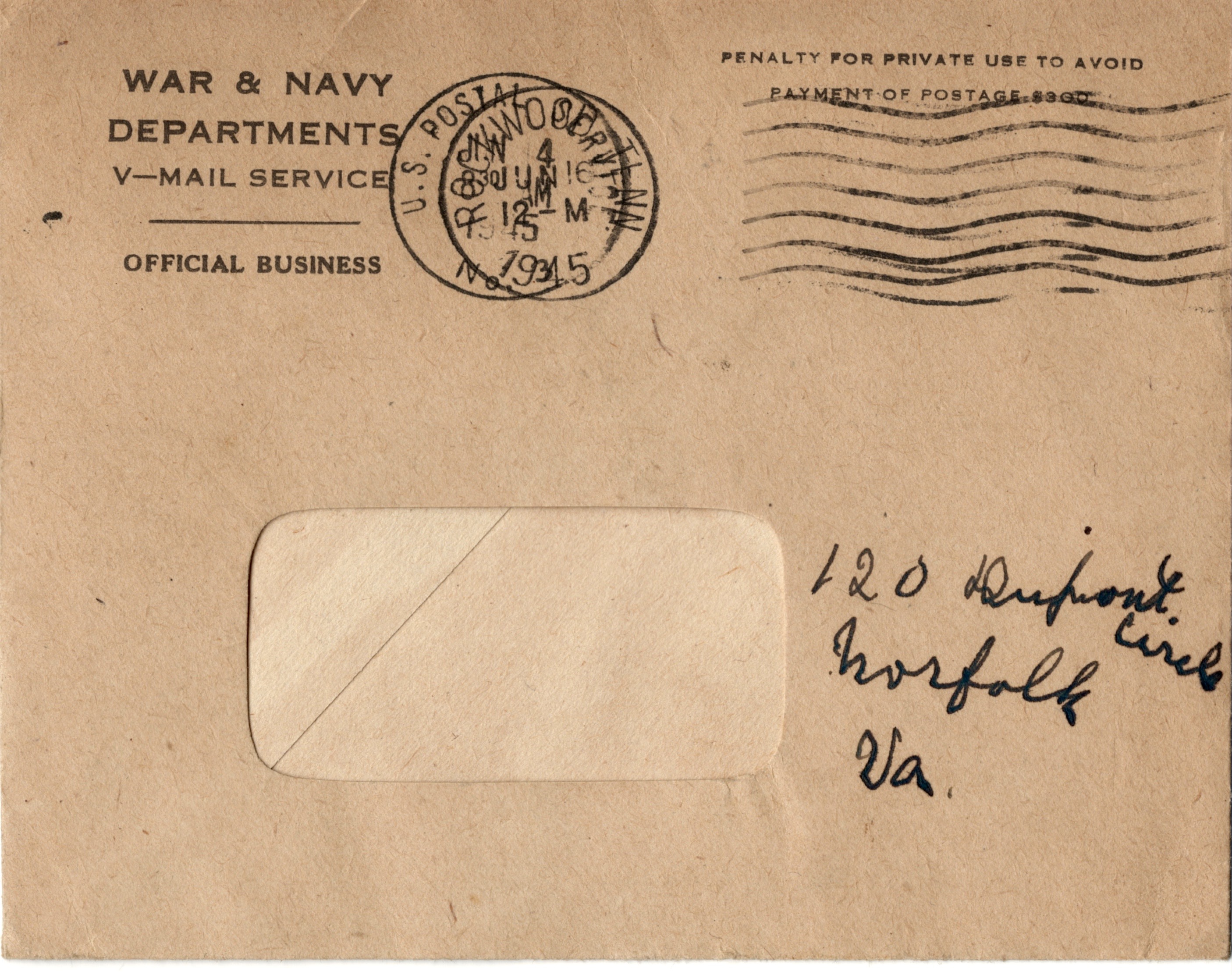
The envelope in which the one above was sent:

Navy Chiefs, Part III

My personal introduction to chiefs came in 1963. It was on my third class midshipman cruise on the USS Lloyd Thomas (DD 764), a FRAM II destroyer out of Newport, Rhode Island. That is at least one, if not three or four stories in itself to be told later.

My next real recollection of a chief petty officer was the senior chief quartermaster who taught navigation at OCS. We learned quite a bit even though much of the course was movies the senior chief let us watch, nearly all as i recall being from the “Victory at Sea” series. But what i most recall was at the end of one class, the old senior chief tells the class, “Yeh, you guys are leaving here and going to the evening mess formation about the time i’ll be reaching over into the back seat of my car on the Jamestown bridge for the first of the six pack of Budweiser i have in the cooler.”

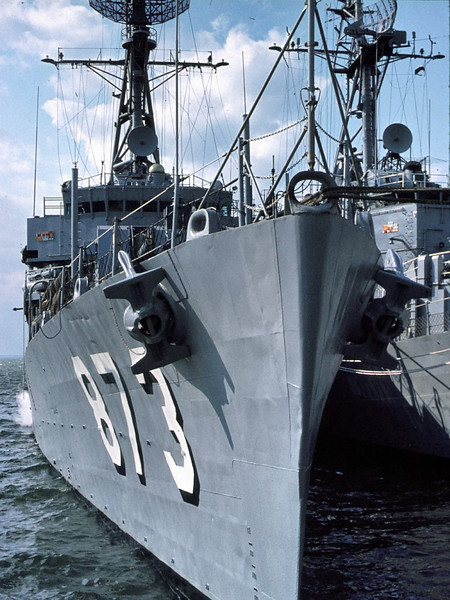
The Hawkins, nested outboard.

But then there was the Hawkins where my real lesson in chiefdom began. i have already written about Boatswainmate Chief Jones. He was my chief as First Lieutenant and first division officer from when i reported aboard until he retired in August 1968. His best buddy was also instrumental in teaching me how the Navy worked.

Unfortunately, i do not remember his name. i do remember his unique rating. Back in the late 1960’s for a short period of time, the Navy had created the rating of SP for chiefs at the E-8/E-9 level. Machinistmates and Boiler Tenders, when they reached the E-8 level became “Steam Propulsion Specialist.” Our man was an E-9 so his rating was “SPCM.” He was so good he was the Main Propulsion Assistant or in Navy lingo “MPA,” normally a junior officer’s billet, but Paul George, CHENG, didn’t want any JO between him and the SPCM when it came to running and maintaining the plant (until my good friend Rob Dewitt took over). He was still very much in charge before i moved from first lieutenant to ASW Officer.

He was a very a large, swarthy, black-headed chief who hung out in the engineering log room, the office and brains of the engineering plant off of the main deck passageway almost amidships. The first lieutenant and his first division were responsible for the maintenance and cleanliness of that passageway, which ran most of length of the main deck.

We began a major program of taking up the tile on that passageway, re-tiling, and repainting the passageway. It was a demanding work requirement, and i was constantly checking on how it was progressing. One workday, around mid-morning, i found my personnel not up to my standards in their work effort. i don’t remember what i did to address that, but i very clearly remember it was wrong.

The SPCM, hearing whatever it was i did or said, emerged from the log room, put his arm on shoulder, looked at me sternly, and said, “Son (not “Mister,” not “Ensign,” but “Son”), let’s have a talk.”

With that and his arm still around my shoulder, the SPCM led me out on the port side of the weather deck amidships. It was there, i got the best lecture on leadership i ever received. the SPCM talked to me about the world, about the Navy’s world, and how it all worked.  i think he gave me the best perspective i could ever had achieved on how to be a good leader.

Although i don’t remember his name, “SPCM” is a tribute to him, and i will never forget.