Category Archives: Sea Stories

Fairly self explanatory, from what I can remember that is.

A Tale of the Sea and Me (For Sam) – Installment 21

Notes from the Southwest Corner: Stormy weather? It seems so calm to me

SAN DIEGO – Late last week (2013), a friend called early in the morning to tell me it was raining downtown.

“Rain,” I said, “What rain?” There was no hint of rain only several miles away. “Yep,” Steve responded, “It’s raining real rain here.”

Rain in June is rare here, spot rain even rarer. So there is yet another Southwest weather corner mystery.

The call regenerated thoughts of storms. Even though I was in the eye of a fledgling hurricane as I recently related, it was not the worst storm I experienced.

That storm came unannounced and unwelcomed.

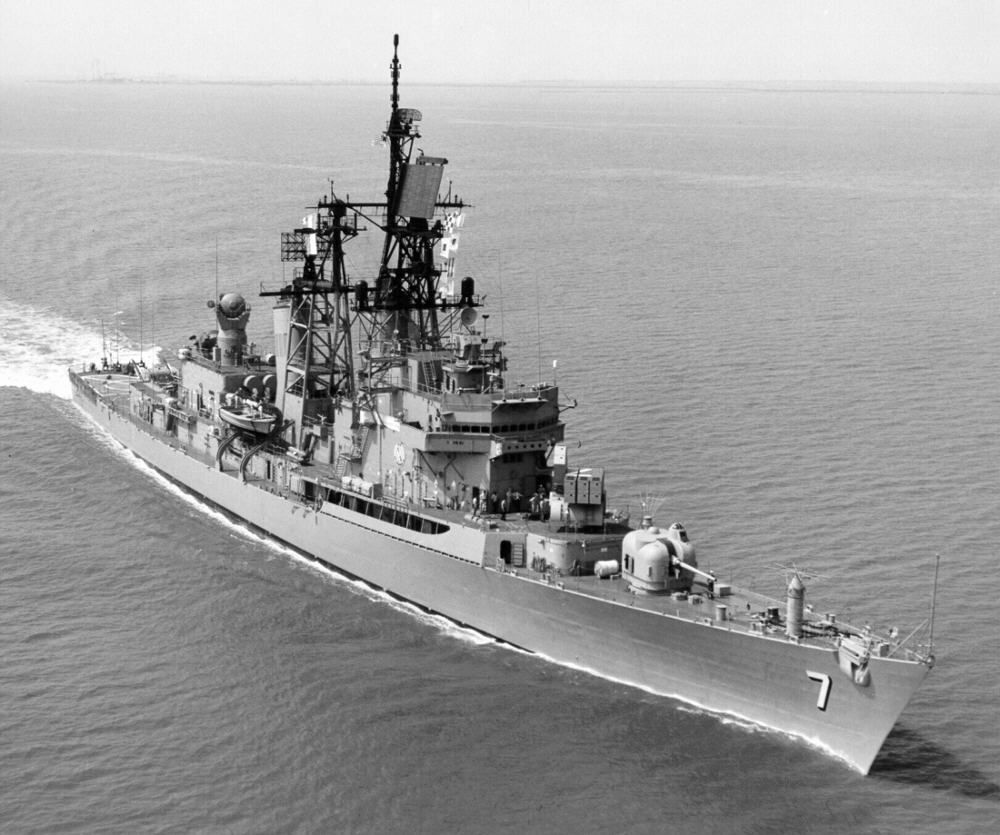
In December 1972, the U.S.S. Stephen B. Luce (DLG-7) returned from a Mediterranean deployment with Destroyer Squadron 24. Being the holiday season, the squadron was allowed to exceed the normal limit of 15 knots.

After crossing the Atlantic on a great circle route to Charleston, SC, the U.S.S. Stanley (CG 32) detached and headed toward its homeport. The other five ships turned north toward Newport, RI, expecting to cover the 1000 miles in about three days, arriving two days ahead of schedule.

There were no warnings about what was ahead. Even without satellites, Navy weather stations normally did a decent job on weather reports, but not this time.

When the storm hit us, wind speeds approached 100 miles per hour, perhaps even more.

The bridge of the Luce was 75 feet above the water line, and green water, i.e. real waves, crashed against the bridge windows almost in relentless rhythm.

We tied bridge watch standers into their posts. Only the officer of the deck (OOD) and his assistant remained unfettered to frequently shift from side to side for better vision. Mostly, this OOD (moi) stood behind the center line gyroscope repeater with one arm around a handrail, making small course changes to find a better course.

The bow would climb up a wave and about one-quarter of the 500-foot ship hung in the air above the ocean before crashing down, the bow plunging under water before settling out briefly and starting up the next wave.

Foam covered all the sea except when the wind gave a glimpse of the dark blue ocean. The other ships were often within a 1000 yards but seldom seen except for their masts, the rest of the ship hidden by the waves.

Our watertight doors proved less than that, leaking from the pounding seas. Over a foot of water rolled about the main deck passageways. The galleys could not keep food on grills or steady in the ovens. We ate what was available, cold. We did manage to make coffee for almost five days.

The Luce took innumerable 45 degree rolls. Hanging tightly on a bridge wing, it seemed as if I was parallel to the sea.

When two other officers and I ate in the wardroom, the chairs were tied to the tables, unavailable. We propped ourselves on the floor against the port bulkhead. After a bite or two, the ship rolled fiercely. We lost our seating and tumbled across to the starboard side, sandwiches and coffee flying everywhere.

One enlisted man with the top rack in a three-tiered section was sleeping peacefully when another jolt tossed him out and down, across to the adjacent tier where he landed in the lowest rack with another startled sailor.

The Luce lost two days, arriving in Newport on its original schedule. Two older destroyers arrived about a half-day later. One newer class frigate arrived a day later. The final ship, another frigate arrived a day after that.

On the one frigate that was last in making Newport, a freak wave crashed off a forward bulkhead and ripped a three-foot hole in the back of the forward gun mount. The ship experienced flooding forward but successfully secured the breach with damage control.

When we pulled in, none of the Luce’s usual weather deck projections remained: life lines, fire stations, and damage control equipment were gone. Ladders (stairs to the landlubber) between decks had disappeared. Plenum chambers for air vents had been ripped back from the exterior bulkheads, eerily resembling giant wings.

Remarkably, we only had one major injury. At the storm’s onslaught, our assistant navigator took a dive into the brass around the chart table and cut a gash in his forehead, requiring several stitches.

Strangest of all, the sun shone daily through the entire ordeal.
Never before and never after have I been so glad to be home for Christmas.

A Tale of the Sea and Me (For Sam) – Installment 20

As noted, it was my summer for learning the Navy way.

A major lesson came mid-summer. i was with a number of my first division sailors who were cleaning the ship’s midship passageway. In addition to all of the weather decks and the hull, the deck seaman also had the responsibility for most of the shared interior spaces, particularly the passageways, what landlubbers would call halls.

Our Engineering Department had a special sailor on board. He really ran the deep hole engineering (fire rooms and engine rooms for the Chief Engineer, the Main Propulsion Assistant (MPA) in charge of the engine rooms, and the “B” Division officer in charge of the firerooms. He was unique and held a rating that only lasted for a few years. During those years, a chief who was a Boiler Tender (BT) or a Machinist Mate (MM), if he passed the requirements he would meld the two disciplines and become a “steam propulsion specialist.” Then, his rating would be SPCS (E8) or SPCM (E9).

Unfortunately, i do not know remember our SPCM’s name. He was a burly six-footer with thick black hair and a booming voice.

The passageway under maintenance was close to the engineering log room amidships. The log room was pretty much the engineering office where records were kept on feed water, freshwater, fuel, oil levels, test results, among others. It was also where our SPCM hung out. i was doing something with my sailors. i don’t know what it was. But i know it was the wrong way to handle things.

Our SPCM emerged from the log room, put his arm around my shoulder, and escorted me respectfully to the port side weather deck. Again, i don’t remember exactly what he said, but i know it had a major impact on me, and because of his counsel, i changed the way i dealt with my men, and it was a major improvement.

The SPCM and my BMC Jones were close friends in the goat locker, aka the chief’s quarters. As a result, they took me into their twosome, and continued to provide me with advice about how to be a better division officer.

After liberty call when we didn’t have the duty, Ensigns Rob Dewitt, Andrew Nemethy, and yours truly were spending a lot of time in Newport. On a Tuesday afternoon when Andrew had the duty, Rob and i repaired to The Tavern, what would be called today a sports bar. We had a beer and went to see a friend of Rob’s in a home nearby. When we left there, we stopped at The Black Pearl, then a shack that served as a lounge for the owner of the three masted schooner of the same name. Barclay H. Warburton III, owned the sailing ship and to have a place to relax, have a drink, and grub, transformed that shack on the pier now Bannister’s Wharf, which had been serving as a sail loft, into a small diner. It was wonderful. We had a sandwich, of course their incredible clam chowder, a beer, and headed back to the ship. It was around 2300.

As i drove down Thames Street, an older couple in a late model Buick pulled out of a side street with no warning. Although i was driving within the speed limit, i tee boned them. It totaled my car. Rob’s head went through my windshield, and i smacked the steering wheel with my face. My car was totaled. The couple escaped with minor injuries. They took us to the emergency room where Rob received stitches, and they patched up my mouth, the front of which had lost another tooth, bringing the total to three front teeth (ha, ha, Brenda Lee). It would be about two weeks before they could replace my two-teeth bridge with a three-teeth bridge. (i was cleared of any culpability).

After several days, Rob was back on the ship, and we returned to normal duty except it would not be a normal week. BMC Jones was retiring the following Monday. The ship was having a change of command on Saturday. So on Friday at early liberty around 1400, the SPCM and BMC Jones invited me to join them at the Lighthouse, a favorite pub for chiefs, to celebrate his retirement with a gin and tonic. the three of us in our summer khakis ordered gin and tonics and toasted BMC Jones. The SPCM did not think one gin and tonic was an adequate salute to my chief. He ordered another for the three of us, and then another. i finally escaped, leaving half of my fourth gin and tonic on the table.

i stumbled back to the ship. Ordinarily, i would have eaten in the wardroom for the evening mess, and then retired to my stateroom in forward officers. But that Friday evening was scheduled for the ship’s hail and farewell party to the outgoing and incoming commanding officers. i drank about a ton of coffee, dressed in a sports jacket and tie, and headed for the small officers club up the hill from the destroyer piers.

In the small club, there was a party going on, and the three star admiral, the commander of Cruiser-Destroyer Fleet in the Atlantic, and his wife were in attendance. i somehow ended up in a conversation with the two of them. Of course, the admiral asked me about my missing teeth while his concerned wife listened. i was still pretty…er, inebriated? i waxed effusively about the event, and they appeared glad Rob and i had not been hurt worse. i walked back down the hill to the ship and my rack.

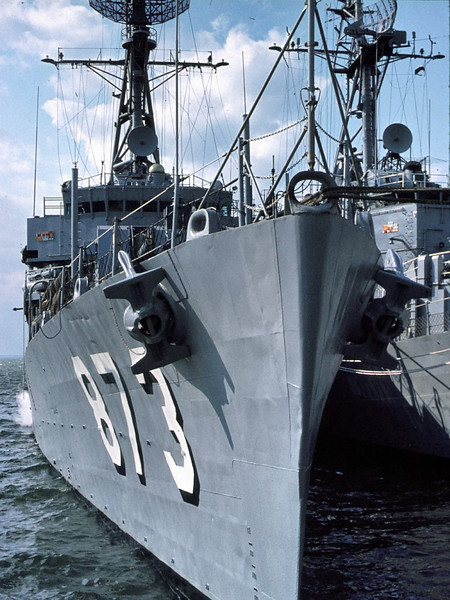
The next day was a grand event: the formal change of command ceremony aboard the USS Hawkins (DD 873). Our commanding officer was being relieved by CDR Maxwell Lasell, a large, physically impressive Naval Academy graduate with a bald head long before it was de rigueur. The CRU-DES band was on the pier . Immediately beyond the quarterdeck, the fantail had a canvas shade rigged. Eight side boys flanked the entry to the quarterdeck from the brow. Just beyond them, in two ranks stood the honor guard awaiting to be inspected by the admiral and the outgoing and oncoming COs. The officer in charge stood in front at attention in his full dress white uniform complete with his Navy sword resting on his right shoulder…and three missing front teeth. It was Ensign Jewell.

The ceremonies commenced at 1000. The band played “Ruffles and Flourishes” three times as the admiral came aboard. After he was saluted, the admiral proceeded to face the honor guard officer as i ordered my charges to salute as i performed the salute with my sword, bringing the hilt to my chin with the blade pointed skyward, bringing it smartly to my side with the blade at a slight angle toward the deck. When the admiral returned the salute, i ordered “to” and brought the sword back to rest on my right shoulder.

The admiral then asked me, “How are your teeth, this morning?”

“They are fine,” i responded, “Thank you, sir.”

Behind him, i saw my new captain, CDR Lasell, silently chuckling.

i breathed a sigh of relief as they moved on toward the rest of the ceremonies.

i would bid adieu to BMC Jones Monday morning, The SPCM would leave shortly after we entered the yards the next month. And i had found a new mentor to add to the XO, CDR Max Lasell, commanding officer of the Hawk.

A Tale of the Sea and Me (For Sam) – Installment 19

Black Oil

Long before Navy ships became sophisticated power chains of today, most Navy ships were fueled by black oil. Black oil was just a step above crude oil. Environmentalists would probably have heart attacks just looking at it.

It was the fuel for ship’s boilers after coal and before “Navy distillate,” a cleaner burning oil. i have a number of sea stories about black oil and Navy distillate. This story is about black oil before that other stuff became the Navy’s fuel of choice. It was a thick, viscous, and clinging substance: think of B’rer Rabbit, B’rer Fox, B’rer Bear, and the “Tar Baby.”

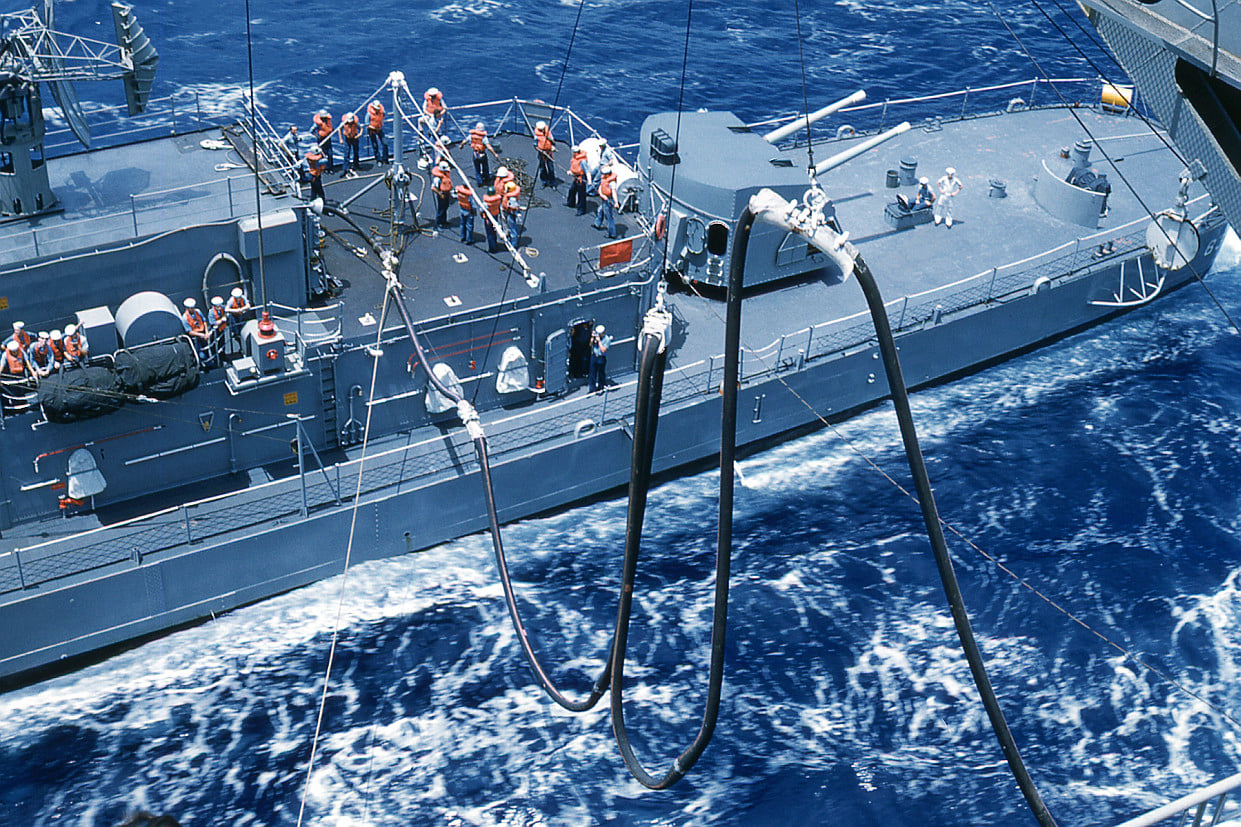
In the summer of 1963, the USS Lloyd Thomas (DD 764) was on exercises in the Atlantic OP areas (operational areas). i was a third class midshipman. We were en route from Sydney, Nova Scotia to Bermuda and were refueling from an old Navy oiler. It was the time of black oil.

During the refueling operation, i was assigned to the “DASH” deck aft. i don’t think the sailors topside who weren’t on the refueling teams were wearing service dress whites as in the Goodrich photo, but they could have been. We were in our dungarees (far and away the most impressive, most effective, and most appreciated working uniforms for sailors ever) and in kapok life jackets. We didn’t wear hard hats but we did have on battle helmets.

Ray Bean, a member of the Facebook group, “US Navy Gearing Class Destroyers” posted some rather amazing photos of the USS Goodrich (DD 831) refueling that same year. Ray’s photo here shows the after refueling station on the DASH deck, just forward of the after gun mount:

The refueling hoses were secured to the post in the middle of this photo and the end was placed in a fitting which was a fuel line to the ship’s tanks. The hose was tied off with what we called a “pigtail” to keep the hose in the fitting.

On this particular evolution, the deck seaman in charge of securing the “Pigtail’ did not do a good job. When the refueling began, the force of the black oil through the refueling lines broke the pigtail. Black oil hit that sailor dead on, carrying him back into the lifelines in the upper left hand corner of the DASH deck as shown in the photo. He collapsed in the corner completely covered with the oily goo.

The disaster was reported to the captain on the bridge. He sent his executive officer back to the station to take handle the catastrophe. By the time the XO got to the station, the pigtail had been secured and fuel was being pumped into the tanks. But this old exec was proud of his self-importance. Seeing the fuel was pumping, he raged about cleaning up the mess. He pointed to the gunky mess in the corner and demanded to the officer in charge to get rags, clean the mess up, and to throw that oily mess overboard.

The officer in charge then said, “But sir, that’s Seaman Jones.”

The XO, startled, mumbled something about cleaning everything up and meekly went back to the bridge.

After we cleaned up the seaman, we all laughed.

A Tale of the Sea and Me (For Sam) – Installment 18

A Mid-Watch Lesson

It was summer school for me in 1968. Andrew, Rob, and i discovered The Tavern, the Black Pearl, and other delights. i was liking my liberty as an ensign. But the learning curve was almost vertical.

Another lesson came one week night when i had the duty. i was assigned the mid-watch (midnight to 0400) as the Officer of the Deck, in port, (OOD). A second class petty officer was my petty officer of the watch (POOW), and a seaman striker from radio was the messenger. It was a cool, comfortable evening and we were tied up pier side, not nested out with one or two other destroyers between us and the pier. We were port side to.

The watch had been very quiet. Liberty had ended at midnight for the crew. It was about 0200 when a very drunk seaman reeled across the brow to the quarterdeck. When i told him he would be put on report for unauthorized absence, the drunk young man went ballistic. He was cursing and threatening me. i was attempting to determine how i should handle the sailor without getting either of us in trouble when the POOW called the duty master at arms.

The duty master at arms arrived several minutes after the call. He was a first class gunners mate. He had on his dungarees but with a tee shirt rather than the chambray shirt. The left sleeve was rolled up to hold his pack of cigarettes above his massive arms.

Without much more than a polite recognition of the officer, me, he put his arm around the shoulder of the sailor and moved him aft. He said, “Sailor, let’s go have a talk in the paint locker.”

The next morning, i slept as last as i could and still partake of the morning mess. After the mess i walked to the forecastle for divisional quarters at 0750 and colors at 0800. The seaman was in first division and was in the second ranch. Chief Jones was laughing. The culprit looked like he might have been through a meat grinder. One eye was black and bruises were showing wherever there was skin.

The MA gunners mate had taken care of the problem. i don’t think the young man was ever UA again and never caused a problem on board because of drinking. The report chit disappeared before making it to the legal officer.

It was an awakening for me. The underground system for discipline at the sailor level worked well, but all of us would have been before a court martial today.

A Tale of the Sea and Me (For Sam), Installment 17

The First Summer

Sea stories abounded in those years. There was less regulation, especially about personal behavior. Drinking was part of the culture. Navy ships were not too far removed from “Rocks and Shoals” discipline. The Uniform Code of Military Justice (UCMJ) was not the dominant means of justice it is today. It was a male culture before the new world had put a stop to many shenanigans. Both officers and enlisted were prone to shenanigans.

And i was a part of a shenanigan as soon as we made fast to the pier.

The welcoming party on the pier was roughly about 700 people, mostly dependents of the crew and the wardroom, lots of children. They were all waiting anxiously as the ship’s engineers connected the auxiliary steam, electric power lines, and the phone lines. The boatswain mates double-upped the mooring lines and coordinated public works put the brow onto the quarterdeck before the guests could come aboard.

The Damage Control Assistant (DCA) who had me wait on the tarmac in Malaga, Spain, came to me and asked me for a favor. After i more or less agreed to help him, he told me he had a problem. He told me he had his family on the pier with his fiancé. Then, he added his other fiancé was also on the pier. He wanted me to engage the second fiancé and keep her distracted while he invited his family to the wardroom with the first fiancé, and then escort them off the ship. His plan was for me to then hand off the second fiancé to him so he could apologize for ship’s business causing him to be delayed in greeting her.

i shook my head in agreement, and amazingly agreed to help him, surprising myself. Even more amazingly, we pulled it off. i never saw either of the fiancé’s again, although i came close to meeting the first after he had dumped the second less than a month later, which provided another sea story.

* * *

For the transit back to Newport, i had shared forward officer’s with the Public Affairs Officer (PAO). i wasn’t particularly thrilled to be with him and deduced he was only the PAO because the CO and XO didn’t want him to fill any billet with responsibility and putting him a position that he was desirous of pursuing as a full time specialty made it easy.

Two new ensigns reported aboard. They missed joining me for the flight to Europe and joining the Hawkins before the western voyage by days. Andrew Nemethy was from Boston. Rob (We called him Bob then) Dewitt was from Maine. They were assigned to forward officers with me.

Forward officers was more like a dungeon than officers’ country. It was on the first deck under Mount 52, which was located on the 01 level (one level above the main deck). There was a small head and a row of three desks with cabinets and drawers above and below the pull down desks. If a desk was pulled down, it was difficult to squirm through to get to the other side as there was less than three feet between the after bulkhead and the cabinets. Amidships there was an opening into the racks. The racks were a larger version of the enlisted racks: metal frames with canvas tied to the frame to serve as “mattresses.” There were two racks stacked on each side of the narrow passageway in bunk-bed fashion.

To put it mildly, it was tight, yet nowhere near as tight as living in enlisted berthing. i still wonder why they had four racks in that compartment. It would have been like being in a sardine can had another officer joined the three of us.

i moved to after officers quarters on the main deck after about six weeks. Andrew and Rob adopted the space as home and remained there throughout their tours. However, we forged a bond as the three new ensigns. They remain close friends as i write.

* * *

i didn’t realize it, but one of best learning periods of my Naval career was beginning.

My First Division Chief Petty Officer was Boatswain Mate Chief (BMC) Jones. He was from Arkansas and about to retire there after he had completed his twenty years of service. He planned to start a gem cutting business and had been working toward that end. He was about 5-9 with skin you would expect on someone who had spent twenty years on small craft and the weather decks of a destroyer. It looked like alligator skin. He was thin, wiry, and and strong, reminding me in that way of my father.

Chief Jones first taught me how to be an ensign division officer. He worked with me before quarters each morning to be sure i was relating the news and direction for the coming workday. Most importantly, he kept me in line to not only play the part but actually become the leader of the division. i remain amazed he did this while always playing the supporting role, always making sure the sailors knew i was in charge. Most of our sailors were close to my age. Yet because of Chief Jones, there was no question as who was in charge: me.

To this day, i remain convinced that the toughest job in any organization is the Navy chief petty officer’s job as a division chief (i’m pretty sure this position in the other military organizations is similar, although not as formal as the Navy’s (CPO’s wore different uniforms, closer to the officers’ uniforms than the sailors’ dungarees and crackerjacks).

We shall call the seaman apprentice Wilson. He came on board after we had returned from the MED. SA Wilson was a strapping young man, about 6-2, and in good shape, about 180-200 pounds. He immediately created the ire of the Leading Petty Officer (LPO) BM2 Carrier. Wilson claimed he was getting seasick when the ship was moored to the pier. Carrier thought Wilson was a sea lawyer, one of the most despicable terms to apply to a sailor.

After a couple of weeks on a Friday, i had gone down to inspect first division’s berthing compartment after noon liberty call. Wilson was sitting on his bottom rack. He was not a happy sea lawyer.

In those days, “liberty cards” were used to control the crew’s liberty. Destroyers had been almost exclusively in three section duty, unless they were deployed when they went to port and starboard, two sections. By this time, 1968, many were in four-section duty when stateside, and three when they were deployed. Each sailor had a “liberty card,” about the size of a business card that denoted what section the sailor was in. In my memory, they were different colors, but i’m not sure. Each morning at quarters, the chief or LPO would hand out the liberty cards to those in the duty section that would have liberty. Each evening or whenever liberty expired, the quarterdeck would take to liberty cards from sailors coming back aboard. The process continued every day unless it was holiday routine, when the LPO would go through the berthing compartment and hand out liberty cards to the off going watch.

Regardless, on a Friday, liberty call went down at noon. The sea lawyer had apparently done something that hacked off Carrier, the division LPO. At quarters that morning, Carrier handed out the cards, but did not give SA Wilson his card. Wilson could not go ashore without his liberty card and would have to remain on board for the weekend unless the card somehow showed up.

When he saw me, the sea lawyer began a rant, going on about he was going to put us all on report for denying him his liberty card. It was the way things were done back then, but certainly not according to the UCMJ even then.

i was perplexed, trying to deal with a situation i had never had confronted. Carrier had gone ashore. i couldn’t consult with him, and besides, this required an immediate judgement from me. As i puzzled, BMC Jones descended the ladder down into the compartment. He asked me what was going on. i responded.

Then Chief Jones, probably 150 pounds soaking wet, turned to Wilson. He grabbed Wilson’s chambray shirt near the top button, shoved him back into the bulkhead, and pushed him upward until the startled Wilson was on his tiptoes. My CPO told the sailor in no uncertain terms, using the most exquisite sailor talk (for the uninitiated, this mean it included enough cussing to fill a book), that he was going to remain on board, and if gave his division officer, me, any grief, he, BMC Jones, would take care of the problem.

Wilson was shaking, mumbling, “Yes, Chief, aye, aye,” and, “I’m sorry Mr. Jewell, i was out of line.”

That was when i realized the power of chief petty officers and also learned, controlled displays of anger, could be a positive leadership tool.