Category Archives: Sea Stories

Fairly self explanatory, from what I can remember that is.

A Tale of the Sea and Me (For Sam) – Installment 27

Notes from the Southwest Corner: Fathers, heritage and work

by Jim Jewell

SAN DIEGO – Last week on a cool, marine layer grey day, I walked a wooden pier in the Southwest corner.

Crossing the end of the pier to Pamela Ann, a barge used for storage, I thought of my father.

Pacific Tugboat Service was at work that morning: work most marine service companies avoid because it’s just too hard.

I wished my father could see me in this environment.

It’s old-timey work: Men working on motors, chipping and painting, craning heavy loads, rearranging the company’s tiny chunk of bay space so cranes, barges, caissons, crew boats, pusher boats, and tug boats fit like a jigsaw puzzle. There was oiling and greasing going on. There was chipping and painting going on. Beating metal into something useful made ship repair sounds, music to my ears.

Tugboats were hooking up to barges and cranes to tow them where they would be utilized on some job. One ocean-going tug was getting ready to sail up to San Francisco pick up a barge, and bring it back to the Southwest corner. Stores for the journey were being staged on the pier, transferred to the tugboat’s deck by crane, and hauled below for storage.

The 62,000 ton “USNS Bob Hope” moved south from the marine terminal under the royal blue arching Coronado-Bay Bridge to the Navy Base. Pacific Tug’s “Harbor Commander,” a small pusher boat, was dwarfed while she pushed against the big monster, holding her steady in the channel.

The scene took me back to the spring of 1974 and Terminal Island, a two-hour drive north of here. My father, Jimmy Jewell, had come to San Diego, a rare trip without Estelle Jewell accompanying him. Six months earlier, I had become the chief engineer of the USS Hollister, a World War II destroyer named after three sailor brothers killed in combat in 1943.

The engineering plant would have made Rube Goldberg proud. My father and I toured the fire rooms (think boilers) and engine rooms while I explained the operation and maintenance requirements of the massive machinery. While Jimmy Jewell knew engines and mechanics better than most humans on earth having worked on them since he started fooling with cars in 1924, his elder son had jumped around a variety jobs and had been much more focused on writing rather than the mechanical side of the world until he rejoined the Navy two years earlier.

My father quietly took in the multiple pumps, forced-draft blowers, distilling plants, generators, and switchboards of the old tin can as we climbed up and down ladders, and finally ascended back to the main deck. As we crossed the brow back to the quay wall, he looked back at the ship and then to me and said, “It’s amazing you are in charge of all that.”

In the late 1800’s, my father’s family in Statesville faced a crisis when my great grandmother passed away. The two boys, one my grandfather, Hiram Culley Jewell, were sent to separate uncles to be raised. One uncle believed in education and sent my great uncle to college. The other uncle, the one who raised my grandfather, believed in hard work, not education. So my grandfather, my father, and my three uncles worked from that point on.

It was old timey work: steam-engine sawmills, plumbing, automobile maintenance, farming, and a myriad of other physically demanding work.

After my ship department head tours ended, I had not delved into old-timey work until I hooked up with Pacific Tugboat, a thirty year gap. I find it somewhat ironic, even poetic that I am back to what my great, great uncle determined: work is good for you.

In that context, I looked at our country today. Most “work” doesn’t require physical work. It’s brain power, service jobs, financial planning, technical expertise, salesmanship, writing, acting, and even talking, which bring home the bacon (if the family hasn’t gone vegetarian).

It seems we have prospered moving into this type of work. But I wonder. Physical labor used to be part and partial of living. I think it made us stronger, more focused on the moment, less fad and protest oriented.

Sunday in a break between golf and dinner, Father’s Day gifts from my wife, I stopped and thanked my father, my grandfather, and that great, great uncle for giving me an appreciation of old-timey work.

A Tale of the Sea and Me (For Sam) – Installment 25

That magical summer of 1968 was about over.

BMC Jones had left. The SPCM had left. My department head, LT Steve Jones, had left. The CO had been relieved. The USS Hawkins (DD 873) was headed for a six-month overhaul in the Boston Naval Shipyard in Charleston, Massachusetts, some 60 miles to the north.

Shortly after we arrived, i would be relieved from my first lieutenant duties and become the ASW Officer. The ASW suite would be undergoing a $4 Million dollar upgrade to the SQS 23G (We called it the 23 Golf”) and the old MK 105 ASW fire control system would be replaced by. The MK 114 ASW fire control system.

Before any of that occurred and because i was still the first lieutenant, i received the assignment of “Tool Control Officer” when we actually did reach the yards. I should have known this was an ominous assignment. Since first division no longer had a chief petty officer or first-class petty officer, BM2 Carrier was the first division LPO, and in charge of the division. Consequently, he became my assistant tool control officer. He was a blessing.

Oh yes, shortly after the Hawk entered the yards, my wedding would occur in Atlanta, Georgia in late September.

Unrecognized by me, my world was about to become greatly different. And i was about to learn some of my most important lessons on how to conduct myself as a Navy Officer on a ship. i was blessed because my new captain was looking over me.

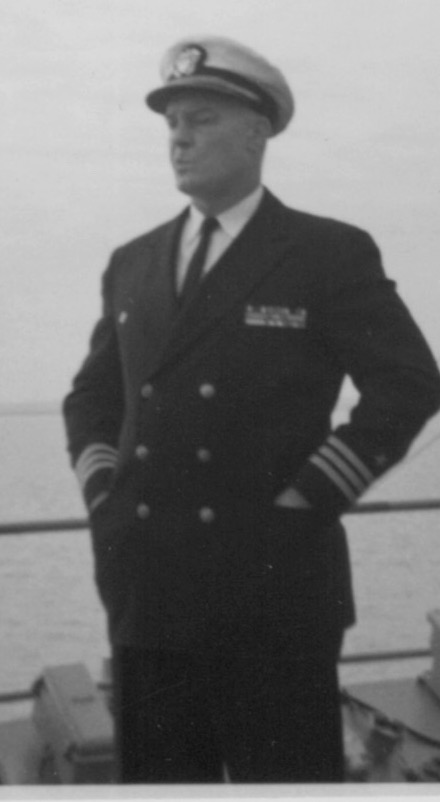
He was an impressive Navy Commander, standing about 6-3, probably around 220, solid, no hair, massive paws that engulfed yours when you shook hands, but elegant, graceful. His smile just sort of took you in, made you feel like you were his friend. It was a while before i saw the anger there. It struck me, when i did see that flash, that his anger was controlled, but more fearsome than most. Only once did i see it flare to explosion. That was about seven months later in Guantanamo Bay, Cuba. Yet even when i met him at the “hail and farewell” party the night before the change of command, it was apparent you did not want to get on his watch list.

CDR Max Lasell was a Naval Academy graduate. His wife Betty was almost as tall as him with a beautiful smile, dark brown hair. He chuckled when the Admiral asked how my teeth were doing as i presented the honor guard in that change of command ceremony. It gave me a good feeling about what was to come.

What was to come was my learning how to be a Naval Officer, Toward the end of the overhaul, the Navy, playing politics, and public relations decided its origin should be ignored and making its officers who forged ahead with leadership on ships at sea be “specialists:” Surface Warfare Officers. Dumb. Cow-towing to the submarine and aviation boys to make them equal. But that is a discussion i will never win and is for a separate post somewhere, sometime. But CDR Max Lasell taught me how to be a Naval Officer on a Navy destroyer.

It began as we went into the Charleston Naval Shipyard in South Boston. Within several days of entering the yard, the Hawkins went into dry dock. Now this was not an ordinary dry dock. It had built to dock the RMS Queen Mary. The dock was huge. As first lieutenant, i was with first division on the forecastle, primarily for line handling duties.

As the ship entered the huge dock, my first division began to heave the 5″ mooring lines to the line handlers on the edge of the dock. It was a foolish attempt. The distance was too great. We should have used a bolo ( a line with a weight on the end of a messenger line. But i was young, naive as a mariner, and macho. So i decided to see if i could get the mooring line across. Wrong!

Finally, we used the bolo and messenger to get the lines across and the ship sitting on the well deck blocks. My actions and my divisions was a terrible display of poor seamanship.

As we secured, our sound-powered phone talker told me the captain wanted to see me in the wardroom.

The CO and i were the only two in the wardroom. Commander Max Lasell dressed me down. He chewed me up and spit me out for being so stupid. He pointed out rather clearly, i had my men for a reason and i was not supposed to do their job. That stuck with me throughout my Navy career. As i was receiving my just due, i was gaining respect for my commanding officer. As he chewed me out, he was also giving me lessons in deck seamanship and leadership. i was not upset he chewed me out. It was deserved. i actually found myself feeling guilty i had left him down.

My next lesson follows.

A Tale of the Sea and Me (For Sam) – Installment 24

Louis Guimond, Part III

One lesson Louie Guimond gave me i could not repeat…and i regretted that.

i wrote of this lesson in my book, Steel Decks and Glass Ceilings. Before the USS Yosemite deployed in September 1983, a chief discovered an unauthorized absentee (UA) who was really a deserter in every way except the last escape clause in the way the Uniform Code of Military Justice (UCMJ) was written, and it was certainly his intent to be a deserter.

i was the XO and a geographic bachelor as my new bride was in San Diego and would remain there until we returned from and Indian Ocean deployment in seven months. Consequently, i was aboard in my cabin when the shore patrol brought this problem child back to the ship.

At breakfast the next morning, i learned the quarterdeck had accepted this clown rather than notifying me. The hair on the back of my neck stood up. i was not a happy camper. i went back to the summer of 1968, when the shore patrol brought back a UA/deserter to the USS Hawkins quarterdeck. That quarterdeck watch notified that XO, Louie. He immediately ran to the quarterdeck and went berserk on everyone near. He refused to accept the sailor and demanded the sailor be sent to base security.

Thus the ship avoided having an organizational terrorist on board and counting against their complement, a spot that could be filled with a productive sailor. They also had avoided dealing with a complex UCMJ legal process that would be time consuming and distracting court martial.

But my quarterdeck had accepted the criminal and i was stuck. My concern i didn’t get the opportunity to do what Louis did 15 years earlier proved valid. That sailor required me to respond to a First Lady inquiry, a congressional inquiry and was a thorn in my side and the ship’s for almost the entirety of my two-year tour.

Louis Guimond knew how to be and XO and he did it.

A Tale of the Sea and Me (For Sam) – Installation 23

Louie Guimond, Part 2

Two of the greatest benefits i had for ending up with a Navy career were my first executive officer and second commanding officer on my first ship, the USS Hawkins (DD 873).

Commander Max Lasell relieved Captain Thomas Nugent in August 1968. He became Captain while he was the Hawkins the commanding officer. He not only gave me so many points about how to be a Navy officer i cannot recite them all, he gave me his trust and his support, which was invaluable both in that first tour and later in my life. i will write of him later.

* * *

LCDR Louis Guimond was remarkable. He could have been a comic book hero, someone so terrific, so unique, it would be difficult to believe he actually existed if i hadn’t been there.

He joined the Navy in World War II and was assigned to submarines where he became a sonarman. He rose in the ranks and became a Mustang, an enlisted sailor that was so good, the Navy made him an officer, not a limited duty officer, not a warrant officer, but a line officer. He rose to the rank of CDR and retired in his last operational tour, the USS Prairie (AD 15). One of the appeasing reflections i had when my last operational tour was XO of the USS Yosemite (AD 19) was knowing that was my first XO’s last tour.

Louie was about 5-8, extremely fit, and a very good athlete. He had premature white hair. His wife, Natalie, was beautiful. They were devout Catholics. i spent the afternoon with them when i was en route to Vietnam. Louie had been transferred to San Diego when i still had about six months before rotating off the Hawkins in December 1969. Their son, Louis Jr. was about sixteen.

As the Hawkins exec, Louie was very strict with the crew. i’m guessing that is because he was a bit wild when he was enlisted and made sure his crew would not be able to cavort like him. Consequently, the crew did not like him at all. They respected him, but they didn’t like the strictness. The wardroom loved him. He laughed and pulled tricks and made every officer comfortable.

i’ve often thought about how he broke one of the rules about being an XO that for a while bothered me. The first and primary rule in the XO book of rules is to support the commanding officer even if you don’t agree with him. Our first CO was the brunt of Louie’s best jokes. For example when the ship was on liberty in Naples, he convinced the CO he should not buy a reel-t0-reel tape recorder that was vertical, that he should get one where the reels were horizontal on the top of the recorder because gravity would make the vertical reels go slower.

My favorite tale occurred just before i reported aboard. The day before Hawkins was getting underway after a week of liberty in Naples, Italy, the navigation team, as usual, had a navigation brief in the wardroom. The XO, as with most FRAM destroyers and many other Navy ships as well, was the navigator. His assistant was a senior lieutenant junior grade (LTJG) named Chris (i cannot recall his last name as i write), a nice guy and competent junior officer. They had the Naples harbor chart and surrounding waters spread out on the wardroom table. The XO went through the brief meticulously covering all possibilities.

* * *

As he closed, the commanding officer, a very conservative ship driver, looked down, and asked what was the object below the proposed track the XO had laid out on the chart.

“Is that a sunken ship, a ship wreck?” he asked concernedly.

“Yes sir,” the XO replied, “but its highest part, the mast, is 70 feet below the surface, well clear of our draft (with the sonar dome, the draft on the Hawkins was just over 20 feet).”

“XO, in no way do i want you to put us anywhere that wreck,” the captain asserted.

Chris and Louie knew it would be useless to protest, and even though it would make back out of its mooring more difficult, they laid out an alternate plan.

The next day at sea detail, the ship got underway. The XO ignored the alternate plan and backed down the initially planned track. As the ship backed down, the captain was looking forward and aft to check for any craft or obstacles. He asked, “Chris, how are we doing on that shipwreck?”

Chris replied much to the navigator’s dismay, “We are doing well, captain; backed right over it; it was well clear.”

The captain’s reaction was not, shall we say, pretty.

* * *

Louis seemed to take the junior officers under his wing. i vividly recall one summer day in Newport, 1969. For some reason, the XO and i were standing on the port bridge wing while the ship was moored outboard in a nest of three destroyers. Looking out over the pier area, the XO spoke to this green, wet behind the ears ensign while looking out over the array of Naval might. “Jim,” he said, “I remember when ships didn’t have all of those antennae wires dishes.” He paused and continued, “They were beautiful back then.”

* * *

When the first CO went on leave in the summer of 1968. Louie was the acting CO and held Captain’s Mast. As mentioned earlier as XO, he was tough and the crew feared him as he would give them no quarter. i had a seaman who had been put on report and for Unauthorized Absence (UA). i was very concerned. The seaman had reported aboard almost six hours late. i was pretty sure Louie would throw the book at the young sailor.

Mast was held on the bridge. When the seaman stood at attention before the podium, Louis asked him why he had not reported as scheduled. Roughly, here is the seaman’s story:

Well sir, my flight got into Logan Airport a bit late, so i hurried to catch a cab. Then when we were going through Callahan Tunnel, the cab driver started hustling me about giving him my guitar. We got in an argument. So i jumped out of the cab with my guitar, i got lost a couple of times but i walked here from the tunnel.

i held my breath. i was waiting for the XO to lower the boom. Louis studied the man’s service record paused for a minute, and said,

“Son, i should give you the max: reduction in rate, half pay for three months, restriction to the ship for thirty days, and 45  days extra duty.

“But that is one of the best stories i ‘ve heard for a long time at mast.

“You are dismissed with a warning.”

i had some extremely good executive officers, and yes, i had several that weren’t good leaders. Of all of them, LCDR Louis Guimond was the best.

A Tale of the Sea and Me (For Sam) – Installment 22

Louis (Louie) Guimond, Part 1

After my personal introduction to NJP that summer of 1968, it was six years before i got to witness it in action again, or at least a variation of it (i think i’ve written of the sea stories before in other places).

i reported to my first ship, the USS Hawkins (DD 873)  in Malaga, Spain in April 1968, and  rode her on the last stages of her MED deployment (that is “Mediterranean” for landlubbers, not “medical”). i relieved the First Lieutenant as the ASW Officer would not rotate until late September that year at the beginning of an overhaul. In those days, the first lieutenant had a bunch of sailors in first division who were more likely to go to mast than most divisions. Not all, but most.

So once we got back to homeport, i spent a lot of time with report chits, XOI, and captain’s mast. The CO, Commander Tom Nugent, was…well, let’s not go there, but he was a stern taskmaster. Strangely, he was lenient at Captain’s Mast. i had several of my boatswainmates get off a lot lighter than i expected.

Then, while late on the evening (2000-2400) Officer of the Deck (OOD) watch on the quarterdeck, i learned the old way was still in my Navy. A very drunk seaman, one of mine in first division, came back from liberty and was so inebriated, i wasn’t sure he would make it across the brow. He was belligerent. When i attempted to calm him, he started cussing me out. As a fresh ensign i was trying to figure out how do deal with the kid while the petty officer of the watch (POOW) called the duty master-at-arms on the 1-JV sound powered phones.

The duty MAA was a first class gunner’s mate. He was big, burly, stout, and ugly. He had a crew cut and his muscles bulged from the tee shirt with one sleeve rolled up to hold his package of camels. He came up to the quarterdeck, saw what was happening and put his arm around the belligerent, drunken sailor.

“Come on, son,” he soothed, “Let’s go down to the boatswain’s locker and talk about this.”

They walked forward together, and i was relieved the incident was over.

It wasn’t.

The gunner’s mate took the young man down to the boatswain’s locker and gave him an old fashioned ass whuppin’.

i know this happened because i came from officer’s call the next morning to quarters for first division. There in the first rank was the offending boatswainmate. i expected him to look pretty bad because he had to be hungover, but he also looked like he had been through a meat grinder. The gunner’s mate had exercised the old style of discipline. My chief explained to me how it worked.

Wisely, i did not question what had happened.

Within a couple of weeks, i saw the old style of Navy justice at work again. First division had a strapping young seaman who was not overjoyed about being in the Navy and was often questioning authority. It did not help that he was also extremely prone to seasickness. If the ship rolled a little bit tied up to the pier or in a nest of other destroyers, this guy would blow lunch.

He had managed to piss off the First Division Leading Petty Officer (LPO), BM2 Carrier. i don’t know exactly what he did, but Carrier was my man second only to BMC Jones, whom i relied upon. Carrier held my hand and escorted me through some tough times. He also was old school, sailor, and back then, liberty cards were used to control who left the ship. The duty section would not be issued liberty cards at quarters. Those not in the duty section, would be given these cards to show to the quarterdeck to get approval to depart after liberty call. The division LPO issued the liberty cards at the close of morning quarters.

It was a Friday. When the LPO issued the liberty cards at quarters, he strangely could not find the seaman’s card. This was a frequent occurrence for sailors who upset the chief or LPO. This meant the seaman would be on board for the entire weekend.

Shortly before the noon mess and early liberty call at noon, i went down to inspect division berthing on the first deck underneath the fantail. The upset seaman was in berthing and seeing me, he became a sea lawyer, screaming about his rights and how the Navy couldn’t do this to him. Again, i was flummoxed and trying to decide how to handle this.

Chief Jones, was about 5-8, a soaking wet 130-pounds, wiry, wrinkled, and about to retire with 20 years in about a month or so. He was also checking out the spaces. Up on the main deck, he heard the seaman yelling below. Chief Jones slid down the ladder to berthing, ran over to where this 6-2, 190 pound kid was berating me. The chief grabbed the seaman by the front of his blue chambray shirt at the chest, pushed him up against the bulkhead and then lifted him up until the seaman’s feet cleared the deck. The chief then launched into a profanity laced tirade that would have made the coarsest of sailors proud, concluding with something along the lines of “don’t you ever confront an officer and deal with your problem on board; see  you at quarters Monday” (Well, i’m sure that wasn’t exactly what he said, but it was close).

LCDR Louis Guimond was the XO, a mustang coming up from the ranks after being a submariner in WWII. He was tough and the crew feared him as he would give them no quarter. Shortly after we went into overhaul at the Charlestown Naval Shipyard in South Boston (the USS Constitution is now moored there), the CO went on two weeks leave. Once again, i had a seaman put on report and forwarded from XOI to Captain’s Mast. i was very concerned. The acting CO the feared XO, who would conduct Captain’s Mast. The seaman had reported aboard almost six hours late and was an unauthorized absence. He had not divulged his reasons at my investigation nor at XOI.

Mast was held on the bridge. When the seaman stood at attention before the podium, Louie asked him why he had not reported as scheduled. Roughly, here is the seaman’s story:

Well sir, my flight got into Logan Airport a bit late, so i hurried to catch a cab. Then when we were going through Callahan Tunnel, the cab driver started hustling me about giving him my guitar. We got in an argument. So i jumped out of the cab with my guitar, i got lost a couple of times but i walked here from the tunnel.

i held my breath. i was waiting for the XO to lower the boom. Louie studied the man’s service record paused for a minute, and said,

“Son, i should give you the max: reduction in rate, half pay for three months, restriction to the ship for thirty days, and 45  days extra duty.

“But that is one of the best stories i ‘ve heard for a long time at mast.

“You are dismissed with a warning.”

And that, my friend, is Navy justice at work in the old days.