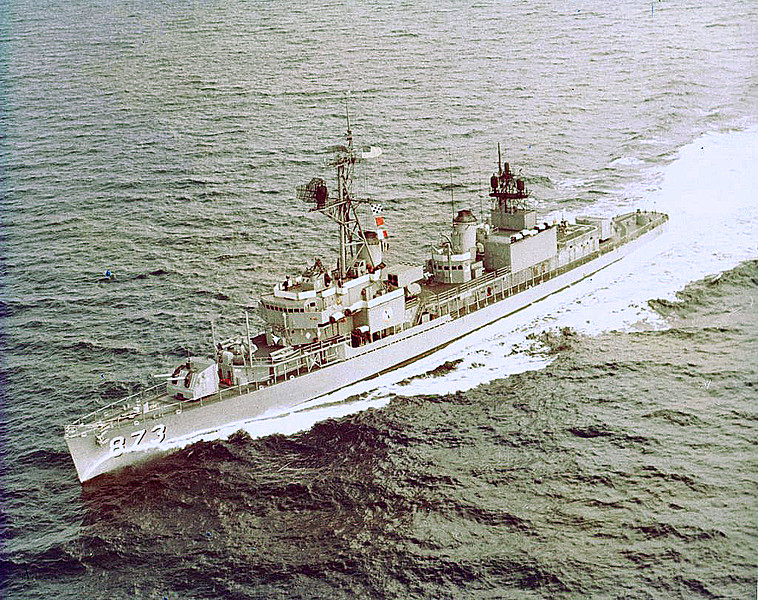
This began when i had one of the three best combinations of CO’s and XO’s i had in my Navy career of ten sea tours.
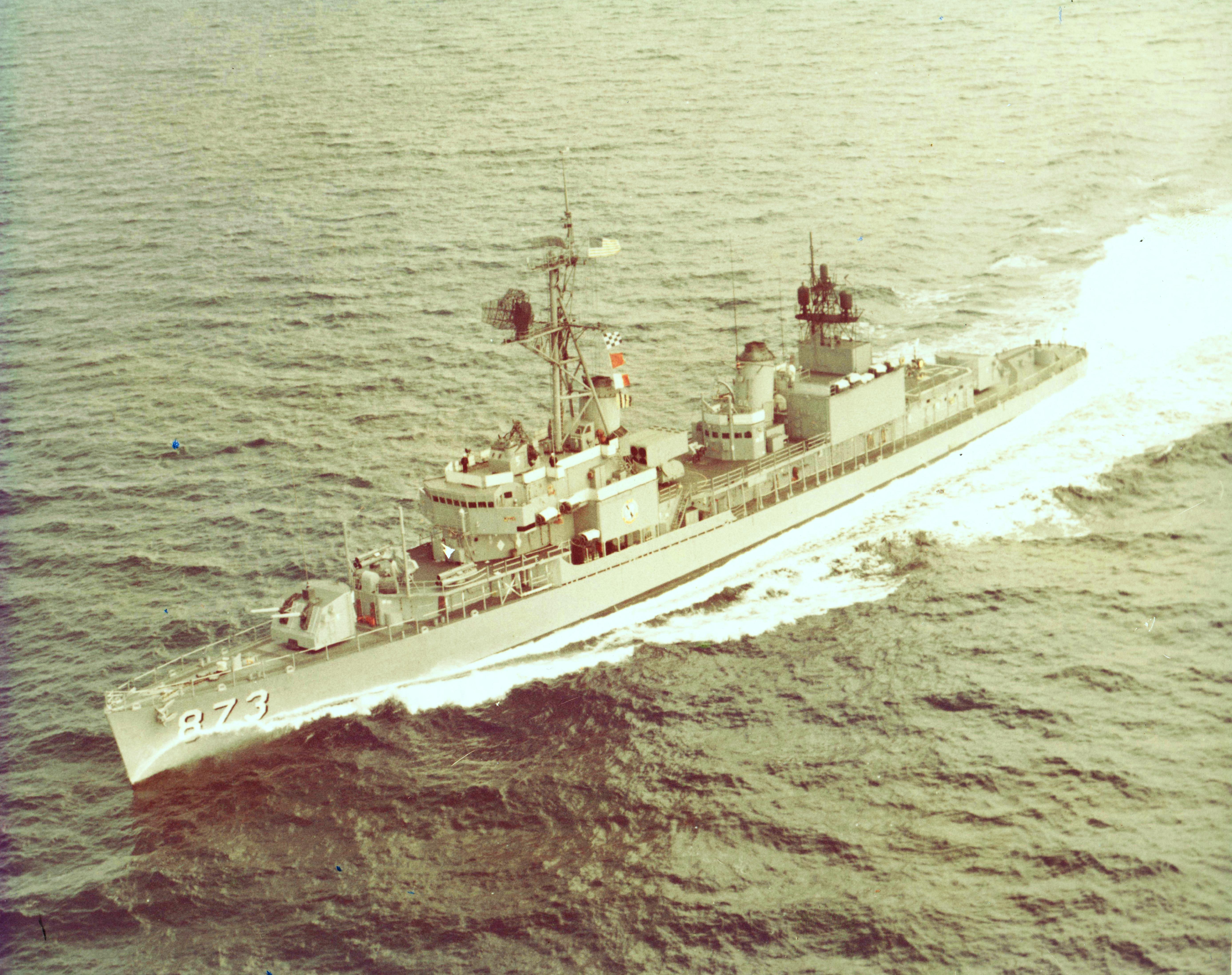
USS Hawkins (DD 873). 1968. Newport, Rhode Island.
USS Hawkins (DD 873), circa 1969
i don’t know why thought of this came into my head this first day of 2020. i mean, the regular two-year overhaul, scheduled to last six months began in September. Commander Max Lasell had just relieved as Captain and Louis Guimond remained as XO. i was still the First Lieutenant until the sitting ASW Officer completed his tour in early October, when i would relieve him. The ship steamed to the Boston Naval Shipyard, nee Charlestown Navy Yard (now long gone). i have about fifty sea stories of those six months. but there is one memory that sticks in my mind and replays over and over again.
The Hawk transited up the Mystic River to the main yard to begin the six-month overhaul. In late October, Hawkins left the yard and piloted to the Navy dry dock in South Boston. The transit was one of my last days as the first lieutenant, subsequently becoming the Anti-Submarine Warfare (ASW) Officer. One of the bigger jobs in the overhaul was the upgrade of the sonar and ASW fire control systems, costing four million dollars in 1968, or just under $30 Million in today’s dollars. So after the ship was docked and the water was pumped out, i was one of the first to go to the floor of the dock and study the underwater hull, now dry and sitting on the huge wood blocks.
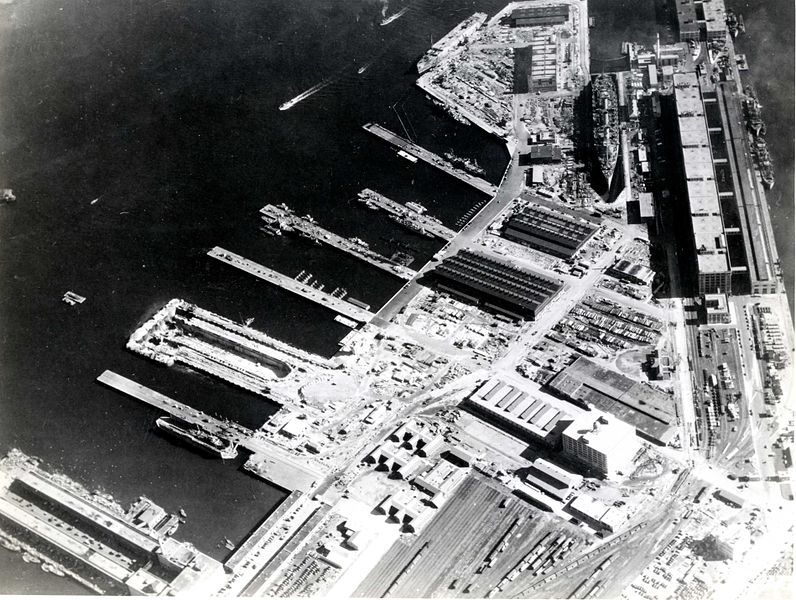
i was awed by the size of the ship, especially the sonar dome which increased the ship’s draft by about ten feet. More impressive was the dock itself. It was dock #3. Reputedly, this dock was built to hold the RMS Queen Mary. At the top right of the 1946 photo below, the Queen Mary is in Drydock #3.
Queen Mary‘s length is 1,132 feet (She currently is in pier side on the mole pier in Long Beach open for tours with the staterooms available for lodging) compared to Hawkins’ length of 391 feet. The British liner has a draft of 34 feet compared the Hawk‘s 14.5 feet (extended to over 20 feet with the sonar dome attached). Queen Mary has a beam of 147 feet while Hawkins was 40 feet wide.
The Hawkins rested on the massive wood blocks as we descended to the floor of dry dock #3. Shipyard personnel escorted the captain, the executive officer, the chief engineer, and me to the floor of the dock as we checked out the screws, the various intakes and discharge valves and, for me, the sonar dome.
i was an ensign. i really didn’t do much more than gape at what i saw. My lasting impression of my destroyer sitting on those blocks in the dock built for the huge liner was “a toothpick in an empty bathtub.”
Please bear with me. i’m reliving my past. This time, it was sponsored by the Facebook group, US Navy Gearing Class Destroyers. The admin guy for the page posted photos of radio central aboard the USS Joseph P. Kennedy, Jr. (DD 850), which continues to be restored as a museum in Fall River, Massachusetts. A shipmate from my first ship, USS Hawkins (DD 873), Gary McCaughey, commented and added a photo of him as a second class radioman, ET3 Mike Rebich, and RMSN Michael Jury in the Hawk’s radio shack in 1969.
i began to comment on the post, but decided i wanted to post my thoughts here because it is part of my story for my grandson Sam. i began with a question for Gary:
Gary, were you on another, ship, like a cruiser before the Hawk?
USS Hawkins (DD 873), circa 1969
Hawkins barely missed a collision with the oiler in rough weather that autumn (i believe it was autumn, October perhaps). i remember talking to a second class (i think) radioman in the radio shack afterwards. i’m wondering if it was you.
i had the 20-24 bridge watch and had the conn during an exercise for a sub testing a new streaming sonar array system. The oiler had replaced another FRAM, which had engineering problems.
The Hawkins had problems of her own as en route (i recall the exercise was in the op areas northeast of Newport, Rhode Island) a freak wave curved around a port side weather deck bulkhead and dumped at least 50 gallons, probably more onto the after switchboard (hmm, i think i’ve written of this before) requiring the damage control gang (LTJG Nemethy was the DCA) to run emergency electrical cables throughout the ship for the remainder of that time at sea.
The Hawkins and the oiler had made several runs on different patterns. Each ship’s CIC and bridge would work outmaneuvering board solutions for the designed run toward the sub’s location with a turn out as we neared the center of the plot, over the sub.
The next run would produce a CPA a bit closer than the others. i asked Captain Max Lasell (i think he had made captain by then) to remain on the bridge instead of going down to watch the movie in the wardroom, adding i would call the wardroom to have them hold the movie’s start until he arrived. Captain Lasell agreed.
For this run, the oiler did the calculations and ran the pattern correctly but apparently executed the maneuver a couple of minutes late. As i realized we were close to in extremis with CBDR, i shouted “The captain has the conn,” and he took over while i made sure his orders were understood and executed immediately. With the captain’s emergency maneuvering, the oiler passed in front of us, port side to, by about fifty yards. i remember looking up and seeing their pilot house.
After the near collision, Captain Lasell and i discussed what happened as he sat in the captain’s chair on the port side. We decided i would have done everything he did although i was not sure i would have ordered the port engine all ahead flank. we weren’t sure we would have collided if i had retained the conn, but we knew it would have been closer.
After the watch, i went to radio to pick up my radio messages. The second class told me he had been on a cruiser that had a collision. We talked for about ten minutes before i went down for midrats. To put it mildly, it had been a bit more exciting than i would have preferred. i had learned some valuable lessons i would use in future close calls.
After my talk to the second class radioman (perhaps Gary), the possibility of what could have happened sunk in. It took me while to go to sleep that night.
This was written in Navy “shipese.” If you would like an explanation, just let me know.
It’s that time, and tomorrow morning, i shall walk up my hill, stand under my flag at the peak — i put a light on it so i could keep it up during the night, not because i am lazy — i might be but not for this — but because a number of neighbors have thanked me for being able to see it in the morning and how good it makes them feel. If i raised it according to regulations, it would be at 8:00 a.m., and many would have already gone to work by then.
i shall stand there, look down on the combatants of the U.S. Navy’s Pacific Fleet, and i will take off my cap and put my hand over my heart (not the cap: the U.S. Flag regulations call for one to take off his cap and put it at his side while putting his right hand over his heart). This will be my salute to all veterans. Later, i plan to go over to the golf course, hoping Jessie Thompson, the Pearl Harbor survivor will be there and i can thank him for his service.
Memorial Day is for honoring those who have died in defense of our country. It has been expanded to honor those veterans who have died after serving. Tomorrow is not a day for mourning, saluting those folks who have left us, or lowering the flag to half mast. Tomorrow is a day for honoring our veterans.
By sheer circumstance and good luck, i am one of those veterans. It wasn’t really a sacrifice for me to serve our country. When i got back in the second time, i gave up my career in sports journalism for the security of my family. i had some close calls, but to me my service on ten ships and two shore duties was not arduous. i remain quietly respectful for those who really put it on the line. i have lost good friends whose lives were cut short because of service. i have number of shipmates who have debilitating injuries and less than good health because of their duty. So my few close calls are insignificant. As i have said often, i loved going to sea.
i hope everyone in this country stops for a moment tomorrow and salutes the veterans who served with honor in defense of our country and our way of life. i hope we put aside our political differences to pay homage to those who have served.
i plan to post one or two more of my Lebanon Democrat columns in the next day or so dealing with this veteran and others. Some of what is included will be repeats from what has been posted before. But i hope it provides the opportunity to think about what our veterans have done.
Why Navy?
SAN DIEGO – As the new year ramps up, I am back in the Southwest corner considering why I made the Navy my career.
My father also has wondered why a boy from Middle Tennessee would choose the sea for his livelihood. Others have wondered the same thing.
The sea called me during my midshipman cruise on the U.S.S. Lloyd Thomas (DD 694) in 1963. We steamed from Newport, RI, to Sydney, Nova Scotia; to Bermuda; and back to Newport as part of the U.S.S. Intrepid (CVA 11) battle group.
My last four weeks were in engineering with two watches and normal work requiring 16-hour work days. Having no more sense than now, I went from my last watch to the crew’s movie in the Drone Anti-Submarine Helicopter (DASH) hangar – “DASH” was a weapon which did not last long. Sailors called it “CRASH” instead of “DASH.” But its hanger on the 02 level just aft of amidships was perfect for showing movies.
This night, I watched “The Quiet Man” for the first time. As I left the theater and traversed the torpedo deck, I walked to the port side and gazed at the full moon.
The ship was making 15 knots. The moon’s reflection cut a wide, rippling, reflective path straight to me. The boilers roared through the forward stack. The bow wave was white, curling from the side and swishing its whisper as the ship cut through the water. “Darken ship” allowed no lights except those for navigation. At least a billion stars blanketed the black sky.
The sea grabbed me. She came down that path from the full moon, wafted across the bow wave, and reached deep inside. I felt her grab my heart and take it away.
I have loved her in her fury of the winter Atlantic, when she tossed a 500-foot ship around like a cork, ripping off protruding metal like dandelion bristles, and tossing sailors around the ship like matchsticks. Her intense fury blanketed the sea surface with froth.
I have loved her in the doldrums of the South China Sea where not a breath of wind existed, and the sea surface was glass for a week. I saw my first “green flash” then.
In the summer of 1973, steaming in the operating areas off of Newport, Rhode Island, my father saw why I went to sea. My ship, the U.S.S. Luce (DLG 7), was undergoing a major inspection. My Commanding Officer learned of my father visiting and invited him to ride during our underway day.
As a lieutenant, I was the sea detail officer of the deck. My father was by my side as I had the “conn” while the ship stood out of Narragansett Bay. As soon as we reached the operating area, we went to 25 knots for rudder tests, rapidly shifting the rudder to max angles both ways. The commanding officer and I went into a frantic dance, running in opposite directions across the bridge to hang over each wing checking for small craft in the dramatic turns.
After the rudder tests, I took my father into the bowels of the ship to our anti-submarine warfare spaces. My father stood behind me as I directed prosecution of a submarine contact. In the darkened spaces with sonar pings resounding, he watched as we tracked the sub on our fire control screen and simulated firing a torpedo.
After lunch, we set general quarters and ran through engineering drills. Finally, we transited back to Newport.
With mooring complete, the captain gave my father a ship’s plaque. My wife and mother were waiting on the pier when we debarked from the ship’s quarterdeck. As we walked the brow to the pier, my father said to me, “Son, I now understand why you would want to make this a career.”
I did. Somewhere in the latter stages of that career, I met a woman, a native of San Diego, and we got married. After a brief taste of being a Navy officer’s wife, she and I returned to San Diego for my “twilight” tour, the last four years on shore duty.
So now when I walk up our hill to raise and lower the flag, I look out to sea and check to see how many ships are pier side at the Naval Station.
And that, my friends, is why I made the Navy career and live in the Southwest corner, far from my home in Tennessee.
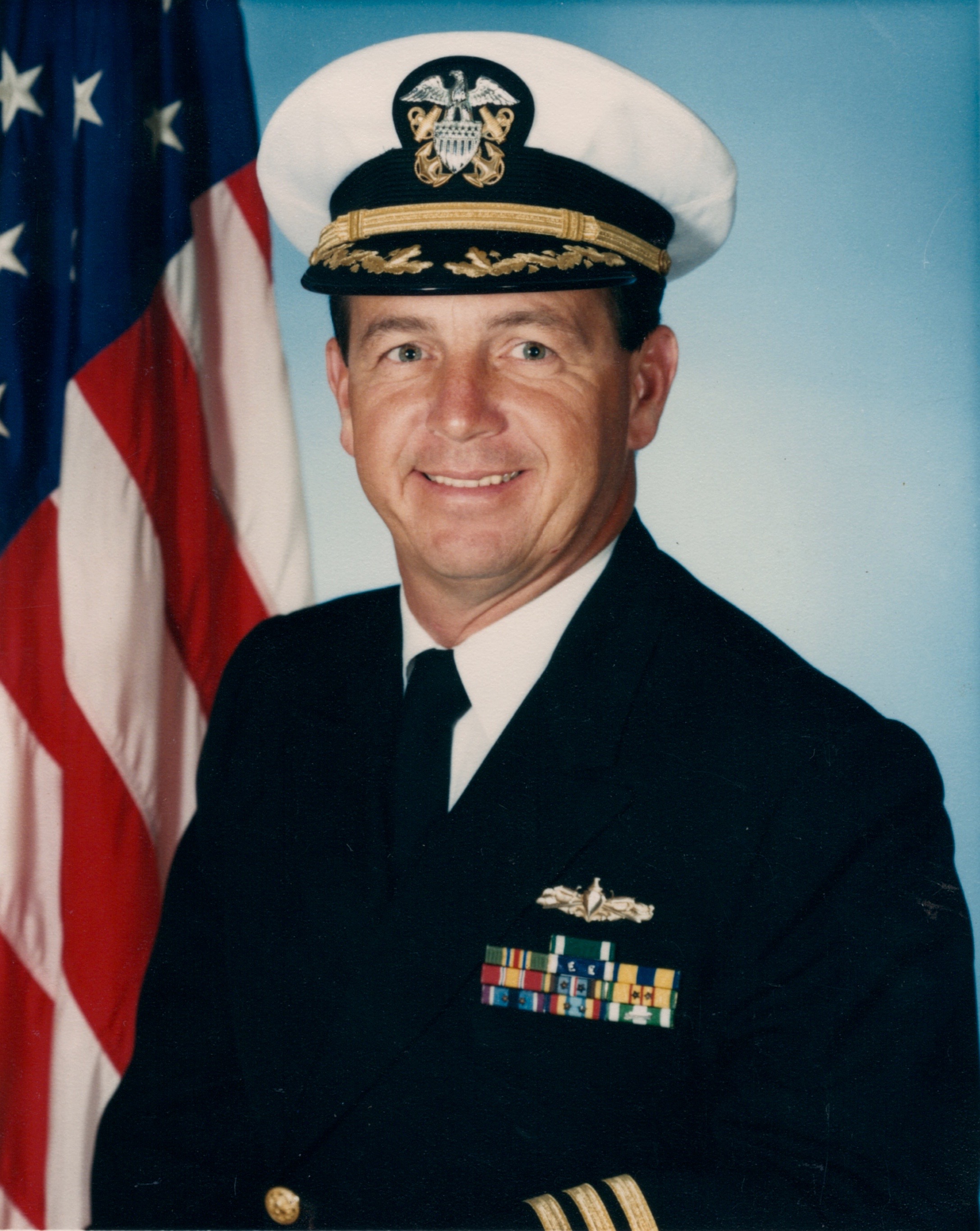
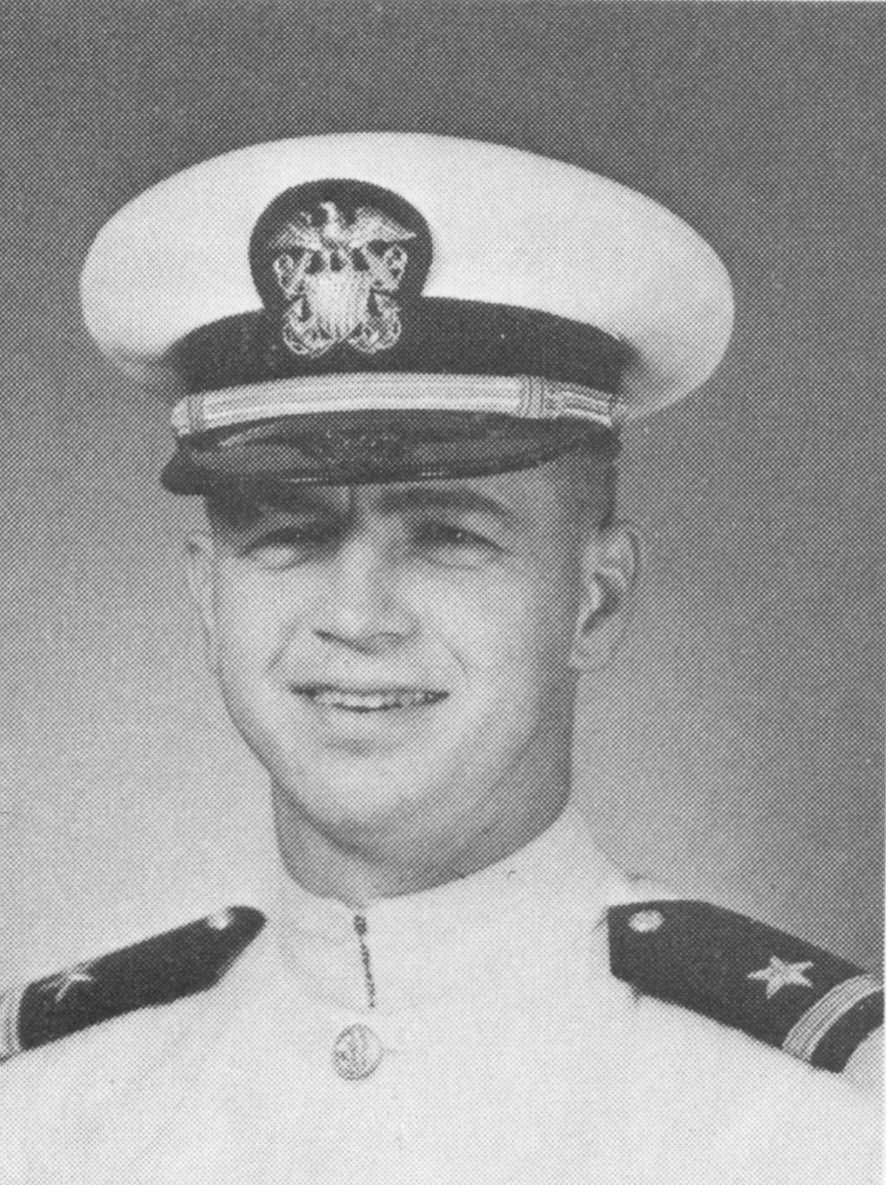
To my family veterans: Thanks. i don’t have photos of numerous others in uniform, but thanks to all.
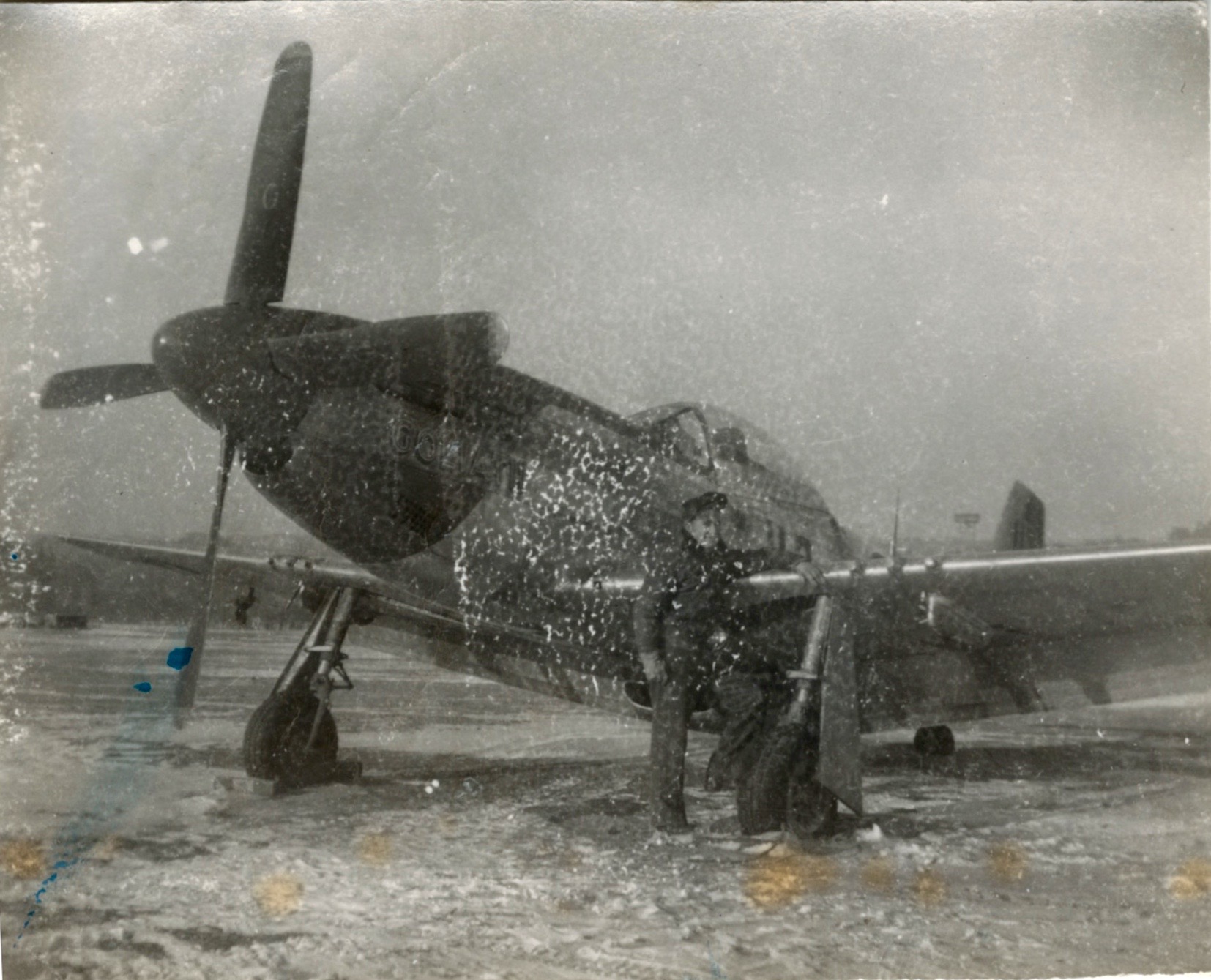
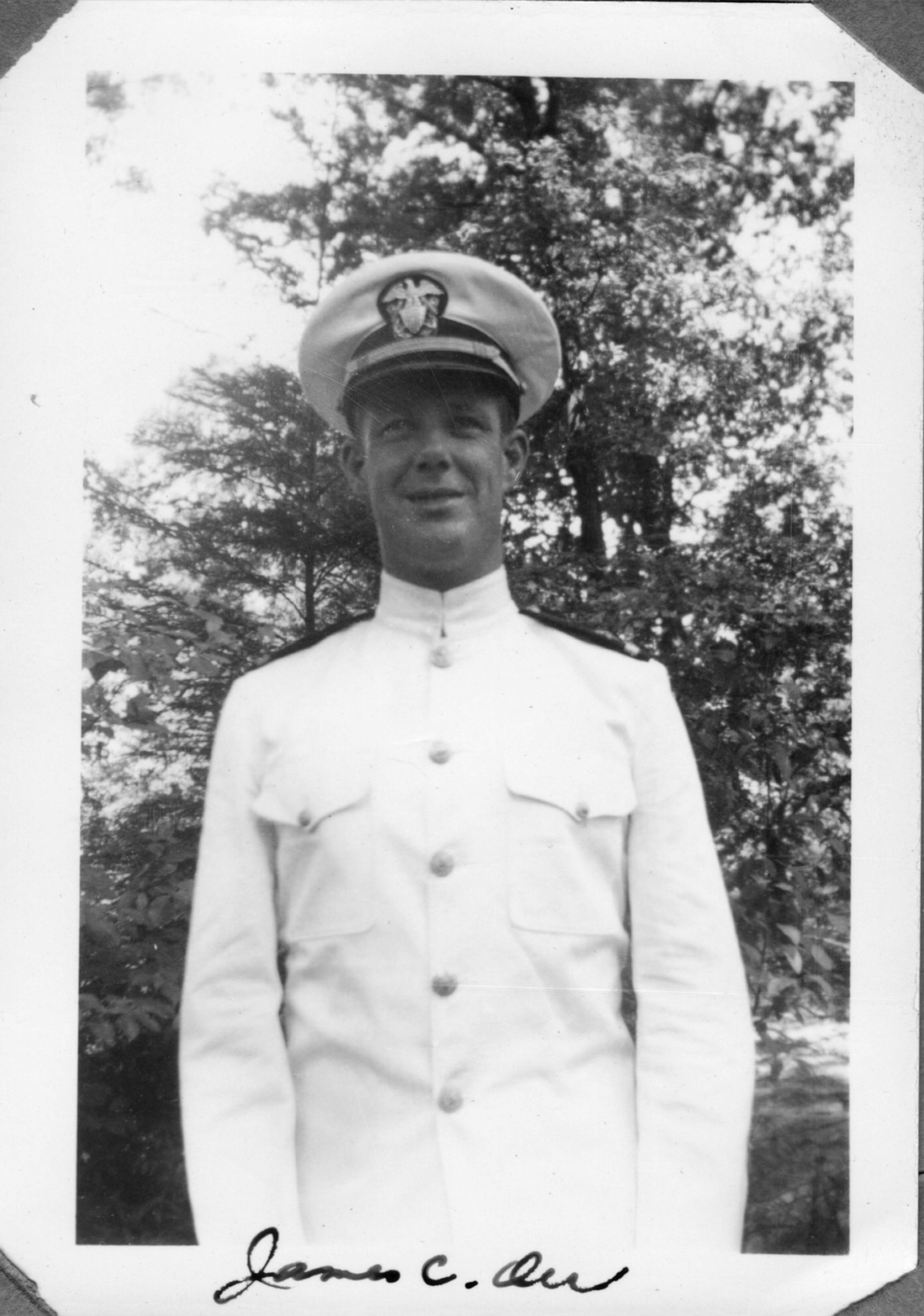
Jimmy JewellJason GanderBill Prichard with his fighter named “Colleen.”Ensign James “Pipey” Orr
Last Friday, after FMG (Friday Morning Golf, a weekly event in my life since 1991 with longtime pals), the six of us sat down with our beers (except for one of us) and began our usual palaver nearly always involving sea stories and war stories (one of us, Marty Linville, was an army artillery officer), both of which could also be called military history, personal accounts, or bullshit.
The group consisted of Marty who retired as a major, his son Michael, his grandson Carson, Rod Stark who was a commander surface warfare officer, Pete Toennies who retired as a SEAL captain, and moi, also a surface commander type.
Michael, who did not serve in the military, began by citing “Platoon” and how his father noted what occurred in the movie was pretty accurate in the events. Marty clarified they were but that all of the events did not happen to just one unit. Then Michael asked Pete if “G. I. Jane,” aside from having a woman (Demi Moore) going through BUDS training at the time, was realistic. Pete replied that the training depicted in the movie was pretty accurate,
Carson, who is matriculating to Linfield College in Oregon with a golf scholarship this fall and the one with no beer, listened intently.
We wandered off to quite a few politically incorrect topics, and i told a story indicating a man should not get in the middle of women arguing about what they should be called.
But afterward driving home, i began to think about what Pete, Marty, Rod, and i went through long ago. All of us did it several times: in college, at OCS, our first military tour, crossing the line, and any special group we joined. Some folks call it informal indoctrination, today it is called hazing and frowned upon, primarily because some people have let get out of hand, do stupid things because they think they are being tougher resulting in people getting hurt or killed.
To us, it was all about breaking us down to remake us into a unit, a team. As Gregory Peck’s character in “Twelve O’Clock High” drummed into his Eighth Air Force unit, it’s all about “unit integrity.”
I have written of how i was indoctrinated to the ways of the sea aboard the USS Lloyd Thomas (DD 764) in 1963 as a Midshipman third class. But there were many other tricks or embarrassments ahead. Those earlier stories involved sailors trying to get a landlubber, a green newcomer, even worse an officer to be, seasick. The other tricks were to embarrass the landlubber.
When a new crew member reported to his division or his work station, he was often sent on a fool’s mission. Common were the assignment to go find “relative bearing grease,” or a “sky hook.”
My favorite was on my first ship as an officer, the USS Hawkins (DD 873). During one afternoon watch with turbulent seas looming and a severe turn about to be executed, the boatswainmate of the watch piped (blew) “Attention, All Hands” on his boatswain’s pipe through the 1MC speaker system and warned the crew to “Standby for Heavy Rolls.” The watch section in CIC (Combat Information Center, or Combat) sent a new radarman striker to the galley to wait for the cooks to give him some “heavy rolls” and bring them back to the watch.
Of course, there was no such thing, and the poor striker waited outside the galley for over an hour in an honest attempt to carry out his order.
Back to the Lloyd Thomas after my time in weapons and operations, i was sent to engineering, first to the machinist mate division standing watches in main control. On my first work day, the LPO (Leading Petty Officer) directed me to go the Auxiliary Shop and ask “A-gang” for some “relative bearing grease.” i did as directed. A-gang told me they were all out of relative bearing grease and i should go to Damage Control Central and ask them for the relative bearing grease. As i walked forward through the mid-ship passageway, it dawned on me there was no such thing as relative bearing grease.
So instead of returning to Main Control empty handed, i went to my rack in midshipmen berthing on the first deck aft, let it down, climbed in, and went to sleep. After about an hour, Main Control’s LPO became worried and sent third class petty officer looking for me. He lost my trail at DC Central and reported back to the LPO. Finally, the LPO himself started his search and found me asleep in my rack. It had been about two hours since he had sent me on on the search.
He woke me and demanded to know what i thought i was doing, that i could be put on report for sleeping on duty.
i responded by telling him after being unable to find the relative bearing grease, i was too embarrassed at my inability to find it and was afraid to come back to Main Control. Not having anywhere else to go, i came back to my rack and laid down.
He bought it.
And i got the best nap i had since getting underway six weeks before.
Back when Navy ships were steam powered and a new concept in engineering plants had just begun, i was the Weapons Officer aboard the helicopter carrier USS Okinawa (LPH 3) homeported in San Diego.
The new program established the Propulsion Examining Board (PEB) to drastically improve the engineering plants of the fleet. The Navy appointed the most experienced and knowledgeable officers and enlisted in engineering to the board and subsequently those personnel conducted the much feared Operational Propulsion Plant Examinations (OPPE’s). If a ship underwent an OPPE and failed, it was more than likely the commanding officer, executive officer, and chief engineer would be “relieved for cause,” a career ending punishment.
i had experience with the OPPE’s on two ships although i was not directly involved. Neither was pleasant. i also had a tour as Chief Engineer aboard the USS Hollister (DD 788), and it was undoubtedly one of my toughest tours. So i was alert to all of the happenings on the waterfront when it came to engineering plant readiness.
One ship, a cruiser also homeported in San Diego, which will remain unnamed here, had undergone an OPPE. The ship failed, and as predicted, the CO, XO, and CHENG were relieved. The bureau of personnel picked a commanding officer to take over who had the reputation of being a superb engineer and unrelenting in driving ship’s force to prepare the ship’s plant for the next round of the inspection.
This CO drove everyone aboard to focus on preparations. His deck, weapons, operations, and administrative people were put into the fire rooms and engine rooms to properly prepare and then paint all of the spaces. They also provided support in administration and training to the engineers who worked harder than the rest of the ship with 16 hour days being the norm while they trained and brought all of the equipment up to expected standards. It was grueling work hours and the new CO was unrelenting in driving his crew toward the goal.
There was one machinist mate who was the leading grouser about what he was going through. He had been called on the carpet several times for his resistance and even had mouthed off to the commanding officer.
As was his habit, the CO had come in one morning at 0400 to inspect some of the work that was being accomplished. After checking out the progress, he had a cup of coffee and returned to his car to retrieve something he had forgotten to bring on board. When he approached his parking spot, reserved for the CO, he discovered his car had been riddled with bullets.
He was sure he knew who did it, the resistant machinist mate. The CO marched back to the ship and went directly to main control where he knew the second class petty officer was working on a piece of gear.
“Did you shoot up my car?” he angrily confronted the sailor.