Category Archives: Sea Stories

Fairly self explanatory, from what I can remember that is.

Joseph, Did You Really Drink Singapore Slings?

i sat in the dark in my comfortable non-reclining chair, reclining…sort of. It was in what is called, i think, the “family room” after being a “den” for as long as i can remember. Either took the living out of the “living room.” Blythe’s mother and i once owned a home in Bryan, adjacent College Station, Texas which had a “great room.” It was a living room and den/family room combination. Cool idea, but it wasn’t particularly “great.” Good plan, though.

But i digress.

i’m sitting in the darkened room with only a night light on the other side providing any light at all. You see, we’ve had smatterings of rain through the day, and some more serious stuff, like may a quarter of an inch predicted through the night. Kidding, right? Rain in the Southwest corner at the end of September. RAIN! Folks, this is Santa Ana season, when the highs sitting over us brings desert hot air, zero humidity, and high winds we call “Santa Ana’s” after the long ago Mexican egotist who killed Davy Crockett at the Alamo and eventually got his just due from Sam Houston: Tennesseans, you see. It is supposed to be wildfire season and the weather guessers keep playing it up while wearing rain gear.

But i digress. You have probably figured out by now that i digress a lot.

Because i sat in the darkened room and simply let my mind rest and roam, thinking about all of the things on which i could digress.

But i digress.

The Padres penultimate game in a season disappointing to most was long over. Maureen had gone to bed so she wouldn’t have to watch the end as that as been a continuing depressing couple of innings nearly all season long. i, being a contrarian and an old, old sports writer, take a different slant. This has been one of the most interesting teams i’ve ever watched in any sport. i found the drama interesting. And the old sportswriter remained true to his rule of watching all sports events to the end, because as Yogi Berra said, “It ain’t over ’til it’s over,” and what i thought was generated by Casey Stengel but, in fact, was first uttered by Ralph Carpenter, the Texas Tech sports information director when Texas A&M came back to tie the to tie the Red Raiders in 1976 for a 72–72 tie late in the Southwest Confernce tournament finals in 1976. The Red Raiders won 74-72, but Carpenter’s comment has become legendary, but Carpenter hasn’t gotten the credit he deserved.

But i digress.

For you see, in the dark of night, i closed my eyes and i saw things i could not see in the light.

After that ball game, i returned to Joseph Conrad, reading his “Youth: a Narrative” of a sea story of the 19th century gone south, about as bad as it could get. In years past long ago, i was close enough to understand.

i could feel it. Feel it.

As i read with intensity as the old hulk of a ship was meeting its demise. i could feel it intensely, intensely enough to stop reading for the night.

i closed the book, the short story would be completed. But not tonight.

When you are my age and not an abject politician, i think most of us spend a great deal of time in reflexion of our past.

Sitting here in the dark, Joseph Conrad and i reflected. Mr. George Dickel of Tullahoma, Tennessee helped us along. And i thought of Conrad and how he could conjure up tales of disaster in the Gulf of Thailand. i wondered how close he got to the dangers of those years with wooden ships, sails still competing with steam, and peril. My peril in my sailing days was slight compared to Conrad’s but when ti happened, it was real, very real.

i think there is a bond with sailors and the sea. i feel it when i read Conrad. i live with it as a part of me.

Thank you, Joseph. i think of you now. i thought of you when i was in Singapore in the old Raffles Hotel, your hangout. Because of you, i ordered the original Singapoer Sling in that bar where you sat with the one leather belt driven fans with arms of bamboo gently rotating quietly while the waiters in sarongs wandered about. Did you like these things that taste like sweet cough syrup?

Think i’ll stick with Mr. Dickel and gin martinis.
A Tale of the Sea and Me (For Sam) – Installment 29

Pearl Harbor, Oahu, Hawaii, August, 1975 — It had been the busiest and most rewarding (and unexpected) deployment of my Navy career. It ended with one of the most satisfying and father-connecting moments in our lives.

James Rye Jewell, Sr., lifetime Lebanon, Tennessee resident and master mechanic who had spent his only two years living out of his small country town in the Seabees in the South Pacific cauldron of World War II, arrived a day earlier and took a helicopter tour of the island. The next day, USS Anchorage (LSD 36), with the sea detail officer of the deck and conning officer being James Rye Jewell, Jr., passed through Mamala Bay into the channel and moored pier side at the Naval Station at Pearl Harbor. Unlike most of my stops in Pearl going and coming from a WESTPAC deployment, it was a short stay. About a dozen or so of male relatives and friends, including my father, came onboard for the “Tiger Cruise” back to San Diego.

A “Tiger Cruise,” in my opinion, was a brilliant PR move by the Navy. When the opportunity arose in a non-combat possible time at sea, sailors and officers were allowed to sponsor a relative or friend to join them for a short time at sea. i believe this program still exists.

Our “Tiger Cruise” was the last leg of a seven-month deployment. The tigers were checked in, taken to their berthing and unpacked. It was late afternoon when my father joined me on the bridge to get underway. He stood by my side as i walked the ship from the pier turned it and maneuvered out the channel and turned east north east on a great circle route to the Southwest corner. When we cleared the sea buoy, sea detail was secured and he and i went below. i showed him my stateroom. He went to a meeting for the Tigers, i did a bit of paper work and we met in the wardroom for the evening mess. Afterwards, he walked about the ship and i did a bit more work in my office until the evening watch (2000-2400) as OOD. He joined me.

Daddy spent almost two hours with me. The squadron was returning together but it was almost independent steaming. i gave the conn to my Junior Officer of the Deck (JOOD) soon after relieving the watch. Daddy and i walked out to the starboard bridge wing, watched the other ships while i explained formation steaming. We looked at the heavens and i explained celestial navigation and some adventures we had experienced on the deployment.

Then, Daddy asked me how my sailors, the crew in deck department felt about the cruise.

Now, my father was raised a Presbyterian and became a Methodist when he married a woman whose grandfather had been a circuit rider and became a bishop in the Methodist church. My father’s mother had given him, and consequently me and my neice, Kate Jewell, the middle name of “Rye.” This was in honor of Charles Thomas Rye who was running and subsequently won the governor of Tennessee election in 1915 running as an ardent prohibitionist. Other than a decanter of whiskey to flavor the women’s boiled custard after holiday meals, there was no alcohol in our house.

i told him the sailors were okay with the deployment, but were very unhappy we had spent very little time in liberty and maintenance period at the Subic Bay US Naval base in the Philippines.

When he asked why they were unhappy with the amount of time in Subic, i told him why. Since 1946, the United States Navy had a presence there, and it became the major US base in the South Pacific. the town of Olangapo across the bridge from the base over “shit river” had been built for Filipinos who worked on the base. It had become the closest resemblance to Fiddlers’ Green in perhaps the world. Sailors went on liberty to chase women. Bars, night clubs, and casinos were the primary businesses and sailors found prostitutes, wild women, San Miguel beer, were available for cheap. Fights, street food that could wipe out your innards were available 24/7. The sailors and officers alike loved it. Most of the married ones considered themselves geographic bachelors.

Daddy was taken aback, amazed this was such an desired place for sailors. He wasn’t ready to accept it. We talked some more until he retired around 2000.

The ship conducted tours and activities for the Tigers, and he spent a large amount of the five day transit with me while i stood watch and did my work. When he wasn’t with me or occupied by the scheduled events, he went, mostly to areas under my supervision and talked to sailors. He spent quite a bit of time talking to my sailors.

When sea detail was set as we approached our return to San Diego, he again joined me on the bridge. After sea detail had been set, there was still a lull in my duties before we reached the sea buoy marking the entry into the channel. We went out on the port bridge wing and admired Point Loma. Daddy looked at me and said still with amazement, “Son, you are right. I’m not sure i will ever understand why?”

He was an incredible man, but he wasn’t a sailor.

A Tale of the Sea and Me (For Sam) – Installment 28

A Father’s Understanding

SAN DIEGO – As the new year ramps up, I am back in the Southwest corner considering why I made the Navy my career.

My father also has wondered why a boy from Middle Tennessee would choose the sea for his livelihood. Others have wondered the same thing.

The sea called me during my midshipman cruise on the U.S.S. Lloyd Thomas (DD 694) in 1963. We steamed from Newport, RI, to Sydney, Nova Scotia; to Bermuda; and back to Newport as part of the U.S.S. Intrepid (CVA 11) battle group.

My last four weeks were in engineering with two watches and normal work requiring 16-hour work days. Having no more sense than now, I went from my last watch to the crew’s movie in the Drone Anti-Submarine Helicopter (DASH) hangar – “DASH” was a weapon which did not last long. Sailors called it “CRASH” instead of “DASH.” But its hanger on the 02 level just aft of amidships was perfect for showing movies.

This night, I watched “The Quiet Man” for the first time. As I left the theater and traversed the torpedo deck, I walked to the port side and gazed at the full moon.

The ship was making 15 knots. The moon’s reflection cut a wide, rippling, reflective path straight to me. The boilers roared through the forward stack. The bow wave was white, curling from the side and swishing its whisper as the ship cut through the water. “Darken ship” allowed no lights except those for navigation. At least a billion stars blanketed the black sky.

The sea grabbed me. She came down that path from the full moon, wafted across the bow wave, and reached deep inside. I felt her grab my heart and take it away.

I have loved her in her fury of the winter Atlantic, when she tossed a 500-foot ship around like a cork, ripping off protruding metal like dandelion bristles, and tossing sailors around the ship like matchsticks. Her intense fury blanketed the sea surface with froth.

I have loved her in the doldrums of the South China Sea where not a breath of wind existed, and the sea surface was glass for a week. I saw my first “green flash” then.

In the summer of 1973, steaming in the operating areas off of Newport, Rhode Island, my father saw why I went to sea. My ship, the U.S.S. Luce (DLG 7), was undergoing a major inspection. My Commanding Officer learned of my father visiting and invited him to ride during our underway day.

As a lieutenant, I was the sea detail officer of the deck. My father was by my side as I had the “conn” while the ship stood out of Narragansett Bay. As soon as we reached the operating area, we went to 25 knots for rudder tests, rapidly shifting the rudder to max angles both ways. The commanding officer, CDR Richard Butts, and I went into a frantic dance, running in opposite directions across the bridge to hang over each wing checking for small craft in the dramatic turns.

After the rudder tests, I took my father into the bowels of the ship to our anti-submarine warfare spaces. My father stood behind me as I directed prosecution of a submarine contact. In the darkened spaces with sonar pings resounding, he watched as we tracked the sub on our fire control screen and simulated firing a torpedo.

After lunch, we set general quarters and ran through engineering drills. Finally, we transited back to Newport.

With mooring complete, the captain gave my father a ship’s plaque. My wife and mother were waiting on the pier when we debarked from the ship’s quarterdeck. As we walked the brow to the pier, my father said to me, “Son, I understand why you would want to make this a career.”

I did. Somewhere in the latter stages of that career, I met a woman, a native of San Diego, and we got married. After a brief taste of being a Navy officer’s wife, she and I returned to San Diego for my “twilight” tour, the last four years on shore duty.

So now when I walk up our hill to raise and lower the flag, I look out to sea and check to see how many ships are pierside at the Naval Station.

And that, my friends, is why I made the Navy career and live in the Southwest corner, far from my home in Tennessee.

A Tale of the Sea and Me (For Sam) – Installment 27

Notes from the Southwest Corner: Fathers, heritage and work

by Jim Jewell

SAN DIEGO – Last week on a cool, marine layer grey day, I walked a wooden pier in the Southwest corner.

Crossing the end of the pier to Pamela Ann, a barge used for storage, I thought of my father.

Pacific Tugboat Service was at work that morning: work most marine service companies avoid because it’s just too hard.

I wished my father could see me in this environment.

It’s old-timey work: Men working on motors, chipping and painting, craning heavy loads, rearranging the company’s tiny chunk of bay space so cranes, barges, caissons, crew boats, pusher boats, and tug boats fit like a jigsaw puzzle. There was oiling and greasing going on. There was chipping and painting going on. Beating metal into something useful made ship repair sounds, music to my ears.

Tugboats were hooking up to barges and cranes to tow them where they would be utilized on some job. One ocean-going tug was getting ready to sail up to San Francisco pick up a barge, and bring it back to the Southwest corner. Stores for the journey were being staged on the pier, transferred to the tugboat’s deck by crane, and hauled below for storage.

The 62,000 ton “USNS Bob Hope” moved south from the marine terminal under the royal blue arching Coronado-Bay Bridge to the Navy Base. Pacific Tug’s “Harbor Commander,” a small pusher boat, was dwarfed while she pushed against the big monster, holding her steady in the channel.

The scene took me back to the spring of 1974 and Terminal Island, a two-hour drive north of here. My father, Jimmy Jewell, had come to San Diego, a rare trip without Estelle Jewell accompanying him. Six months earlier, I had become the chief engineer of the USS Hollister, a World War II destroyer named after three sailor brothers killed in combat in 1943.

The engineering plant would have made Rube Goldberg proud. My father and I toured the fire rooms (think boilers) and engine rooms while I explained the operation and maintenance requirements of the massive machinery. While Jimmy Jewell knew engines and mechanics better than most humans on earth having worked on them since he started fooling with cars in 1924, his elder son had jumped around a variety jobs and had been much more focused on writing rather than the mechanical side of the world until he rejoined the Navy two years earlier.

My father quietly took in the multiple pumps, forced-draft blowers, distilling plants, generators, and switchboards of the old tin can as we climbed up and down ladders, and finally ascended back to the main deck. As we crossed the brow back to the quay wall, he looked back at the ship and then to me and said, “It’s amazing you are in charge of all that.”

In the late 1800’s, my father’s family in Statesville faced a crisis when my great grandmother passed away. The two boys, one my grandfather, Hiram Culley Jewell, were sent to separate uncles to be raised. One uncle believed in education and sent my great uncle to college. The other uncle, the one who raised my grandfather, believed in hard work, not education. So my grandfather, my father, and my three uncles worked from that point on.

It was old timey work: steam-engine sawmills, plumbing, automobile maintenance, farming, and a myriad of other physically demanding work.

After my ship department head tours ended, I had not delved into old-timey work until I hooked up with Pacific Tugboat, a thirty year gap. I find it somewhat ironic, even poetic that I am back to what my great, great uncle determined: work is good for you.

In that context, I looked at our country today. Most “work” doesn’t require physical work. It’s brain power, service jobs, financial planning, technical expertise, salesmanship, writing, acting, and even talking, which bring home the bacon (if the family hasn’t gone vegetarian).

It seems we have prospered moving into this type of work. But I wonder. Physical labor used to be part and partial of living. I think it made us stronger, more focused on the moment, less fad and protest oriented.

Sunday in a break between golf and dinner, Father’s Day gifts from my wife, I stopped and thanked my father, my grandfather, and that great, great uncle for giving me an appreciation of old-timey work.

A Tale of the Sea and Me (For Sam) – Installment 25

That magical summer of 1968 was about over.

BMC Jones had left. The SPCM had left. My department head, LT Steve Jones, had left. The CO had been relieved. The USS Hawkins (DD 873) was headed for a six-month overhaul in the Boston Naval Shipyard in Charleston, Massachusetts, some 60 miles to the north.

Shortly after we arrived, i would be relieved from my first lieutenant duties and become the ASW Officer. The ASW suite would be undergoing a $4 Million dollar upgrade to the SQS 23G (We called it the 23 Golf”) and the old MK 105 ASW fire control system would be replaced by. The MK 114 ASW fire control system.

Before any of that occurred and because i was still the first lieutenant, i received the assignment of “Tool Control Officer” when we actually did reach the yards. I should have known this was an ominous assignment. Since first division no longer had a chief petty officer or first-class petty officer, BM2 Carrier was the first division LPO, and in charge of the division. Consequently, he became my assistant tool control officer. He was a blessing.

Oh yes, shortly after the Hawk entered the yards, my wedding would occur in Atlanta, Georgia in late September.

Unrecognized by me, my world was about to become greatly different. And i was about to learn some of my most important lessons on how to conduct myself as a Navy Officer on a ship. i was blessed because my new captain was looking over me.

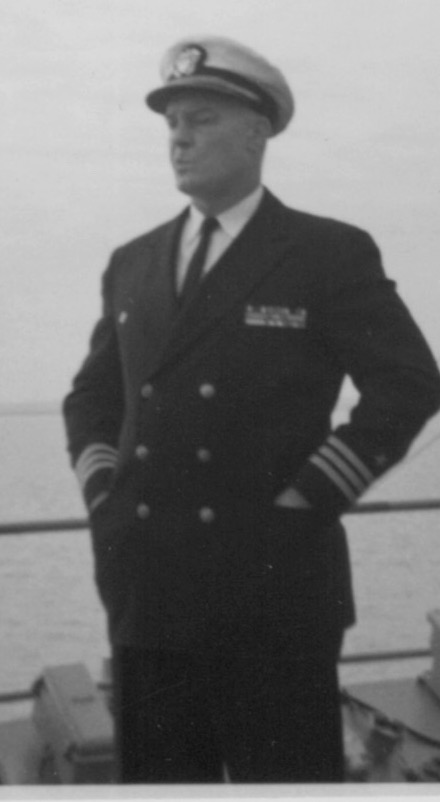
He was an impressive Navy Commander, standing about 6-3, probably around 220, solid, no hair, massive paws that engulfed yours when you shook hands, but elegant, graceful. His smile just sort of took you in, made you feel like you were his friend. It was a while before i saw the anger there. It struck me, when i did see that flash, that his anger was controlled, but more fearsome than most. Only once did i see it flare to explosion. That was about seven months later in Guantanamo Bay, Cuba. Yet even when i met him at the “hail and farewell” party the night before the change of command, it was apparent you did not want to get on his watch list.

CDR Max Lasell was a Naval Academy graduate. His wife Betty was almost as tall as him with a beautiful smile, dark brown hair. He chuckled when the Admiral asked how my teeth were doing as i presented the honor guard in that change of command ceremony. It gave me a good feeling about what was to come.

What was to come was my learning how to be a Naval Officer, Toward the end of the overhaul, the Navy, playing politics, and public relations decided its origin should be ignored and making its officers who forged ahead with leadership on ships at sea be “specialists:” Surface Warfare Officers. Dumb. Cow-towing to the submarine and aviation boys to make them equal. But that is a discussion i will never win and is for a separate post somewhere, sometime. But CDR Max Lasell taught me how to be a Naval Officer on a Navy destroyer.

It began as we went into the Charleston Naval Shipyard in South Boston. Within several days of entering the yard, the Hawkins went into dry dock. Now this was not an ordinary dry dock. It had built to dock the RMS Queen Mary. The dock was huge. As first lieutenant, i was with first division on the forecastle, primarily for line handling duties.

As the ship entered the huge dock, my first division began to heave the 5″ mooring lines to the line handlers on the edge of the dock. It was a foolish attempt. The distance was too great. We should have used a bolo ( a line with a weight on the end of a messenger line. But i was young, naive as a mariner, and macho. So i decided to see if i could get the mooring line across. Wrong!

Finally, we used the bolo and messenger to get the lines across and the ship sitting on the well deck blocks. My actions and my divisions was a terrible display of poor seamanship.

As we secured, our sound-powered phone talker told me the captain wanted to see me in the wardroom.

The CO and i were the only two in the wardroom. Commander Max Lasell dressed me down. He chewed me up and spit me out for being so stupid. He pointed out rather clearly, i had my men for a reason and i was not supposed to do their job. That stuck with me throughout my Navy career. As i was receiving my just due, i was gaining respect for my commanding officer. As he chewed me out, he was also giving me lessons in deck seamanship and leadership. i was not upset he chewed me out. It was deserved. i actually found myself feeling guilty i had left him down.

My next lesson follows.