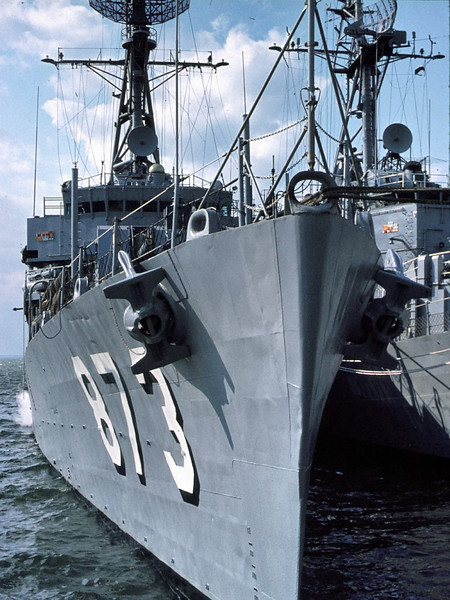
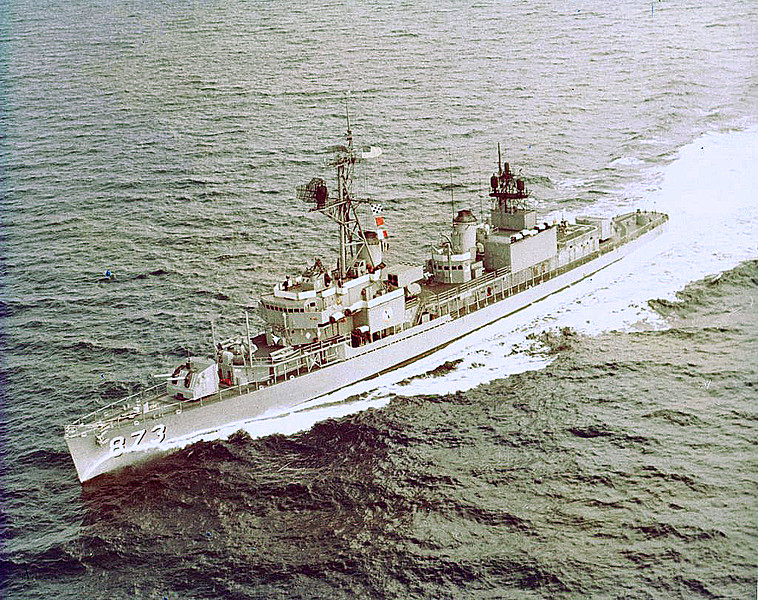
The sea and the Navy kept me busy. It was not only my top priority, it kept me from dwelling on my personal problems. We were headed to sea. All of the grungy old shipyard workers had left. The miles of pneumatic tubing, the pneumatic tools were back in the yard’s tool shed with the manager there wearing a spiffy new olive green foul weather jacket.
And the Hawk was underway for refresher training (REFTRA).
The transit south would have been uneventful except, of course, passing off of Cape Hatteras our first night at sea: the weather turned bad, the seas turned nasty, and sailors turned white and blew seasick blues and barfed a lot, the normal Hatteras impact on north-south transits along the eastern seaboard.
We arrived in Guantanamo Bay in early February (if i remember correctly). The Navy facility is now home to the US detention camp that will be closed soon. Today’s folks would be aghast at what we did in 1968 and how we did it. We were greeted by the senior members of the “Refresher Training Team” for a litany of what we would be doing for the next two months. We began that regimen the next morning. Early next morning.
I arose around 0330. Before 0400, I started inspecting all of the spaces for which the ASW officer was responsible to ensure Material Condition YOKE was set properly. When the training team came aboard later, they would check and the ship would get dinged if the team found any discrepancies. We found out they were very good at finding discrepancies.
i finished my tour of spaces usually with just enough time to grab a bite of breakfast in the wardroom before heading to the bridge as the sea detail JOOD. i would get to the pilot house as the quartermasters were completing covering all of the ports and windows with old navigation charts. Before we were ready to get underway, the “mobile training REFTRA instructors would arrive and inspect YOKE. Their bridge team would be on the bridge as we got underway and conducted limited (as in no) visibility. The navigator, quartermasters, and CIC would take radar ranges from objects to advise the conning officer, OOD, and Captain on how to proceed out of the bay. Once clear of the bay, the chart paper would come off and our training day would begin in earnest.
Usually, we would set General Quarters (GQ) immediately. It seemed engineering drills nearly always were the first of our exercises. The mobile training team (MTT) would put the engineers through all sorts of causalities. That meant the rest of the ship would spend a lot of time without power. We all were learning.
Every facet of our capabilities were tested. i was the GQ Junior Officer of the Deck (JOOD) and Sea detail. i was the check sight observer (to be explained later) in the forward 5-inch 50 caliber gun mount, Mount 51, for gunnery exercises, and was in under water battery plot for the ASW exercises. In other words, except for about 15 minutes for the noon mess, i was busy.
The ship would return to Guantanamo around 1700. i would eat at the evening mess quickly, return to my stateroom to assess the reports from the day, read the radio messages, and then prepare for the next day’s training. i would hit the rack around taps, then rise the next day around 0330 to repeat the process the next day.
Ahh, but did get a break…except it wasn’t. About every fourth or fifth day, we would pull gunfire support duty, this included weekends. This was 1968. To say the relations between the United States and Cuba were strained would be a slight understatement. There were fears Castro forces would attempt to take the Guantanamo Naval Base away from the US by force. So, the Hawkins, would go to anchor to be the duty gunfire support ship. There the sky one director would be manned by a junior officer and one gun mount would be manned to conduct fire if the Cubans tried to attack the base. They didn’t but it sure did add to more work.
It was long days and seemingly would not end, but it would end in about two months.
* * *
Then, something occurred that impacts me even today.
In those days, Filipinos were not allowed in any other ratings than that of stewards. Stewards served as valets, butlers, cooks, and waiters for officers in the wardroom. One of the best of the stewards was a young man, i’m guessing about 20 years old. He was very good at his work and just a good guy.
This ship was conducting engineering drills in the afternoon. Material condition Zebra was set meaning the maximum physical security. All ports and hatches were dogged shut. Permission had to be granted to open any hatches. The young steward was in the forward damage control team, which mustered in the wardroom. Part of the engineering drills was exercising the damage control teams. The steward was sent aft with a message for one of the other damage control team. Shortly after he went aft, the drill was concluded.
No one noticed the steward was missing. He had not arrived at the other damage control party. He was missed when he didn’t show up for preparing the evening mess in the wardroom. His missing was reported to the bridge. A muster of all hands was called for immediately. The steward did not show up.
The ship immediately began combing its track backward. He apparently went overboard. We finally came to the conclusion, he must have decided to open a hatch to the weather decks to deliver the message. What occurred next will forever be unknown. We didn’t know of any problems he had that would have make him to decide to jump overboard. We guessed a wave washed down the main deck when the ship made a sharp turn and that might have swept him overboard. As i wrote earlier, i will never know.
We continued to search the seas down our track until the next morning. Navy helicopters first arrived to help in the search. Then, the Coast Guard came on station to relieve us. i’m not sure how long the search continued, probably several days. But the young man was never found.
We interrupt this program for yet another out of sequence sea story.
Gary McCaughey, a shipmate from my first ship, the USS Hawkins asked me to repost my article about the Gloekle twins. Since a number of old tin can sailors have begun to read my sea stories, especially those who also had service on the mighty Hawk; Oh “Daily News” how i do hear your calling me, Gary’s request made a lot of sense.
The Gloekles, in their own way, were another reason the Navy was so unique and interesting back in the tin can days. They had problems with grasping what was going on and making connections. However, they were intent on doing their jobs, and i have no doubt they would have served us well in a real war at sea. i am glad i met them.
A couple of months ago, i queried several Hawkins sailors about the Gloekles. i told them i was thinking about writing a post about the Gloekles and would appreciate any input.
i may have entertained you (maybe) with some information on these Hawkins sailors before, but to make sure here’s the story:
My first ship was the USS Hawkins (DD 873). After getting my commission from OCS in early February 1968, i attended the Anti-Submarine Officer’s two-month course in Key West and then flew to Rota, Spain, on to Malaga where i joined the Hawk on her way out of the Mediterranean en route from a nine-month deployment. i immediately became the First Lieutenant in charge of First Division, the deck gang, as we crossed the Atlantic to our homeport of Newport, Rhode Island. i became the ASW Officer as we entered our ROH (regular overhaul) in Boston in September. After a six-month overhaul, we went to GITMO for refresher training (for non-Navy folks that was Guantanamo Bay where Atlantic based ships went through two-month period, getting underway every weekday for certification as operational after overhauls.
By the time we returned to Newport, i had qualified as one of four OOD’s (Officer of the Deck underway) in four section watches and one of four CDO’s (Command Duty Officers, who stood twenty-four hour duties and acted as the captain’s representative, responsible for the ship when the captain and the executive officer were ashore.
The Gloekles were not some small islands in faraway sea. Nor were they some dangerous passage close to some foreign shore. i had some first hand knowledge of the Gloekles. They were nice, friendly, sincere young men. Twins. They were SA’s (Seaman Apprentices) when they reported aboard and were assigned to First Division, the deck division, the one headed up by the green officer, one Ensign Jewell. They were of the old Navy.
i had experienced that Navy on my Third Class Midshipmen cruise aboard the USS Lloyd Thomas (DD 764). There were sailors on the Thomas who thought of their ship as their home, their parents, their world. They lived on board for their entire careers. There was a fireman who had made it to second class BT (boiler tender) at least three times (and then would get busted at captain’s mast) with eighteen years in service on the Thomas. There was a second class cook with 17 years of service who also lived on board, and there were more. They would not have been considered the brightest bulbs in the light fixture, but they served that Navy well and that Navy served them well.
The Gloekle’s were not in Mensa by any stretch. But they were sincere, well meaning, and as mentioned before nice young men. From somewhere in the Midwest as i recall.
They also had a penchant for getting themselves in predicaments and at least on two occasions dragging me with them.
In the summer of 1968 after our return from the Med, we went out to the op areas for several aerial gun shoots where our two twin gun mounts (5″ 38) fired at a aircraft-towed target sleeve. i was assigned as check sight observer for Mount 51 on the forecastle. i sat in a seat up in the left front of the mount with a sight. My job was simply for safety. Before the mount captain could fire either gun, i looked through the sight to ensure we were shooting at the right thing, the target. i would tell everyone on the JS or JP sound powered phone circuit (as best as i can remember) if the guns were aimed “on target,” “clear,” or “cease fire” if they were aimed incorrectly, like at the aircraft rather than the tow . The mount had 12 personnel cramped inside including me. It was hot and it was loud (and this was long before anyone had come up with hearing protection). i loved it although i wanted to be more a part of the action rather than as a safety observer.
The hot case man in Mount 51 was one of the Gloekles. i don’t know which one. But i well remember looking back and watching him working at his task. The hot case man squatted at the rear of the mount underneath where the mount captain stood on his raised platform. He wore his regular dungarees, a battle helmet, and large asbestos gloves. His job was to deflect the powder casings as they were ejected from each mount after firing a round to ensure they went out of the mount through the hole in the bottom of the mount and onto the forecastle deck. It was an assignment coveted by no one. But this particular Gloekle twin obviously was enthralled.
His look of concentration was beautiful to watch as he swatted the brass casings. He knew his job was important, and he was completely focused on the task at hand — after a gun shoot, another job was to “police the brass.” Any of the casings, about a yard in length with diameter of five inches, that had not rolled overboard were collected and tossed into the sea. i often wish i could have saved them all, stored them, and then sold them for the brass; i would be a rich man today; we have a three-inch brass casing used to hold dried flowers by our living room fireplace; for a long time, i had the base of a five-inch casing and used it for an ashtray. i don’t know where it went. But Gloekle was not concerned with that. He was doing his job.
At that time, the First Division chief was BMC Jones, an incredible Navy chief and a superb boatswain mate. Just before the noon mess, he and i were walking the main deck, checking on how the painting of the ship was going.
Chief Jones turned to me and asked, “Have you ever seen a one-armed Gloekle?” At first, i thought he was talking about a unique piece of equipment used in deck evolutions. Then i began to consider he was pulling my leg. Finally it dawned on me, he was talking about one of the twins.
“Yeh,” the chief continued, “Gloekle was in the mess line (on the port side of the main deck) and he got frustrated with something. He turned and hit one of the grates on a air duct. His fist and arm went through the grating.
“He broke his arm and the doc put in several stitches. Won’t be good for much of anything for at least a month.
“Damn one-arm Gloekles,” he mused.
The Gloekles also were known by shipmates as good guys. One struck for the radioman rating while the other was a DK (disbursing) striker while we were in the yards for overhaul. The disbursing striker didn’t make it and returned to the deck division as a seaman.
In May of 1969, Hawkins went to the Portsmouth Naval Shipyard for a month. There the fantail deck was strengthened and a special davit was installed. The ship had been designated as the Atlantic recovery ship for the Apollo 12 mission in July, a backup to the planned return in the Pacific where the aircraft carrier USS Hornet (CV 12) had the primary recovery assignment.
Taking advantage of a month in the shipyard, the deck division cleaned and repainted the paint locker. To do so, they had moved all of the paint into a large conex box on the pier. One afternoon before liberty call, the new first lieutenant came to me and said, “You aren’t going to believe this, but Gloekle locked himself inside the paint locker. He was in there for about two hours until someone discovered him there just before knock off. We have no idea how he did it.”
i had been qualified as OOD (officer of the deck on the bridge watch) in late February 1969 and as CDO (Command Duty Officer, responsible for the ship during an in port 24 hour period) shortly afterwards. i had the CDO duty one night in August while the Hawk was in a maintenance period and Hurricane Blanche was building southeast of Norfolk (in June, Hawkins’ home port had been changed from Newport to Norfolk; i was not thrilled with the change). i read the message board after eight o’clock reports and there was no radio traffic that addressed Blanche as a threat to the Naval Base.
After making my rounds before taps, i went back to the wardroom and caught the 10:00 o’clock news. The lead story was how the ships at Norfolk Naval Base were preparing to sortie because of the approaching hurricane. i had heard nothing from higher commands. i called radio, no answer. RMSN Gloekle, the other twin, was standing the evening watch in radio Somehow, he had locked himself out of radio and had spent a couple of hours trying to get back inside the radio shack. Finally, he woke up the duty radioman who had another set of keys.
When the dust settled, Gloekle brought me the message board again. The radio message from SOPA (Senior Officer Present Afloat) had ordered the sortie preps about two hours before and each ship was required to report if it could get underway within twenty-four hours. i called the captain and the chief engineer at their homes. The engineer confirmed the main engines were open for maintenance, requiring more than a day to button them up and get underway. The captain confirmed the radio message response i had written and i sent it out immediately, later than other ships but apparently okay with the chain of command. A disaster had been averted.
One of the best things about the draft was Navy ships were melting pots of the United States. Sailors were from everywhere in the country and with all different kinds of backgrounds. Many i have known went on to successful careers in a variety in the civilian world. Many stayed in, like moi, and had good careers. Back then, some stayed in because it was a safe place to be, like i said earlier, it was their home, their world. i enjoyed knowing all of them except for the small number of miscreants i ran into through twenty-two years.
And then there were the Gloekle’s. Sadly, i don’t know what happened to them. But i remember them fondly in spite of some problems with them locking themselves in or out of things.
My website now has a cleaner look and will be easier to navigate because of Walker Hicks. The man is the man. His skills continue to amaze me from the time we first met in the early part of this century. That does not include he is just a great guy, but he is.
One note. You may access my posts chronologically by clicking on the arrow below the current post. You may also find them under the “Categories” in the menu bar at the top of this page.
Once again, i am interrupting my chronological sea stories. This effort is similar to my attempting to providing sequential numbers for these posts. In other words, there are some errors somewhere. i will eventually straighten this all out. But not now; no, not now. i am having too much fun to fool with such accuracy.
When i began getting responses from the USS Hawkins Facebook group, i realized many of those folks who were a part of their crew and wardroom might have known one of my favorite people during my Navy career. i went back into my archives and found the below post from 2020. The events occurred near the end of our 1968 Refresher Training in Guantanamo Bay. i will resume that journey on the next go-round. This is for my Hawkins’ sailors who may have known the man.
When i began writing this, i thought i previously had written about the Hawkins’ liberty week in Ocho Rios. i could not find it, so i have included it here. i apologize to those who may have read about those infamous three days. This is a tribute to Red Moore. My story is intertwined with Red’s. He was a good man.
i had lost his name, thought it might have been Johnson. Then, another file folder being cleaned out revealed his actual name in three brief lines on a yellowed sheet of notebook paper. i finally had the name of the guy i had thought about on and off for about for a half-century. It is sad i could not recall his name correctly.
Red Moore.
Boiler Tender First Class Petty Officer Red Moore. i never knew his real first name. And he would have frowned on anyone renaming his rate to “boiler technician.” He was a boiler tender and his fireroom was his church.
USS Hawkins (DD-873).
i was the First Lieutenant and then the Anti-Submarine Warfare Officer in the Weapons Department throughout my near two years on board. Red was, obviously, in the Engineering Department. i had sort of a realization who he was and not much more until an early April (i think) liberty port call in 1969.
He remains, after my near twenty-three years of my Navy service, one of my fondest memories. After that fateful weekend, we were friends as well as shipmates. Red Moore was a sailor’s sailor, old style.
And that man knew more about the Hawk than anyone, anytime, not to mention how well he knew how Navy destroyer life was supposed to be lived.
Red reported aboard from boot camp either in late 1950 or early 1951. Red was a fireman apprentice. The Hawkins had been commissioned in 1945 as a straight stick Gearing class destroyer. In the spring of 1949, she was reclassified from a “DD” to “DDR,” the designation for a radar picket destroyer, meaning the DDR’s had a single 3″/50 caliber gun mount removed from the 01 level aft for additional radar equipment. That year, she also moved from the Pacific Fleet with a home port of San Diego to the Atlantic Fleet and her new home port of Newport, Rhode Island. That is where Red reported on board.
In 1960, her homeport was moved down the coast to Mayport, Florida (Jacksonville). Four years later, she went into the Boston Naval Shipyard to be converted to a FRAM I destroyer (Fleet Rehabilitation and Modernization) in 1964 removing the forward Mount 52 gun mount and added ASROC. After the conversion and being relabeled as a “DD,” not a “DDR.” she remained in Newport, her home port a second time around. i joined her in Malaga, Spain in late April 1968 as she was concluding another Mediterranean deployment.
i include the Hawk’s history here only because Red Moore was aboard that entire time tending his boilers.
When we completed an overhaul in January, 1969, we went to Guantanamo Bay for “refresher training” aimed at getting us ready and certified for Navy operations (many stories here). After about six weeks of the intense, 0400 to 2200 work days for me, with one of two days liberty in Guantanamo (yippee!) each weekend, the entire ship’s company was ready for a liberty weekend somewhere else.
Friday morning, i arose at 0430 to check the material condition of my Third Division spaces, stopping in the wardroom for a cup of coffee, running to the bridge to relieve as the junior officer of the deck for Sea Detail, participating in the “low visibility” exercise simulated by taping old navigational charts on the ports of the bridge, wandering from the bridge to ASW plot to the forward mount and back to the bridge in training exercises, i returned to the bridge to resume JOOD duties as we returned to GITMO to drop off our training team. Reversing course, we headed for liberty. Oh boy!
At the conclusion of sea detail, the CO, Commander Max Lasell, called me over to the captain’s chair on the starboard side of the bridge/pilot house. We had had a turnover that week with a department head and another OOD rotating off the ship. The captain told me he was qualifying me as the fourth OOD because, he said, i had enough sense to call him at any time i was in doubt about the ship’s location, condition, or safe navigation.
It was about 1800 when we secured from Sea Detail. i had a quick bite at the end of the wardroom mess, worked up the plans for our Monday morning exercises when we returned to GTMO, and lay down for about two hours. After all, this new OOD was assigned the midwatch. i stood the four hour watch, hit the rack at 0400, got up 45 minutes later to be the sea detail JOOD for mooring in Ocho Rios, Jamaica. We tied up to the copper mining pier about 0800. Then the fun began.
As ASW officer, i was also the “MWR ” (Morale, Welfare, and Recreation) officer and as such had to immediately report to the quarterdeck and meet the tour coordinators from Ocho Rios and gather the information about entertainment and attractions in the area. This took about an hour to arrange all and get the word out to the crew. i had decided i needed rest and was headed to my stateroom for a “NORP” (Naval Officer’s Rest Period) when someone told me i had pulled Shore Patrol Officer duty. As such, i needed to take a tour of the area with the local police to identify the potential trouble spots and determine how our half-dozen shore patrol crew would be deployed. Before liberty call, i was accompanied by the senior enlisted shore patrol petty officer. It was Red Moore.
The story of that day is below, but to continue with my lovely liberty, i was eager for the duty to end, so i could get some sleep before having about six hours of liberty on Sunday before we sailed. Addressing several problems that arose with my division folks kept me up until about 0230. i hit the rack then. Heaven…i thought.
Ninety minutes later, the messenger woke me up. A copper ship had arrived and our pier space was needed. We set the Sea and Anchor detail and moved to an anchorage. This episode took about three hours. Blessed sleep awaited. Then Ralph Clark, the senior watch officer came to me with an apology. He had not advised Rob DeWitt, the relieving shore patrol officer, he had the Sunday duty, and Rob, being a bright boy, had spent the night in a room at the Playboy Club. Ralph couldn’t get in touch with Rob, so i would have to stand shore patrol duty that day as well. Red Moore had been relieved by another first class and the rest of my “liberty” in Ocho Rios was spent chasing drunks.
i returned to the ship at 1330. We set sea detail at 1500, and got underway, securing Sea Detail at 1730. After being relieved, i went to the wardroom evening mess and retired to my stateroom. But this junior OOD had been assigned the evening watch (2000-2400). i awoke after just over an hour of sleep and headed to the bridge. After the watch, i returned to the wardroom for midrats (midnight rations, and man, you just can’t miss midrats if you are a sea dog), once more finding my rack, this time around 0030. Ahh, such pleasure.
However, we had to set Sea Detail at 0400, and i had to check condition Yoke in my spaces before that. So i was up at 0315, checked my spaces, and reported to the bridge. We arrived at Gitmo at 0630, picked up the trainers, and headed back to sea.
On our liberty weekend, i had about ten hours sleep over the three days and no liberty for our “liberty” weekend.
But you know what? It was worth it to be able to tell this tale and spend a day of duty with BT1 Red Moore. Red made my job as shore patrol officer a piece of cake. He knew sailors and knew where they would go to get in trouble, what kind of trouble they could find, and how to take care of it. He kept me aware but pretty much took charge. He was fun to watch in action.
In the late afternoon, one of our patrols came back to our SP station at a downtown police precinct and reported one hotspot was out in the jungle. Apparently, a clearing had been made and a big tent structure had been converted to a dance hall, complete with a bar. There were a number of huts nearby. The number of prostitutes normally around Ocho Rios was very small. But a bunch of these ladies of the night had been picked up in the capital of Kingston and bussed across the island, a bit over 50 miles, and deposited at this party town in the jungle. Sailors, being sailors, had flocked there.
Around 2200, Red and i decided we should check out the place as liberty was expiring. It wasn’t expiring at fantasyland. It was hopping there. The band was playing loud with a driving beat, the bar was doing a brisk business, and women and men filled the place dancing.
When several of the sailors spotted the lieutenant junior grade in uniform, they came over to talk. One was my second class torpedoman. They were trying to buy me a drink, but i kept declining. One of the women asked me to dance. i declined her as well. Then as the group and i were chatting, i felt something between my legs. The spurned dancing lady had her hand on my crotch from behind me. As gently as i could, i removed her hand and with Red walked to the other side of the dance area. There some drunk decided he didn’t like officers and decided to take me on. He confronted me and was about a foot from my face shouting profanity. i tried to think how i could reason with a drunk and if we had enough shore patrol to wrestle him down and get him back to the ship.
Red stepped between us, told the belligerent drunk to calm down. Even though drunk, the sailor knew not to mess with Red Moore. Red ushered me to our truck, and we left. As Red was driving away, i said, “Moore, i appreciate what you did back there, but i could have handled him if he tried to hit me.”
“Oh, Mr. Jewell,” Red replied, “I wasn’t worried about him hitting you. I was worried you might hit him.” He continued, “That would have caused more trouble in so many ways we don’t even want to think about.”
He was right.
After that liberty weekend, BT1 Moore and i spent more time together. We would meet on the weather decks when he had come out of the forward fire room and i had come down from a bridge watch or perhaps during the workday, and just chat, learning about each other.
About nine or ten months later, BT1 Red Moore left the USS Hawkins after 18 years of service on one destroyer. He was planning on retiring in Arizona, his home, after completing his 20 years of active duty. For what we Navy folk refer to as our “Twilight Tour,” Red had been granted his request to spend his last two years as a recruiter in Phoenix, i believe.
Before i left the Hawkins just before Christmas of that year, i learned Red had been killed in an automobile wreck in West Texas on his way to his new duty station.
i had a bunch of enlisted folks who greatly helped me along the way. In my formative tour, BMC Jones, an SPCM whose last name i cannot recall, BM2 Carrier, and the entire sonar gang, ASROC gunner’s mates, and torpedo men were invaluable in teaching me how to be a good officer.
Red Moore was a master of boilers, the Navy Way, and life. i wish i could have a beer with him right now.
Charlestown Naval Shipyard, Boston, Massachusetts, 1968-69 — it was absurd in so many ways…
I already have written of two goofs I made when Hawkins entered the overhaul. That six-month overhaul showed me a ship’s time in port had both the good and bad sides of the coin. Mine was complicated.
The ops boss, supply officer, the gunnery officer, and I decided to commute from our apartments in Newport daily, a trip of 70 miles one way. We would leave around 4:00 a.m. and get back to our apartments and our wives around 7:30 or 8:p.m. We would eat dinner and go to bed around 8:00 p.m, repeating the process each weekday for six months.
The gunnery officer and I were in three section duty, meaning every third day, we would spend 24 hours on board the ship. I had just taken this beautiful young Atlanta debutante away from her family and horse and put her down in an apartment so she could spend about three hours a day with me and be alone the rest of the time in a strange place. It is no wonder the short marriage did not end well. I still feel badly about that.
The yards. Ah, the shipyards. Honestly, it blew me away this first time. It was unlike anything I imagined could be in the Navy. It was bustling, inefficient, dirty, sooty, steel and concrete. It was long before the Navy became concerned about the debris and dirt from sandblasting. It was our ship in shambles, hoses of all kinds running everywhere. Sailors and sand crabs (the Navy’s derogatory term for non-navy government employees). It was prior to hearing protection but with pneumatic deck grinders grinding at a decibel level unheard of in football stadiums.
Men in dungarees and dixie cups, later ball caps, climbing all over their ship — ship’s force work we called it not recognizing the unintended play on words. Grizzled, unshaven old men in coveralls and work boots, recovering from the previous night’s toot at the tavern, red-eyed, crawling around with the sailors performing the shipyard work. Coffee, coffee, dark, old, burnt coffee, no cream, no milk, before creamer, no sugar, what the hell’s a latté? everywhere. Except at scuttlebutts, which are inoperable, no water, except what the ship is floating on, dark, filthy water, with yard waste, foul stuff from the scuppers, and black oil bubbles on the surface.
I was still the first lieutenant. My senior enlisted subordinate was BM2 Carrier. Chief Jones had retired. Shortly after we entered the yards, the new boatswain’s mate chief came aboard. I don’t remember his name. He was short, pale, puffy, with white hair, and immediately identified as a “ROADS” scholar. That stood for “Retired on Active Duty Sailor.” You could identify them with the permanent crook in the forefinger of their coffee cup holding hand because they sat in chiefs quarters with a cup in that hand, not doing too much more than that. I really don’t remembering him doing anything the entire time he was on board.
♦︎ ♦︎ ♦︎
The new ASW officer sits in his stateroom, second stateroom, port side, after officer’s quarters, on the main deck below the ASROC deck amidships. The compartment is too narrow for a desk chair, requiring him to sit on the bunk to work at the desk. He shares the narrow space with the COMMO (communications officer for landlubbers), while he fills out evaluations for his sonar technicians, ASROC gunners mates, and torpedo men. This is while the yard workers above are grinding down the deck topside to metal, loosening the tabs that hold the overhead insulation. The little metal buttons drop intermittently on the paper or his head as he works away with the noise barring sane thought.
This is the stateroom where the COMMO had the duty one night. He was a strait laced, god fearing Naval Academy LTJG. Several other of the officers snuck a lady of the night onto the yards and the ship. They gave her instructions, and closed her inside the stateroom. She crawled up into the upper rack. The COMMO awoke. Screaming, he jumped out of the rack and was trying to figure out what happened. The schemers were in the AOQ passageway outside the stateroom, entered and told the COMMO their joke. He was not pleased. The schemers, still laughing, escorted the lady back to her lair in Boston.
♦︎ ♦︎ ♦︎
The ensign has the duty and goes up to the 04 level to check on the shipyard work being done to “Sky One” gunfire control director. About a half-dozen yard workers are sitting on the deck next to the director. He asks why aren’t they on the director working on the system. They can’t, they say. There is no scaffolding, they say.
“Well, you can get up there without scaffolding,” he points out.
“Oh, no,” they say, “Can’t do that. Against union rules,” they say, “Must have scaffolding.”
“I can get some boatswain’s mates to rig scaffolding,” he offers.
“Oh, no,” they say, “Can’t do that. Against union rules. The riggers have to rig the scaffolding.”
The ensign walked away shaking his head in disbelief. Things didn’t happen like that in his Navy.
It took another four days for the riggers to show up.
♦︎ ♦︎ ♦︎
Then the Hawkins goes to dry dock. But the dry dock at the Charlestown Naval Shipyard has another ship in it. So, the Hawk goes to the commercial yard. That dry dock was built for the HMS Queen Mary.
Entering and leaving a dry dock is one of the most exacting science and art combinations in the Navy. You are putting a very large object on wooden blocks to hold, in FRAM destroyers cases, about 3,000 tons. The blocks are situated to sit on exact points of the ship’s keel. Getting the ship there is an art.
This was my first experience of a dry docking. I erred in an earlier sea story about the CO chewing me out. It did not occur when we entered the yards, but we we were docking in Queen Mary‘s dry dock. The distance between the forecastle and the dock walls were way to far to try and throw a mooring line. We should have begun with a shot line. I remain in awe of my ensign ignorance, and it was, I’m sure BM2 Carrier’s first time in charge of the forecastle and first time in dry dock. I should have known better, or at least done a little research.
♦︎ ♦︎ ♦︎
After we were docked and the rest of the water had drained from the dock, yard personnel, and key ship’s personnel went down into the cavernous dock. My first thought, which still remains intact over a half-century, is the mighty destroyer USS Hawkins (DD 873) looked like a toothpick in a bathtub.
I was simply awed by the vastness of it all. The ship looked so small in that dock. But as we walked toward and under it, The propellers, aka screws, were tremendous. The hull was dented and sealife clung to the sides. We walked under the sonar dome, which projected another 6-8 feet underneath the keel — It was the reason STCS Rogers and I were included in this party.
I felt very small.
♦︎ ♦︎ ♦︎
Because of the distances, the only exit from the ship was a gangway that stretched from the ship’s 01 level amidships to the dock’s side. It was probably about 30 feet, but it seemed to be about 100 yards. It was akin, but not quite, to those swinging bridges across chasms. For safety, cargo nets were strung below the gangway for the entire length to ensure if someone fell off they would be saved to falling to the dry dock deck.
Sometime in early December, I had the mid-watch as the OOD. The Petty Officer of the Watch, the Messenger. We stood there for four hours. It was cold. Over the course of my life, I have been extremely cold about four times.
The first time was fishing for sauger below Pickwick Dam in Tennessee in February 1968 with my father and uncle. There was ice on the water and it snowed. The third time was standing on the bridge wing of the USNS Geiger (T-AP 197) entering Pusan in January 1970. At the fourth coldest moment, I was attired in a golf shirt and shorts when I played golf at Harding Park outside San Francisco in July 1976. But the first time in that dry dock in Boston, where I wore my service dress blues and my heavy bridge coat with its lining as i did entering Pusan.
But it felt cold and lonely on that quarterdeck in that cavernous Boston dry dock in the middle of the night.
♦︎ ♦︎ ♦︎
One of the more significant jobs during the overhaul, perhaps the most expensive, was the upgrade of the SQS 24 sonar to the “G” revision and changing the 105 ASW fire control system to the new SQS 114 ASW system. The ship alteration cost over $4 Million in 1968 dollars. This ensign from Tennessee making about $400 a month just didn’t seem to be the guy you would want in charge of this. But I was. However, I had a spectacular group of folks working for me. Senior Chief Rogers was the most knowledgeable person in Anti-Submarine Warfare expertise I met during my career. He brought that knowledge to bear. First Class Sonar Technician Alan Ernst was the leading petty officer. He is the guy that made it happen. I reconnected with Alan in later years. He had become a successful financial guy, but passed away too soon from brain cancer.
The entire sonar gang was dedicated, good guys. I didn’t do much more than tell them to do it right, keep the spaces clean, and don’t get in trouble. They knew I checked to see if they were following those guidelines, and they always exceeded my expectations.
We left the yards with a super and current anti-submarine capability. And knew I was blessed…at least as a Naval officer.
It’s been a while. i have had other projects, some posts that were not really sea stories, but related, a lot of home tasks, and golf. Did i mention golf?If you would like to read my posts that are not sea stories, you can subscribe to my website (no charge) in the menu above andreceived emails when a new post is on line. But it’s time to get back to my sea stories.
The next lesson Commander Lasell gave me came in another wardroom session between the two of us. It was not pretty. i learned a lot.
In those days, overhauls were conducted in a much different manner than today’s overhauls, even the one in 1982-83 in on the USS Okinawa (LPH 10). Our ship’s company lived on board during an overhaul unless their living quarters had to be part of an overhaul job. The shipyard performed the major upgrades and “ship alterations” (SHIPALTS). The ship’s crew and officers were with the shipyard workers throughout the overhaul, monitoring and learning about the changes. They also performed maintenance and repair not being done by the shipyard.
To perform their work, the crew used shipyard tools: pneumatic chippers, grinders, and other similar equipment. The Tools Officer, aka me, who had no clue about tool inventory, had to check out all of the necessary tools and issue them to the crew as needed, and keep an inventory of what had been checked out and what had been returned. BM2 Carrier, who remains one of the best LPO’s i ever had in a division or department was as naive as i was in bookkeeping. We were also unaware that shipyard workers would take the tools we had checked out for ship’s company as well as the pneumatic hose, the conduit for powering those tools.
After the first month, the shipyard put out a report on tool status. Hawkins’ inventory was over $1,000 in arrears for missing tools.
The captain had called me to the wardroom where the two of us were there alone when he read me riot act (in a most kindly manner) for the line handling disaster when we had entered the yard. i was called to the wardroom again for a one-on-one with CDR Lasell. This one was actually worse for me. i felt i had let the captain, the ship, and the Navy down by poor record keeping.
After that, Max Lasell and i met in the wardroom many times. Usually, it was one-on-one, but those meetings often included Louie Guimond. None of those follow-on meetings were to give me a motivational ass-chewing. Those meetings became a time for me to give the captain information about the status of what was going on in the Weapons Department and Max providing me guidance in how i should continue improving my leadership.
After the first yard tool assessment, we never lost another tool. A month later, i was relieved as first lieutenant and became the Anti-Submarine Warfare Officer. i was looking forward to turning over the yard tool control job to my first lieutenant relief. But the CO and XO decided Petty Officer Carrier and i were doing such a good job, i would continue as tool officer. Ugh.
But we did okay…except for one thing. As we concluded the overhaul, our tools had to be returned to the yard’s tool control guy. We had all of the tools we had checked out. i was thrilled until Carrier told me the yard workers had continue to steel the pneumatic hose. We were just shy of $1,000 shy of hose. My very short career and a major ass-chewing loomed before my eyes. BM2 Carrier told me not to worry.
The two of us put all of our tools on a large dolly and headed to the yard’s tool shed. We stood at the window as the tool guy checked off all of our tools. He then gave us the total for the unreturned hose. Carrier pulled out a ubiquitous olive green foul weather jacket from our stock. He told the tool guy he could have it if he forgot about the missing hose. The tool guy was thrilled. Our total of missing tools magically went to zero, not a bad deal. A foul weather jacket that cost about $30 bucks in 1969 and a zero debit for tools.