Category Archives: Sea Stories

Fairly self explanatory, from what I can remember that is.

A Tale of the Sea and Me: Pray for No Rain

In the late spring of 1974, Commander George Phelps soon would be relieved in a change of command ceremony aboard the USS Hollister (DD 788) in Long Beach. The outgoing captain, XO, and department heads considered what the options were if it rained. The weapons officer suggested that we move the ceremony from the 01 deck (with attendees in folding chairs on the pier) to the reserve armory about 3/4 of a mile away. The captain asked how were we going to get the crew there.

The weapons officer replied, “We’ll march the crew there, sir.”

At that, the captain, the XO, the Ops officer, and yours truly, the chief engineer, fell out of our chairs laughing at the idea of such a debacle.

The discussion reminded me of a story from one of my best golfing buddies, Marty Linville. Marty, an Army major who was awarded the Silver Star for his actions as an artillery officer in Viet Nam, was stationed at the Naval Amphibious School primarily as the director of the Navy’s gunfire support range on San Clemente Island.

During a rare command personnel inspection, Marty was in charge of the gunfire support personnel. He was having them take position for the inspection as was about to give them the command “dress right, dress,” but had second thoughts. He called his master chief petty officer to the front to consult.

“Master Chief, what should I expect if i order the troops to “dress right dress?”

Without hesitation, the master chief replied, “Chaos, sir; absolute chaos.”

That’s “Devine,” Not “Divine”

Within the last couple of weeks, i recognized i had made an omission In my book, Steel Decks and Glass Ceilings. i stated i had only encountered four women in the Navy before reporting aboard USS Yosemite (AD 19) to relieved the executive officer. i missed one.

The first female officer i met during my career was LT Carolyn Prevatte, an unrestricted line officer. i mentioned her in my book. Carolyn came to the Texas A&M NROTC Unit about the same time as i took over as the Senior Naval Officer of the unit. Her primary job was to be the liaison and coordinator for women who had just been allowed to be in the Corps of Cadets. The Navy unit had only one female cadet but there were several more in the Army and Air Force Units. She, my wife Kathie, and i became fast friends.

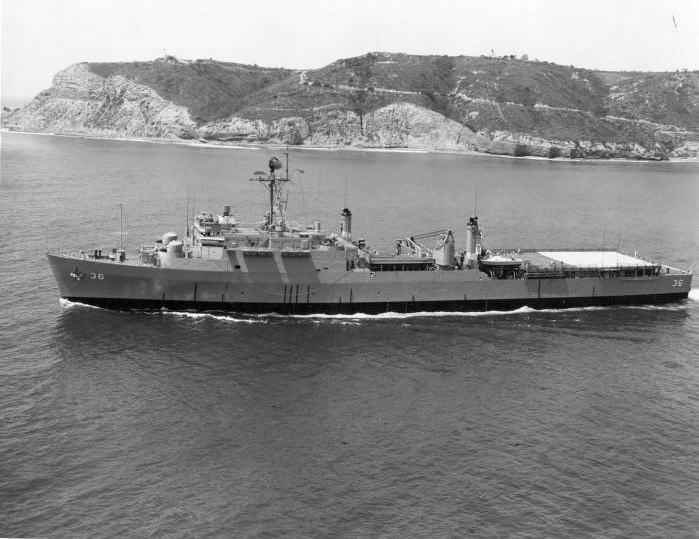
In the book, i also mentioned an enlisted deck hand on a tugboat that was providing USS Anchorage (LSD 36) support while getting underway in San Diego. Then, i overheard two women officers discussing administrative business while sunning in swimsuits at the pool outside the Admiral Kidd Bachelor Officer’s Quarters (BOQ).

If you read the posts on this website frequently, you should know many of my posts are sea stories about my career in the Navy. My ultimate goal is to create a collection for my grandson, Samuel James Jewell Gander — a bit of a grandfather brag: Sam will graduate from McNeill High School ion Austin this May and has been accepted to the prestigious Savannah College for Arts and Design.

i have told sea stories about my previous ships and have posted several about my tour as Chief Engineer (CHENG) on the USS Hollister (DD 788). In a note listing topics for my sea stories, i found a line that read “I. M. Devine.” i recognized she was the woman i left out.

Lieutenant Junior Grade I. M. Devine was an Engineering Duty Officer assigned to the Long Beach Supervisor of Shipbuilding that ran ship’s overhauls in the Los Angeles area. The Hollister had entered the Todd Shipyard in Long Beach for its six-month Regular Overhaul. LTJG Devine had been assigned as the SUPSHIP coordinator. CHENG, aka me, was designated as the ship overhaul coordinator. i laughed when i heard the name of the SUPSHIPS coordinator. i thought they said her name was “I Am Divine.”

We entered the overhaul in September 1974. i almost met my goal. When i relieved as CHENG, i had assessed the ship’s condition after returning from an arduous deployment to Vietnam and subsequent becoming a ship for reserve training. i decided i would consider my tour successful if we made it to the ROH without missing an at-sea assignment. We were scheduled to off load our ammunition and ASROCs at Seal Beach when one of our main generators went out. We finally had it repaired and made it to the offload but we had missed the one scheduled underway period for my time as CHENG.

But going to sea on the Hollister was over for me. She would be in overhaul after i was relieved to report to my next tour in late February 1975.

LTJG Devine was red headed with a nice smile. She was not what i would call pretty, but she was trying to do her job and we got along well…until the overhaul period began.

The two main engine spaces and two firerooms needed major repairs to pumps and especially auxiliary steam piping. The shipyard workers were performing poorly and often blocked ships force from doing their work. i was not happy as the overhaul coordinator of the chief engineer.

i noted my frustration with LTJG Devine and asked her to check it out. I expressed my concerns in the regular meetings of the ship (the captain and me), the shipyard (their coordinator and upper management, and SUPSHIPS. After several weeks of no improvement, i asked the captain to meet with the head of SUPSHIPS, a captain. CDR George Phelps and I went to the Supervisor’s office where he and LTJG Devine waited for us.

George Phelps was old school Navy in that he was the commanding officer, the captain. He ran the ship and stayed out of the engineer’s business. It was much like the merchant marine in there were two fiefdoms on the ship: the engineer and his department and the captain with the rest of the ship. But he backed me to the fullest on every occasion. This was one.

Before we could state our concerns, the supervisor head pointedly stated he believed that i was prejudiced against women and was making false accusations. CDR Phelps gave me the okay to respond with a friendly poke of his elbow in my side.

i explained how the work in our engineering spaces was not on schedule and the shipyard workers had poor work habits or didn’t work at all. Then, i asked LTJG Devine if she had even been in the engineering spaces as i had requested. A good supervisor would have gone through all of the work on the ship several times a week. A really good supervisor would go through those areas every day.

LTJG Devine hesitated and the captain urged her to answer. She finally admitted she had not gone down into the engineering spaces at all. She was replaced the next day.

i felt sorry for Ms Devine. i still do. She had been thrust into a very tough job. i’m guessing no one explained the requirements for being a good SUPSHIPS coordinator, perhaps because she was a woman. i hoped then and i hope now, she came out of the experience okay.

Today, looking back on that incident and my XO tour on Yosemite, i think my complete agreement with CAPT Frank Boyle, my CO, that we didn’t have women on the ship; that we didn’t have men on the ship; we had sailors, and all would be treated equally was positively influenced my by experience on the Hollister.

Elusive Butterfly

In Spanish, mariposa means butterfly.

No, my title is not about the Mariposa diner on Magsaysay Steet, the main drag in Olongapo when the town across the bridge from the U.S. Navy’s Subic Bay Naval Base was the closest thing to Fiddler’s Green that has ever been.

Some of us Navy folks might have experienced a wild night or several wild nights out in that crazy place. However, one of our favorite pastimes in Subic was to walk out of the Naval Base main gate, cross the bridge over “shit river” and watch in amazement as sailors tossed coins into the filthy waters and Filipino young boys dive off of the small skiffs or the bridge itself to retrieve the coins. From there, Mike Peck, Pete Toennies, Al Pavich, OW Wright, and i would walk down Magsaysay roughly a half mile and enter the Mariposa diner. The small open-air restaurant was below street level. The few rickety tables offered a great view of the street. Across Magsaysay was the Wagon Wheel, a bar with many women and where sailors flocked for fun and…

In the Mariposa, we each would order a half-pint of rum made up in the mountains to the north. i believe the rum maker was “Pine Castle.” We would add a coke and ice. The serving cost seven pesos. The ice was four of those pesos. The rum and coke was three pesos.

There, we would watch the show. The shore patrol’s paddy wagon would cruise up and down Magsaysay. They would frequently spot a hungover or drunk sailor, often with only part of his uniform still attached. The shore patrol would corner the sailor and proceed to the paddy wagon with the sailor attempting to get away. Often his attempt was abetted by a young woman who would emerge from the Wagon Wheel or another bar and start swinging wildly at the shore patrol until the SP’s managed to get the sailor in the back of the paddy wagon and lock the door.

It was a grand show to watch while sipping our rum and cola under the old, rusting service tray, which had been painted and hung on the wall. We all admired that tray and thought it was hilarious.

On one such occasion, we were talking when i revealed it was my birthday (January 19, 1970). Mike Peck went up to the proprietor behind the bar. When he came back, the group had kicked in a couple of dollars to buy the tray. It was my birthday present. i wanted to hang it in my home office but Maureen put her foot down. The sign now hangs in my briar patch, my garage work shop and escape from reality.

◆ ◆ ◆

But that “Mariposa,” aka butterfly, is not what i was thinking about.

i was thinking about Bob Lind’s 1965 song “Elusive Butterfly of Love.” Thank you, Dr. Bill Holland.

You see, i came under the spell of an amazing man, the aforementioned Dr. Holland when i began my real journey from my misspent scholarship courtesy of the Navy and two glorious years at Vanderbilt. i went from a very poor engineering student to a hard working three-job, commuting student at Middle Tennessee State University choosing to pursue a Bachelor of Arts in English, something very rare at that time. In fact, i think i was the first student to get a BA degree in English as nearly all English majors were pursuing a BS degree to become teachers.

So i wandered with great wonderment through every level of capability in professors, loving it, punching my tickets for non-English requirements, and wallowing in my deep adoration of literature. Primed with my experience of Dr. Scott Peck and his Shakespeare course, i fell under the spell of Bill Holland. We became friends and i would skip other classes to wander with him across campus and to his office where we would wander further off Romantic Literature and Wordsworth and Robert Penn Warren to investigate the then new idea of Atlantis being in the Aegean, not the Atlantic, and symbolism and hidden meanings of Bobbie Gentry’s “Ode to Billie Joe.”

Eventually, we got around to Bob Lind’s “Elusive Butterfly of Love.” Now, that’s the mariposa that caused me to start this post.

The lyrics:

You might wake up some mornin’
To the sound of something moving past your window in the wind
And if you’re quick enough to rise
You’ll catch a fleeting glimpse of someone’s fading shadow
Out on the new horizon
You may see the floating motion of a distant pair of wings
And if the sleep has left your ears
You might hear footsteps running through an open meadow

Don’t be concerned, it will not harm you
It’s only me pursuing somethin’ I’m not sure of
Across my dreams with nets of wonder
I chase the bright elusive butterfly of love

You might have heard my footsteps
Echo softly in the distance through the canyons of your mind
I might have even called your name
As I ran searching after something to believe in
You might have seen me runnin’
Through the long-abandoned ruins of the dreams you left behind
If you remember something there
That glided past you followed close by heavy breathin’

Don’t be concerned, it will not harm you
It’s only me pursuing somethin’ I’m not sure of
Across my dreams with nets of wonder
I chase the bright elusive butterfly of love

Across my dreams with nets of wonder
I chase the bright elusive butterfly of love.

i know we arrived at about a half-dozen hypotheses and never settled on one deeper meaning of that song. But our discussions covered a wide breadth of connections from biblical, history, literature, and even math. i learned so much from Dr. Bill Holland and forever will be grateful.

Then, reminiscing about my halcyon wanderings from seventy-nine years ago, i reexamined “Elusive Butterfly of Love.”

It seems to me i chased that damn elusive mariposa for about twenty-eight years. i have loved women since somewhere on the south side of puberty. i loved so many who will never know of that amore i had for them. Many will. It was easy for me to love, almost a curse. As Bobby Moore and the Rhythm Aces put it, i was “Searching, Searching, Baby, for my love.” But the love i sought was fleeting, elusive. It didn’t stick. i loved them then; i love them now. But they found all sorts of reasons to not love me. i suspect my going to sea might have had some impact in many of those cases.

But in my late thirties, i told that mariposa of love to take a hike. i was done, burnt out. i decided a single man was what i wanted to be for the rest of my life. i wanted to love women, but i wanted my (and their) independence.

So being the goofy guy, i met this woman. Come the end of July, we will have been married 42 years. She remains gorgeous while i have wandered to old bald man silliness. Yet, she loves me.

And that, my friends, is the best thing that has happened to me.

You see, that friggin’ elusive mariposa of amar ended up in my net.

The Grand Whiner

The last of us are a fading breed. Perhaps there are some groups of old men somewhere who are like us, but they, like us, i fear, are fading as well. i am pretty sure there are not that many men younger than us (and that’s not too young, mind you) who have our characteristics.

We think our bunch of guys are unique. We grew up in a world different from now. Our parents had seen the First World War, the depression, World War II. America with all of its faults, was still an incredibly wonderful place in which to grow up. We played outside. We bought bubblegum with baseball player cards to stick in our bicycle spokes so the bike would sound like a motor bike (not) when we pedaled. We walked to school by ourselves. We listened to radio with Fibber McGee and Molly, The Great Gildersleeve. Tex Ritter. Fred Allen, Gang Busters until television came along with oaters, The Mickey Mouse Show, Andy’s Gang with Midnight Cat demanding “Plunk Your Magic Twanger, Froggy.” We went fishing in creeks with rope stringers to carry our catch. We hunted squirrels and rabbits with .410 shotguns, graduating to .12 gauge shotguns. We played ball, all kinds, without supervision on vacant fields.

We went to school and chased girls for fun for several years before chasing them for dates and first kisses and wearing our letter sweaters, and hoping for something a bit more.

We reluctantly did our homework and many went to college. Then we went to “our war” as my good friend and OCS roommate, Doc Jarden, called it. It wasn’t our choice, but it was our responsibility, our duty as it had been for our fathers. Some of us actually found it a good life and stayed in. i actually got out and got back in from financial necessity even though there were many other options. i loved the sea.

And we grew up and went to our own war — well, it wasn’t really ours, and we didn’t really want to go, but we wished to be good citizens, we complied and went (while others resisted their responsibility to their country in various ways for various reasons).

And then we retired (or actually “completed our active duty service”) on pensions that would not completely sustain us; so, we went to work after “retirement.”

We played sports until we couldn’t because of age or injury. And we ended up playing golf, a lot of golf. It became a passion. We played every week and added to our group.

After each round, we would gather around pitchers of beer and tell stories and opine about the sad state of the world today. Our group became semi-famous at the North Island Naval Air Station’s golf course, “Sea ‘n Air.” We would sit and laugh and cuss — man, you don’t get a bunch of Navy and Army guys together without barrels of profanity — and we gave each other hell. It was a sport and we laughed.

We prided ourselves on being “assholes” and even found being called one had become a compliment. We realized we were a lot like Statler and Waldorf, the two curmudgeons on Sesame Street. We adopted the title for our group: Curmudgeons. We brought our wives into the gang and would meet every year for at least one or two dinners.

Several years ago, we began to harass one of our members, Pete Toennies, a retired Navy SEAL captain, about never hosting one of our dinners. So Pete accepted the challenge and invited us to his home on Coronado. During one of our conversations before the grand occasion, Pete and i produced the idea of making Marty Linville the honorary head of the bunch. A title was created and Pete came up with the idea of a fez for the group head — being true curmudgeons, i claim and Pete claims we were the original coiner of the title — but Pete took action, acquired a fez and had the title sewn onto the headgear. He rewarded Marty at the party with the fez.

It read “Ancient Order of the Curmudgeons” across the top and arching across the bottom was “Grand Whiner.”

Marty loved it and wore it proudly. He later bragged when he and his wife Linda went on a church trip to Turkey, he wore his fez

It was fitting. Marty stories are legendary. i’ve captured several of them here. He was one of the nicest guys in the world…in his own way. He was everyone’s best friend. And he could be as nasty as was required if the situation called for it, sometimes when it didn’t.

If you read my posts, you already know Marty passed away last July, fittingly the day after Independence Day. i miss him terribly. So does everyone else in our group of Curmudgeons. Before we begin our pitchers of beer every week after our round of golf, we raise a toast to Marty.

The group for the annual dinners has become four couples from the maximum of eight. At the last dinner, three of the four curmudgeons wondered if Linda still had the fez. Rod Stark, who was also from Kansas like Marty, and who had known him longer than all of us including me, said Linda had given the fez to him. We decided to elect the next Grand Whiner. To my surprise, the other three voted for me unanimously. i accepted but inside i was a bit upset. i thought the other three were more curmudgeonly than me. Then i realized being upset was something a true curmudgeon would do.

i consider the honorary position an honor. After all, that means i am at least a bit like Marty.

All four of us have problems associated with old age, Navy service, and some pretty wild living, not to mention diets that would make health experts blanch. In not so many years, we will be gone as happens to all old men.

i don’t think there will be any like us following in our footsteps. The world has changed. For example, i don’t think any of us ever had long hair. i know none of us had or have tattoos. We danced with our ladies, never in a Mosh Pit.

That is not to say the folks coming after us are bad, just different. i like the way we were better. i just don’t think folks coming after us will be like us.

And i guarantee there will never be anyone like Marty Linville, the original Grand Whiner of the Ancient Order of the Curmudgeons.

A Tale of the Sea and Me: Haircuts

In case you don’t know, Navy ships had barbershops when I went to sea. Some guys with the “storekeeper” (SK) rating manned the barber chairs with not much barber training and guidelines to make the haircut conform to regulations, regardless of the desire of the barberee.

Officers on ships could get appointments. The enlisted waited in line. The haircut normally took about five minutes. In no way did the one-chair barbershops, except for the chair, resemble THE Modern Barber Shop, Pop’s, Mr. Eddins, or Alberto’s barbershops, which i frequented when i had hair.

USS Hollister (DD-788) underway off Oahu, Hawaii, with her crew at quarters, 2 October 1969. Photographer: PH2 Stanley C. Wyckoff. Official U.S. Navy Photograph, from the collections of the Naval History and Heritage Command.

When I completed “destroyer school” in 1973, I reported to the USS Hollister (DD 788) and became the Chief Engineer. The Hollister was a reserve ship out of Long Beach. It was in the early 70’s and the men’s style of the day definitely did not include Navy regulation haircuts. Length was glory, apparently. The reserve units of the day were very relaxed in enforcing haircut regulations, because hair was so important to the younger set, it was assumed many reservists would simply quit rather than whack their hair.

It was also a common practice for the wardroom officers to leave early Saturday afternoon on the reserve weekend to frequent the officer club on base. This occurred one spring Saturday when I had the duty as command duty officer (CDO), the senior officer in charge while the captain and executive officer were ashore).

One of our regular officers was a brand new Naval Academy graduate. After the officers left for the club, I changed the watch bill and put the new ensign on the quarterdeck (the only egress and ingress for the ship), and directed him to make sure no one went ashore without a regulation haircut.

The ensign relieved the officer of the deck (OOD) at noon. Around 1400 (2:00 p.m.), I walked out to see how it was going. About 80 reservists were in the barbershop line, spilling out onto the onto the weather decks just forward of the after gun mount and around the fantail. Apparently, hair was not as important than liberty for most of those reservists.

After my check around 1400, the ensign called me in the wardroom. One hirsute second-class petty officer had requested to speak to the command duty officer. I agreed.

The young man was enraged. “I have an appointment with my hairstylist at 1600. If you let me go ashore, I will get a haircut.”

“Sure you can go see your hairstylist at 1600,” I said sympathetically, adding, “Right after, you get a regulation haircut.”

It took almost four hours and a tired barber, but they all finally went on liberty.

Nearly all of the officers who had gone to the club did not return for the evening. Next morning, quarters exhibited probably the most regulation haircuts seen in the reserve units of the period. It also produced more screaming and yelling than one would expect. The reserve officers were enraged we required their troops to get haircuts. Fortunately, my captain thought it was as funny as I did.

Oh yes, all who had suffered the barber’s shears that weekend remained in the reserves. Reserve pay was a good augmentation to one’s income, which suggests, hair isn’t quite as important as we often think it is.