Category Archives: Sea Stories

Fairly self explanatory, from what I can remember that is.

A Tale of the Sea and Me – A Wild and Crazy Year, the Beginning

It really was a little more than a year. My father and uncle picked me up in Norfolk in my uncle’s ’59 Pontiac Star Chief and took me home the first weekend in December 1969.

i had just over three weeks of bliss before heading to San Diego for my one-week course on Classified Materials.

Then i boarded a MAC flight that stopped in Fukuoka, Japan, before going on to Yokosuka, which was the western Pacific headquarters for the Military Sea Transport System (MSTS) — about half-way through my year’s tour, it was renamed Military Sealift Command (MSC). i arrived the Yokosuka BOQ around 2200 and crashed. The trip had taken about 20 hours.

i was also on the back end of an inoculation issue. Just before i transferred from the Hawkins, our chief corpsman reviewed my records and determined i needed no shots. Apparently, his sources were not the same as the West Coast medical folks. When i went to pick up my flight orders on Friday morning, i was informed i must have a bunch of inoculations. Since i was departing on Monday, i could not do them in sequence, but had to get them all that afternoon. i did.

i spent my week with my hometown friend Lee Dowdy in his apartment. Lee had served on the USS New Jersey (BB 62) and was on an amphibious squadron staff. After my shots, we went to Mickey Finn’s in El Cajon to watch the Dixieland Jazz Show. We had to leave after about a half hour as those shots, a bunch of them, took their toll.

After a cold night in the transit BOQ in Yokosuka, a small Breeko block building with a broken heater, i walked to the MSTS office. It was a cloudy, damp morning. The overweight civilian behind the desk informed me that my detailer had missed on several salient points, i.e.

  • “Every major port in the Pacific” was actually four: Sasebo, Japan; Pusan, Korea; Quy Nhon, Vietnam; and Nha Trang, Vietnam.
  • “The only Navy personnel aboard the troop ship” was actually 18. In addition to me as XO, there was a CO, a chaplain, two doctors, a chief boatswain mate, a chief storekeeper (SKC), a SK2 who was also the barber, a second class personnel man (PN2), and eight corpsman, including a master chief corpsman (HMCM).
  • “Families, civilian independents” were actually 1500 Republic of Korea troops being carried to the two Vietnamese ports and returned to Pusan.

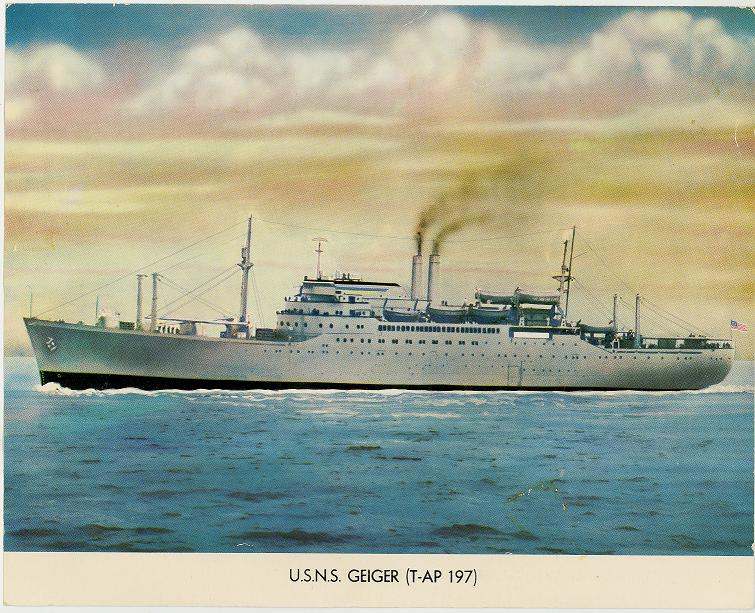
i left that afternoon and flew to Sasebo on a Navy C-2 cargo plane. i spent another night in a rather unimpressive BOQ, and reported to the USNS Geiger (T-AP 197). i immediately put a letter in the mail to my detailer, informing him of the slight difference between what he told me about my tour and what it really was.

The wild and crazy adventure was about to begin.

A Tale of the Sea and Me – A Space Trip

It was time for the last operation at sea for me on the Hawkins. It was November 1969. That spring, the Hawk had been selected to be the backup recovery ship for Apollo 12. She would be the ship in the Atlantic on the takeoff in case of an emergency and after the spacecraft had landed on the moon and men walked on the moon for the second time.

First, we had to go to Portsmouth Naval Shipyard just south of Norfolk. Our fantail had to be strengthened to support the crane designed to lift the Apollo spacecraft fromN the sea onto our main deck.

Then, we headed to Bermuda, one of the most wonderful places in the world, where we we would stand out on daily operations to practice picking up a dummy replica of the capsule. i was the “Apollo Recovery Officer of the Deck” and felt like i had attained the top of my seamanship skills maneuvering to pick the dummy capsule in open seas.

This was serious and treated as such, but we knew the primary landing spot was the Pacific and the aircraft carrier USS Hornet (CVS 12) was the primary recovery ship.

Finally, we went to our station in the Atlantic roughly halfway between coast and the Azores. We had franked envelopes that signified the ship and its crew was part of the team for Apollo 12. We listened on the radio waves from Houston. It was a happy moment even though we were a distant part of it.

Then, just after they took off, NASA reported the capsule had experienced two lightning strikes. As I recall, the rocket took two extra orbits around earth while the NASA team worked on the problem. We were told Hawkins would likely be the recovery ship if the problem could not be resolved. The astronauts switched to auxiliary power, which resolved the problem. But for several moments we went to full alert.

Pete Conrad, Alan Bean, and Richard Gordon were on their way to the moon. The Hawkins stood down from our alert status. We bored holes in the ocean, listened while Apollo 12 landed in the Pacific and headed back to Norfolk.

It was my last time at sea on the USS Hawkins. It had been a wonderful eighteen months. I’m sure i’ve omitted many of the sea story adventures and hopefully will remember them all and include them later.

i thought my next year would really distance me from the Navy, and i would pursue sports writing for a newspaper.

It didn’t quite work out that way.

But the Hawkins was one of my best experiences ever.

A Tale of the Sea and Me – Liberty

There was one more big operation that occurred before i left the USS Hawkins (DD 873) in December 1969. In between at-sea time, it was party time. Oh, we worked and worked hard, but if we didn’t have the duty, it was liberty, fun.

One of my favorite escapes was when Andrew Nemethy, the Damage Control Assistant (DCA) and Rob Dewitt, Main Propulsion Assistant (MPA), and moi, Anti-Submarine Warfare Officer (ASWO) did not have duty on the weekends. i hadn’t had a vehicle since the wreck in ’68 summer Newport with Rob as my passenger who took a bigger hit than i did, and after my divorce when my former wife took our car home with her. So i was always a passenger. However, i took turns driving when the trio headed to the side of Virginia.

Andrew had a Fiat Spider and Rob had a powerful BMW road bike (Rob or Andrew, you will have to provide the details on that beautiful beast). We swapped off from driving the bike, to driving the Spider, and riding shotgun. i was more shotgun than anything else. Our target was to visit the hills with the primary focus of taking in women’s colleges. Mostly, we would just spend time in the elements of real Virginia. Rob had his banjo, Andrew had his guitar, and both were accomplished. Me? i played a very poor jaw harp. But i did stay in rhythm. Oh, i don’t think we met any of the students at those women colleges. But damn, it was fun.

And then, there was Naval Station, Norfolk; Amphibious Base, Little Creek, Naval Air Station, Oceania, and the Army’s Fort Story. Each of these, some with a couple each week, would open the gates to folks of the human persuasion and invite them to a dance or event at their officers’ clubs. Now today, this is politically incorrect and i’m guessing most females back then weren’t real pleased with us calling these gatherings “hog calls.” An officer could, if his body could tolerate it, attend a hog call every night of the week in the Norfolk area. In fact, the “hog calls” was pretty straight up, not like the “Westerner” in National City, close to the Naval Station, San Diego where sailors went with hopes of meeting up with “West PAC widows,” wives of sailors who were deployed to the Western Pacific and looking for some side action. i have several friends who met their wives at these so called “hog calls,” and they weren’t hogs at all but pretty, intelligent women. Think of the Richard Gere movie “Officer and a Gentleman.”

My favorite was the Tuesday and Thursday nights at the O’Club at the Amphibious Base, Little Creek. When you entered, you were handed a song book. “Pappy,” a rotund, old, bald, and great piano boogie woogie player would sit down at his 88 keys and begin. Every one sang along with all of the old piano standards. The favorites and oft repeated service ‘s song, the Navy’s “Anchors Away,” the Army’s “When the Cassions Go Rolling Along,” the Marine’s “Marine Hymn.” The favorite for everyone in Pappy’s place was when he would bang out the Air Force’s song. Everyone would raise their steins and lustily sing, “Off We Go Into the Wild Blue Yonder…Crash!” and the song would end.

Time at sea was work, hard, long work. We didn’t feel guilty when we hit the beach, hard.
A Tale of the Sea and Me – A Storm

As we entered autumn of 1969, the end of my Naval career, i thought, was set even though it would be nothing like i thought it would be. There were two more operations for the Hawkins with me on board.

First, we headed to the North Atlantic operating areas to serve as a ship to be tracked on what i believe was a submarine towed sonar array. The second ship was an oiler taking the place of another destroyer which had experienced engineering problems.

En route, we hit a rogue storm. The after engine room had not set x-ray properly. It was standard practice to leave the starboard side hatch open as it was set forward behind the main deck bulkhead, designed to keep sea water from hitting the hatch. The fresh air contributed just a bit in providing fresh, cooling air into the tropical conditions of the engine room. It also, occasionally, would allow a watch stander to emerge and get some relief from the heat and the humidity in the space. As the ship rolled about on the evening watch, a wave of sea water caught the starboard side main deck, flowed aft and flipped into the bulkhead opening and down the hatch. It splashed down the hatch ladder and hit the secondary ship’s switchboard (the main switchboard was in the forward engine room, main control. A machinist mate on watch reported an electrical arc light a bolt of lightning jumped between the switchboard and the ladder, a distance of about four feet. The ship went dark immediately. Tin cans were built to survive and almost every piece of electrical gear had a steam backup. The Hawkins kept on steaming.

This happened 55 years ago, so forgive me if my recollection is a bit shaky. If anyone who was on the Hawk during that operation, please send me corrections.

Damage Control entered the problem quickly and efficiently (Thank you, Andrew Nemethy). Emergency electrical cables about six to eight inches in diameter ran down the main passageways and up and down ladders.

The seas were rough and it was cold. We weren’t sure if we could continue on for our rendezvous with the sub and the oiler. But our electricians and damage control got us back on close to normal operations.

It was a scary time. But what happened next was even scarier.

A Tale of the Sea and Me – Destiny and Detailers

The Hawkins had completed its submarine Polaris missile shoots and had returned to the new homeport of Norfolk. i was Anti-Submarine (ASW) Officer on the USS Hawkins (DD-873), a FRAM destroyer that had recently changed home port from Newport, Rhode Island to Norfolk, Virginia. i was running with two other officers in the Hawkins wardroom, Andrew Nemethy from Massachusetts and Rob Dewitt from Maine. i was coming up on the time to request to remain aboard for the second half of my three-year obligation to active duty or request to be assigned somewhere else. Andrew and Rob were commissioned later than me but they too would soon have to face the decision.

George “Doc” Jarden was the Administrative Officer aboard the USS Guam (LPH 9), a helicopter carrier in the amphibious force. He and i were roommates and classmates in Officer Candidate School (OCS) and had become good friends. Doc was also facing a similar decision about staying or rotating.

Andrew and i had discussed staying aboard the Hawkins, and after we got out, buying a sailboat, sailing it to Europe, selling it and using the money from the sale to kick around the continent until we ran out of money and came home to grow up.

i had become “the wardroom sea daddy” on the Hawkins and found myself in an awkward position. The XO was new. The Operations and Engineer department heads were new. My weapons department head wasn’t the brightest bulb in the light array. Captain Max Lasell began to rely on me, especially concerning the weapons department. i also think he liked me and saw my potential as a Navy officer. The captain and i would meet often in the wardroom to share thoughts on the ship’s operation and learn more about each other.

i decided i needed to split my tour and go somewhere else. But where?

There were other factors in this problem.

After building up the numbers of service members during Vietnam, the military forces were beginning to cut back the officer corps with early releases, reductions in rank and other strategies. This began to play in our decision about what to do next.

Doc and i often met after our workdays at the Red Mule in Norfolk, a hamburger and beer joint we liked. We discussed our decisions about rotation on most of those occasions. We were so similar our service numbers were only two numbers apart. Doc’s was 726236 and mine was 726238 — it is remarkable to me i can remember such things because the Navy went to social security numbers by the time i returned to active duty in 1972. We had the same detailer, the officer in the Bureau of Personnel who was responsible for determining our fate in staying aboard or rotating.

Doc, a Duke graduate, was a liberal in his thinking. i described him as the hippie’s gift to the Navy. Even then, i was pretty much apolitical and focused on being a twenty-year old man enjoying life. So, i was surprised as Doc and i were quaffing our beers after cheeseburgers and fries when he said, “I’m going to volunteer to go to Vietnam.” i was shocked. We both had agreed one of the primary reasons to get our commission at OCS was to avoid the draft (the draft lottery was not created until a year or so after we were commissioned) with the concern we would end up as ground pounders in the Army. Now, Doc was thinking about volunteering to go there.

“What, Doc? How could you come to such a decision?,” i almost shouted.

“Well, i’ve been thinking about it,” Doc explained, “Our parents had World War II, and whether we like it or not, this is our war.

“I want to be a part of our war,” he finished.

Now, it may have been the couple of beers i had downed, but i mused and agreed.

We began calls to our detailer. It was tough to get through by phone but we did it, often calling at 0500 when they opened up their lines to accommodate officers on the west coast. The detailer — i have not included his name as i have tortured him enough — informed us a release of officers would be coming soon. He told me i would be cut early. He told Doc he didn’t think he would be cut. Doc and i met again at the Red Mule and scratched our heads. Over a beer or two, of course.

The cut came. The powers that be cut those officers in essentially “non-critical” billets. I was ASW officer on destroyer, including being the sea detail, general quarters Officer of the Deck. Doc was Administrative Officer on a helicopter and like me the sea detail and general quarters OOD, i.e., essential.

We were not cut and resumed our calls to our detailer. He told us they didn’t get down to the numbers they needed, and another cut was coming. He told me i would be cut. He told Doc he would not be cut.

The criteria for the next cut was fitness reports. Fitness reports were the assessments of officers by their commanding officers in the performance of their duties. Doc and i had been rated high in our fitness reports (fitreps: officers performance report submitted by his senior every six months) and were not cut.

But wait, the detailer told us. They still had to make another cut. i was sure to be cut, he told me. Doc was told he would not be cut. Perhaps, i guess, it was because i was on a destroyer and Doc was on an Amphib. i do not know.

The next cut was done by commissioning date. The date chosen was one month after we were commissioned. Both of us remained on active duty.

i decided to act on Doc’s idea about Vietnam. i volunteered to be a forward Naval Gunfire Liaison Officer (NGLO or GLO). This is a job that requires the officer, aka me, to go out ahead of the front lines, usually with a radio talker and call in fire on the enemy. Really bright people who want to live past the next year stay away from these kinds of assignments. Not me.

The detailer readily, almost gleefully agreed to my proposal. After all, there were very few officers applying for GLO and most that were assigned balked at the idea as much as possible. Not me.

We began planning the rotation when he told me i would be required to extend my active duty for a month. Astounded, i asked why. He explained that any assignment to Vietnam required a complete year for the assignment. To perform the duties of GLO, i would have to go to a gunfire support school and to Survival, Evasion, Resistance, Escape (SERE) training, a two-week course requiring the trainee to be captured and experience being a Prisoner of WAR (training), including some forms of torture, like waterboarding.

Some sense kicked in: “You want me to extend a month to go over there and probably get my ass shot off? Forget it? What else you got?”

Now mind you, this phase of detailing negotiations took about three, maybe four months of negotiation.

On the next phone call, the detailer told me had an assignment that might appeal to me. i asked him what it was. He told me i would be the executive officer of the Military Sealift Transportation System (MSTS) Transport Unit One (The name of the command was changed later the next year to Military Sealift Command or MSC. i asked him what the job entailed. He said he didn’t know but he would check with the others in the office. i waited on the phone for almost three-quarters of an hour. Fortunately, BUPERS did not have muzak for waiting.

When the detailer came back he explained that no one really knew exactly what it was, but one detailer recalled from the past what he thought was.

“And what did he say?” i implored.

“We think you will be the only Navy Officer on a USNS ship manned by government civilians,” he explained, “The ship is a transport that carries U.S. troops and dependents to and from various ports in the Pacific,” finishing with, “We believe you should hit every major port in the Pacific in your year’s tour.

He paused after my earlier rejection of GLO because of the extension of active duty,  “You will have to extend a month to attend the Register Publication System school for communications in your new assignment.

“Hmm,” i mused, “Extend a month to see all the major ports in the Pacific and being the only Naval personnel on the ship.”

“I’m all in,” i explained.

This occurred sometime in October. Shortly afterward, i received my orders in a radio message to detach from USS Hawkins (DD 873)  in December 1969  and report to RPS school in San Diego and proceed to to Yokosuka, Japan to report to MSTS Headquarters for further assignment to Executive Officer, MSTS Transport Unit ONE. To be honest, i was pretty pumped. i began my preparations in earnest.

As usual, there are several more stories in this too long for inclusion here.

The wearisome and very long flight to Yokosuka put me in late in the evening in mid-January. The next morning, i walked in the rain to the MSTS office building. It was a dreary, dark day. The office was dark and bare. The overweight civilian with a dark tie, white shirt, and dark suit, rose from his chair and shook my hand across the large metal desk and motioned me to sit in the chair in front of him.

He told me i would be leaving that afternoon to fly to Sasebo, Japan. i was not impressed with Yokosuka and wondered if Sasebo would be different. Then, the man behind the desk dropped the bomb on my ideal tour: “Well, it’s not quite what you were told.

“You will be the executive officer of an 18-man unit. There is a CO, a lieutenant commander, you, two doctors, and a chaplain. There is a boatswainmate, storekeeper and corpsman chiefs, 6 corpsman, 3 storekeeper enlisted,  and a seaman.

“There are three troop transports for carrying 1500 Republic of Korea troops to and from Vietnam out of Pusan, Korea. Sasebo is the port for six days of upkeep and resupply. Your unit is aboard the USNS Geiger (T-AP 197), the other ship in the current rotation is USNS Barrett (T-AP 196). The third ship currently in overhaul is the USNS Upshur (T-AP 198). Greatly disappointed, i caught a Navy flight to Sasebo the next day.

i reported to LCDR Hank Fendt on the Geiger and found out we would be dropping off new and picking up ROK’s that had been Vietnam for a year in Quinhon and Na Trang. i sent an letter to that detailer: “Dear sir, all the major ports in the Pacific are Sasebo, Japan; Pusan, Korea; and Qui Nhon and Nha Trang, Vietnam. The “US troops and military dependents are ROK troops and officers. Thanks.”

Yep, i was disappointed. But it turned out pretty well. It was a good recalibration for me, and gave me a lot of time to think. It also was a wild, wild time. That is yet another story.

What i didn’t know was what happened to my friends. In the last several years through the new things people love to hate like Facebook i have reconnected to my old shipmates, Andrew Nemethy and Rob DeWitt, and my OCS roommate Doc Jarden.

i thought all three had gotten on the next reduction in force. Now i know the rest of the story.

Rob was not cut, rotated to a command ship, the USS Wright (CC 2), homeported in Norfolk. After a working on motorcycles and getting several post graduate degrees, he ended up in home state of Maine as an orthodontist.

And then there was Andrew. i was sure he made the cuts. He didn’t. i found this out when i inquired after he made a comment about being in Vietnam. When Andrew learned of my new assignment and found out he would not leave the service early, he decided he would follow suit and requested a tour in MSTS. He got it. He was assigned to the MSTS office in Saigon. He describes how he got there:

You were the inspiration for that, traveling all around the Orient on a freighter having a jolly old time in ports, seeing the world, and writing poetry, which as you may recall, We sent back-and-forth to each other. That I ended up in Vietnam is all due to you!

What could go wrong? The glitch was that I had no idea…MSTS had posts in Vietnam. Oops.  That is why Lasell was chuckling at my orders when they came in. Traded a cushy boring job on the destroyer for the excitement of being in the middle of a war. You were the inspiration for that, traveling all around the Orient on a freighter having a jolly old time in ports, seeing the world, and writing poetry, which as you may recall, We sent back-and-forth to each other. That I ended up in Vietnam is all due to you!

The Lasell Andrew mentions was the commanding officer of the Hawkins. He was on of the best i had in the Navy. Ironically, his last tour was the commander of the MSC office out of San Francisco. Sadly, he passed away after i had finally located him in the Southwest corner before i could go see him. i owe him a lot.

Doc’s story was similar to Andrew’s. Again, i thought he had got out early. Again, when i reconnected with him, he straightened me out in the following email excerpt :

JJ…

Hey sailor…belated Happy Vet’s Day.  Note the switch to personal email–my day-to-day involvement with our local NPR station is just now coming to an end.

So, my tour after the Guam.  In early July, 1968 got a nice note from Bupers to proceed unodir within 60 days to DaNang to take over as officer in charge of a river squadron.  Okay, then…not exactly the kind of news one hopes for, but we had all volunteered and that was the way it was.  Lots of anxiety, but basically resignation.

Meanwhile, the CO of the Guam was a tough son-of-a-bitch, and like all COs of carriers–fixed wing or helo–was an aviator.  He was uncomfortable on the bridge, but at the same time had little time or respect for young OCS officers.  He only reluctantly qualified anyone as an underway officer of the deck.  I was one of the few.

You know, I have no idea there was a person, a detailer, making decisions about my next duty. I did request to join MSTS, because I was sick of Norfolk, new we weren’t going anywhere, and wanted something a little different in my last year than the same old same old. You were the inspiration for that, traveling all around the Orient on a freighter having a jolly old time in ports, seeing the world, and writing poetry, which as you may recall, We sent back-and-forth to each other. That I ended up in Vietnam is all due to you!

The glitch was that I had no idea, stupidly, that MStS had posts in Vietnam. Oops.  That is why Lasell was chuckling at my orders when they came in. Traded a cushy boring job on the destroyer for the excitement of being in the middle of a war. What could go wrong?

Fortunately, nothing, and I would not trade the experience, nor taking an in country discharge making money and then traveling back around the world, for anything. Just about killed my poor parents though, especially since I was an only child. Taking four weeks, or maybe it was three, of survival training down at Quantico,, with Marines, was an interesting experience and also launched my interest in fitness and being in shape, which I turned out I was pretty good at. Carried that athletic interest for the rest of my life. It was a cold slosh of reality too, since they threw us in a simu,aged VC prison camp and among the things they did was throw us in a muddy pond, during the winter, so it was really cold, and then “tortured” us and used psy ops tricks on us.

I will never forget that the guy who probed the hero in our platoon and outsmarted our captors to unite our crew was the least likely looking hero of the bunch, a gangly professorial JG. Meanwhile a commander who was going to Vietnam, an older guy and seemingly all no younger,  totally fell apart before our eyes, and was not shipped out as a result, at least that’s what I heard. So you never know who’s going to be the brave one or how people will react. Lesson learned.

My theory was that if the Viet Congress wanted to get me, I would try to at least be able to run like a bastard and at least be as fit as they were. Plus I had good boots and no flip-flops.

Now the rest of this story also is dripping in irony. The funny thing is three of us ended up in journalism of sorts. Doc became a television producer. Andrew was a journalist in Vermont, and i have been all over the charts in my writing efforts.The real rest of the story is there are three guys with whom i had great relationships and shared good and hard times and we have reconnected. We have our lives to live and they are in Maine, Vermont, North Carolina, and the Southwest corner. i might get to visit with them in the coming days, but time, which does not change, is getting shorter. It doesn’t matter. i have reconnected with three pretty special people.

And as you can see, Andrew and Doc can tell stories as well or better than me.