Category Archives: A Pocket of Resistance

A potpourri of posts on a variety of topics, in other words, what’s currently on my mind.

Veteran’s Day

In 1970, i had a cup of coffee seventeen times in Qui Nhon, Nha Trang, or Cam Rahn Bay, Vietnam; was caught in the crossfire of .50 cal rifles between mistakened U.S. forces once, friendly fire i think it’s called; thought i was shot at five other times; and at night from my ship’s weather decks, watched tracers from firefights several miles away.

About 0200 in Qui Nhon, a cargo ship moored aft of the USNS Geiger (T-AP 197) on the DeLong pier had a zapper charge blow through her cargo hold. i watched from my stateroom porthole as she took on a list, held upright by her mooring lines with the huge tire fenders between her and the pier being blown up in the air and bouncing down the pier while the crew from several Asian countries running down the pier avoiding the bouncing tires and some climbing our accommodation ladder to inquire about joining our Merchant Marine crew.

At anchor in  Nha Trang Bay after Army intelligence informed us we were a target for zappers in the area, i spent the night with Doc Miles Humphrey, standing by the safety lines on the 03 level, with my .45 cal pistol, the only one of five guns i knew were on the ship, feeling pretty hopeless, watching for any signs of underwater swimmers. The zappers must have been scared away.

In 1984-85 with USS Yosemite anchored off of Masirah, Oman, we were informed by Navy intelligence Iranian gunboats might attack us. We had ad hoc .50 cal rifle teams posted around the perimeter of the main deck and 02 levels for a week or so. Checking out these teams with almost no weapons training, the helpless feeling i had in Nha Trang Bay returned.

In my 15 years at sea, i experienced about ten near collisions and a half dozen or so storms strong enough to frighten the most experienced mariners. i don’t remember ever being scared in the Navy. I felt helpless those two times, i was concerned, especially when other ships were putting my ship and the crew in danger by not following the rules of the road. i have been frightened a number of times in my non-Navy life.

But then, the dangers i brushed near were nothing. Nothing. i have friends, close friends who died. i have friends who were horribly injured and brutally tortured — none of them talk about it, or regret it. Death, pain, long term disability are part of the agreement. They are proud of their service.

i’m proud of my service too, but my service was not so much service as a means to financial security and more so going to sea on ships. Still i am proud of my service.

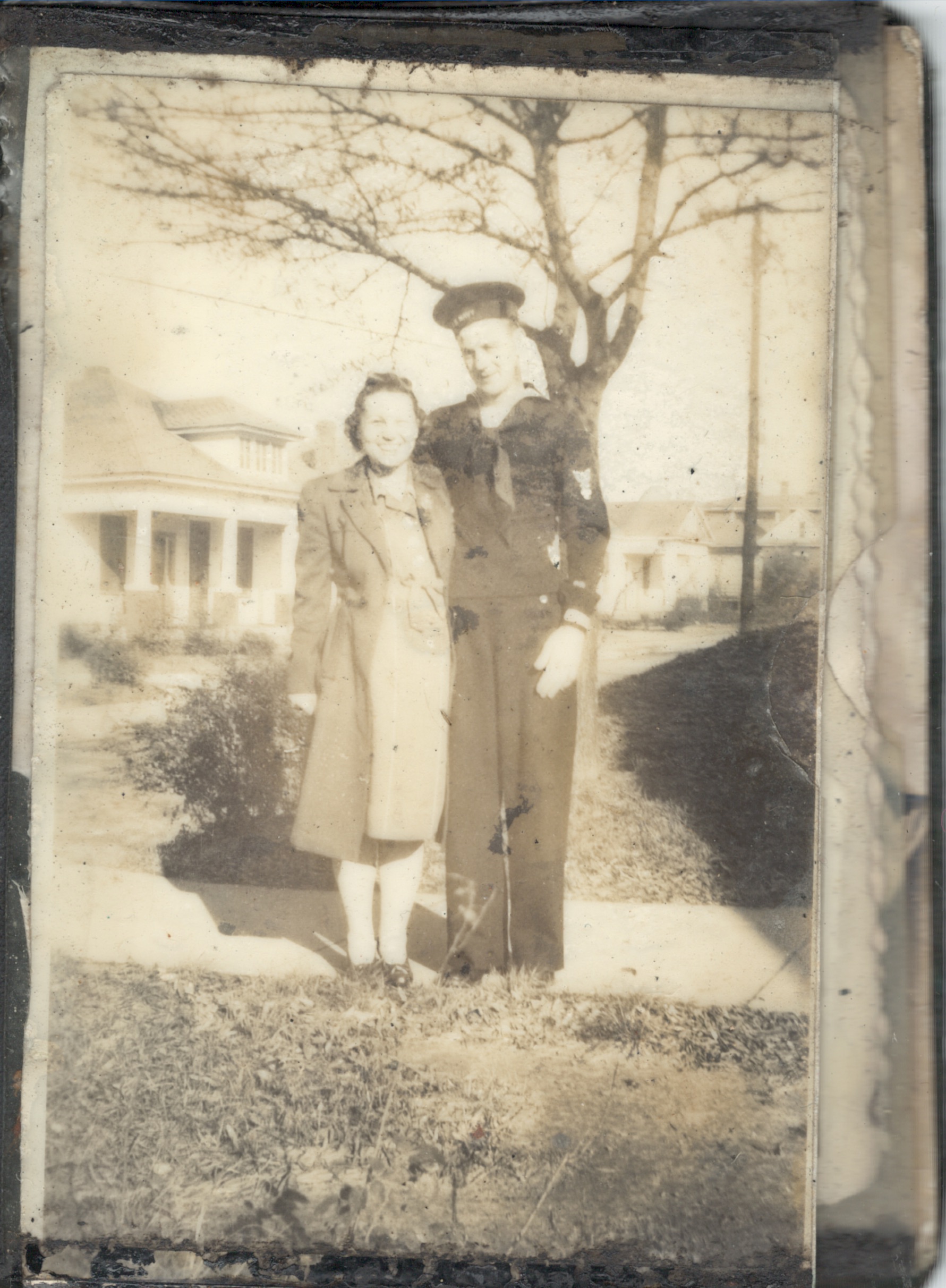
Jimmy and Estelle Jewell, autumn, 1943.

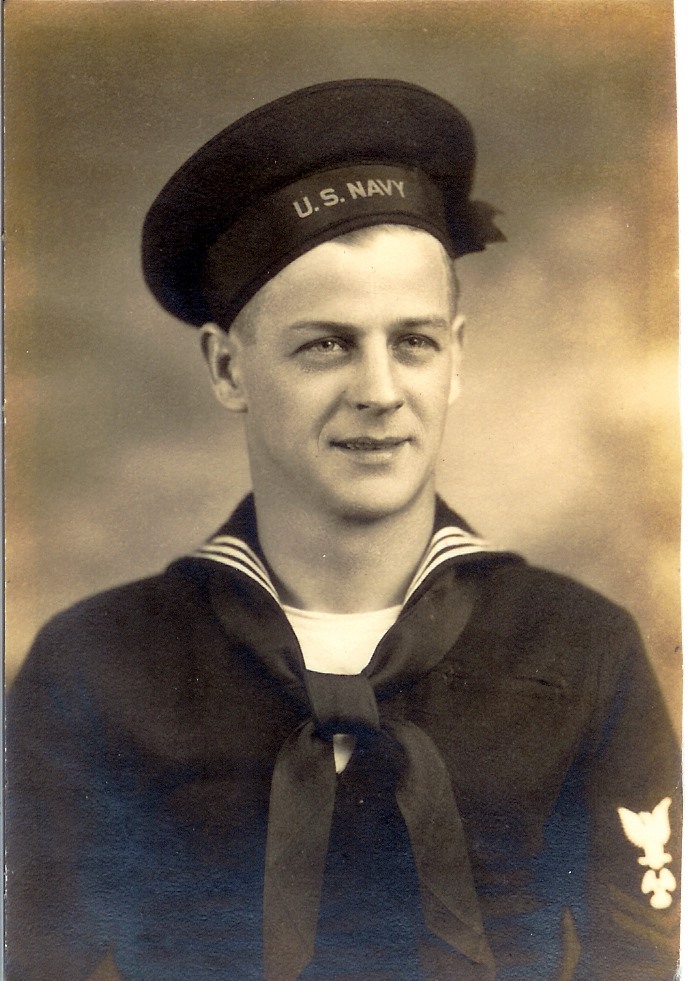
i think of my father’s service and the service of his generation. It is mind boggling to me: he and all of the other men in that generation who dropped the only lives they had ever known to fight a war in places they had never dreamed of much less been to.  Jimmy Jewell was a youthful automobile mechanic in small country town with his first child on the way. He decided to enlist before being called by the draft. He felt it was his best choice and would allow him to serve using his expertise, fixing things, like automobiles. With a pregnant wife and a sense of duty conflicting in his decision making,  he made his decision based on the inevitable service he knew would come to pass. He took with him a pocket-size faux leather album he kept in his pocket the entire time he was gone containing precious photos like the one here of his wife and him.

i try to imagine how he felt as he went to Parris Island, South Carolina for boot camp, and Davisville, Rhode Island for Seabee training, and Gulfport, Mississippi to wait for his ship, places in the states he had never been. Then, what was on his mind when, with 1 five-month old son and his wife on his mind, boarding that liberty ship, traversing the Panama Canal, picking up more 75th Battalion Seabees in San Francisco, crossing the Pacific, and spending almost two years, in the middle of a war like no wars in its expanse.

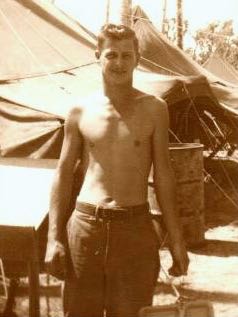
I try to imagine him watching kamikaze planes from his motor pool crashing before they reached him. i have been to several of the places in the South Pacific where he had been thirty or forty years earlier. i understand why many of his photos show him shirtless in the intense heat and humidity on those jungle islands.

The stories he told me about those times in the war at Espiritu Santo, Vanuatu, New Caledonia; Bougainville, New Guinea; an LST ride to Luzon, Philippines. He showed me photos as he told me the stories and gave me a box with those photos to keep. i fervently wish we had taken time for him to tell me more stories and also wish i had recorded those stories in order to get them right in the retelling.

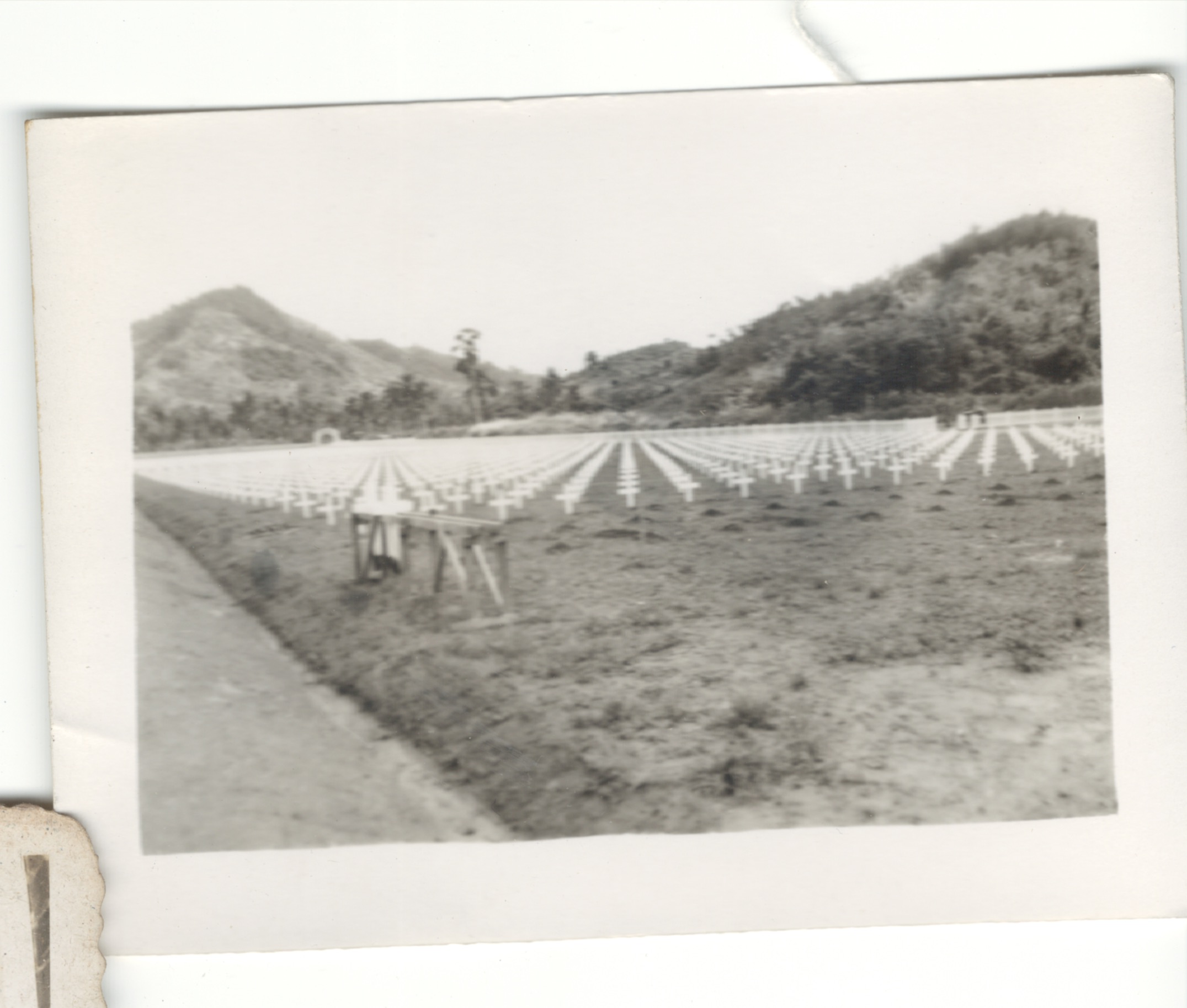
But there was one photo that tells it all for me. Today, Veteran’s Day, is not just to honor those who died in service. The ensign (U.S. flag to you non-Navy folks) is flown two-blocked, not at half mast for it is a day to be proud of our service, not sad. Still there are those who didn’t come back from their service. They remain in places their sons and daughters won’t ever visit. One of those who didn’t come back could have been my father. Heck, now that i think about it, i might not have come back from some of my service: just haven’t thought of it in that way before.

i am proud of all of my fellow veterans for their service. But there is a quiet awe i feel when i look at the photo my father gave to me:

U.S. Military Cemetery, World War II, Luzon.

A Microwave Story

Amy Beth Hale posted on Facebook this morning about getting a new microwave oven. She had put off doing so for about a year and a half after the old one went out, and did so mostly because the light over the stove died with the old microwave.

It brought back a memory of a microwave that wasn’t so benign in its passing. It is a second hand story, so i will attempt to keep it anonymous for i cannot vouch for the veracity. But it’s a good story.

Out west in a hilly region of the countryside, there is a wonderful golf course: tough, up and down among many pines with narrow fairways and small greens, and a small lake. Homes are built around the beautiful private course and many of the residents are club members.

Several of these members played a couple of rounds each week with each other with small wagers. One such wager was at the fourteenth tee at the back of the lake. The group had a standing bet they would all pay a hundred bucks if someone could hit a ball off the tee about sixty degrees right of the fairway line and reach the other side of the lake, about 290 yards away. Each time, they reached the fourteenth tee, they would take turns before their tee shots for the match to try and hit the other side of the lake.

One member whose home was behind the fourteenth tee was often close but still short of his goal. He knew the harder the golf ball, the further it would go. So he devised his plan of winning the standing bet. As they walked from the thirteenth green to the next tee box, he said he had to run inside his house and get something out of the kitchen. When he got inside, he placed his golf ball in his kitchen microwave and turned it on high, figuring microwaving it for a minute or so would make the ball hard enough to go longer and get his shot to other side of the lake.

He turned on the microwave.

The other golfers heard the blast.

The microwave exploded and ruined a good portion of the kitchen.

The golfer/house owner never found the golf ball. His future tee shots never reached the other side of the lake.

i’m not sure why, but i laugh every time i think of that story.

Thanks, Amy Beth.

Déja Vu, Only More So

Last Thursday evening, i attended an event, which produced déja vu for me but in spades. i began this post later that Thursday evening and have been trying to get my head wrapped around it since then.

The event was not as well attended as it should have been. But on the other hand, the few who attended experienced an impactful evening made more so because of the intimacy of just a few.

Sixteen folks were there.

Andrew Maraniss was the speaker. He told of a difficult time in our history and how one man faced it and not only endured but succeeded with very little support. In doing so, this man opened the door to a new and better culture.

The book is Strong Inside: Perry Wallace and the Collision of Race and Sports in the South.  i read the book shortly after it was published in 2014. It told of how Wallace became the first black athlete to play in the Southeastern Conference in 1967. He played for Vanderbilt. The story is almost overwhelming from many angles. Wallace endured severe racial prejudice, threats, and even violence. Those with best intentions did not provide him the support he needed and he had to grit his teeth and make it on his own.

Make it he did. And finally Vanderbilt made amends for the lack of support and Perry took his rightful place in the history books for being a pioneer who led the change for sports in the South and his rightful place of honor at Vanderbilt. Andrew’s two books, Strong Inside (the adult edition mentioned above) and Strong Inside: The True Story of How Perry Wallace Broke College Basketball’s Color Line (young readers edition),  provide a vivid portrayal much better than anything i could offer here.

But the Vanderbilt Alumni meeting was an experience.

i was there…i mean i was at the meeting and i was in Nashville when the Perry Wallace story  unfolded.

The meeting was unique. Although small in number, the attendees included two young boys, recent graduates, and graduates who attended during Perry’s time there. There were guests, my wife, daughter, and two neighbors included.

The reaction to Andrew describing the events in the book brought a palpable, emotional response. Andrew’s style is informal, casual and fit this event perfectly. Those who had not heard the story believed but it was hard for them to imagine it actually happened. Those who had heard the story and read the book, especially me, were taken back again.

The question and answer period was just about perfect. All of the questions and comments were pertinent and on point. Andrew’s discussion for each question left everyone feeling their questions were answered and their time well spent.

And i was taken back again. i was gone by the time Perry had matriculated. But i was around. i saw him play for Pearl High School, the first time a black school had played a primarily white school (Father Ryan, the winning opponent had several black students and athletes). i saw him standing just out of the foul circle, take one step, catch a teammate’s foul shot, which had hit the back of the rim and bounce up and back to the court, Perry catching it with his right hand at the top of the arc and slamming it back through the net. i heard of his feat at Vanderbilt practice picking quarters off the top of the backboard.

Although i was no longer a student at Vanderbilt, working my way through Middle Tennessee State, i spent a great deal of time in Nashville and was thrilled Wallace and Vanderbilt had broken the color barrier and were succeeding. i had no idea, none whatsoever what Perry was going through.

Perhaps i was just too naive. Looking back on my life my naiveté has been one of my problems throughout my life, even now. i have written here about wondering why folks with darker skin color were at a lower social level, wondered why i didn’t even seen youn black youth, much less play with them. i loved the blues and recognized blues was the propriety of black folks. i listened into the deep of night most nights during high school. As the youth representative for a church committee, i even made a stand for integration.

In college through the good graces of Kent Russ, i met Ralph Boston and remain impressed until this day. i also saw Bob Hayes tie the 100-yard world record. And Cy Fraser and i were frequent visitors to the New Club Baron, a black night club featuring blues and rhythm and blues where we would be two white young men in the middle of a packed house of folks with darker skin, and we would stay into the wee hours.

i just didn’t get it. The protests and the sit-ins had reached a peak. i should have known. i tell myself i should have done more than one measly pronouncement at a church meeting. But i was working two jobs, commuting daily to MTSU, playing softball in a church league, and finding ways to get to my fraternity on the Vandy campus as often as possible. i was interested in getting my degree, going out with women, having fun, and moving on, on and out. That was it. Even with all of the news and the hubbub around the protests, i just didn’t know (as the late Bob Warren, a Commodore teammate of Perry’s said to him years later: “I just didn’t know”).

These kind of thoughts frequently play in my mind. In quiet moments, i try to remember how i missed it, how i didn’t know. i am glad Perry Wallace, “the Jackie Robinson of SEC sports,” did what he did. We needed someone to step forward. i’m proud of Vanderbilt for at least initiating the possibility and even though it was bumbling, giving Perry the avenue to make it happen.

Last Thursday, i went through all of those thoughts one more time: déja vu. As usual, i had no more answers. But i was moved by Andrew Maraniss and was gratified at the response of his audience.

A final note: We have progressed. Athletics is one avenue that opened doors for blacks (i’m using this term for folks of darker skin color than me because someone much more up to date than i told me that was the current preferred politically correct term: i hope i am not offending anyone). Our schools are, at least on paper, integrated. We have made strides through the efforts of many brave people willing to step forward for the first step. i believe both of my daughters and my grandson are color blind. Yet when i look around, i see progress but a long, long way to go before we are truly integrated.

As to how we do that, i feel much like i felt when i watched Vietnamese families escaping a terror, willing to risk the very lives of the families they loved so much by jumping on boats with no idea those boats would even float and heading to the sea with only vague promises and hopes, leaving their homes, their country by the thousands, coming over that horizon south of Vung Tau every day for more than a week. i said to myself then and i say to myself now, “i don’t know what we can do, i don’t know how we got to this point, but we should have done more to prevent this from happening.”

The question now is not what we could have done for Perry then, but what can we do for Perry now?

A Comment on “A Goodbye Long Ago”

One of the most special people in my life who remains one of my dearest friends sent me a comment on my post including my retirement speech. She and her husband are at the beach in autumn — i loved the beach or the coast in the autumn winds and frothing seas. i responded to her comment, and when finished decided what i had written to her captured my feelings about my time at sea. Here it is:

i wish i could spend an evening with you two discussing why i chose the sea, or rather how the sea chose me. There are not a hell of lot of things i believe in. The sea can do that to a fellow. But i believe in the sea. She told me to believe in her.

i wish i could go to sea again, not the graceful sea of the sails and gallantry or even the commercial success of bigger and bigger ships carrying bigger and bigger cargo. No, i wish i could go to the sea again in the clanking, wheezing steam and metal digging into her waves with men on the bridge and down in the holes to take my orders for all ahead full and fifteen degrees right rudder and steady on one four five degrees and ring up turns for twenty-two knots and walk to my port wing in the deep dark of the mid-watch with my cup of steaming black coffee in my hand and my cigarette dangling from my lips (yes, back then i didn’t know or didn’t believe it was a curse and i enjoyed them in the dark of the mid-watch with my coffee) and on the port wing looking abeam to check to see if i could determine the horizon in the black lit by millions of stars and a crescent moon, knowing there were no contacts because Combat Information Center had divulged through sound-powered phones their radar repeaters sweeping green across the black screens had shown no blips within their range, and sipping my coffee, drawing on my smoke, and looking, not up at the impressive array of light in the heavens but down, down deep into the dark, dark blue of the sea flecked with white foam of bow waves, and she would talk to me, tell me i was her own, and ask me if i knew her secrets below and of the storms and the doldrums. And in the cold of the wind abetted by twenty-two knots with the collar on my foul weather jacket up, i never knew but could feel her secrets and fall in love all over again with a warmth in my gut from her knowledge that was almost mine.

Enjoy the beach and feel the sea.

A Goodbye Long Ago

In my quest to get all the facts right in my book about my tour aboard the USS Yosemite, i hit a wall. Tough to write when events of just under forty years ago become hazy. So i have been going through piles of stuff i saved back then primarily as a source  for writing later. Like now later. Much of that pile had little to do with my Yosemite tour. But i was hoping to find some nuggets i had squirreled away in the wrong place,  a rather annoying habit of mine. While rummaging, i found this speech i gave at a pretty significant date in my life.

i decided i would save it and post on November 30.

You see, that was the significant date. In 1989. It was the day i completed my active duty  Navy service, the second most important event that day. The most important event occurred about seven hours later, although that primary event had begun in the late evening the night before. That was when Maureen broke water, and i took her to the hospital to give birth to Sarah, our second daughter.

i had predicted the date in late February when Maureen announced she was pregnant and the due date was early November. i said, “Nope. November 30.” 

“Why?” she queried.

“Because that is the date of my retirement date, and will put me in a quandary,” i declared (or something like that).

i was prophetic.

i stayed with Maureen in the labor room (and man, was it well named) throughout the night, getting little sleep while attending to a beautiful woman enduring more pain than i could imagine. My quandary was beginning to grow. My retirement ceremony was scheduled  for 2:00 that afternoon. i was hoping Maureen would deliver in the morning, so i could get to the ceremony, but it didn’t look good as the sun came up and morning kept moving toward noon.

There were a bunch of friends and relatives in town to attend the retirement ceremony, including my parents who were staying with us, along with Blythe. But for once in my life, i made the right decision. If birth did not occur before the ceremony, i would stay with Maureen. i called Rod Stark, the XO of the Amphibious School, and asked him to read my speech for my retirement in abstentia. Rod agreed.

Then just before noon, the doc came in. Maureen had been given an epidural and a nurse had turned Sarah in the womb, so Maureen was finally comfortable, or as much as she could be. i asked the doc, considering Maureen’s condition when she would give birth. The doc hesitated. Then i asked if he thought i could make the ceremony and get back before birth time. He said i could.

i called my parents and asked them to bring my uniform to the school. i left the labor room in time to get to the command, change, and be there for the ceremony. Blythe graciously agreed to stand in for her other mother. Patsy, Maureen’s sister, was wonderful. She had come to the hospital earlier that morning and told me to go to the ceremony and she would sit with Maureen.

i went, made it through, went to the post party at the Sandpiper O’Club, shook hands and rushed back to the hospital. About 9:00 p.m., i donned the hospital rig over my dress blues sans blouse, and we went to the delivery room. A half hour later, Sarah came into this world.

It was a hell of a day.

Back to the ceremony, Captain Blackmon, Rod, and i explained the situation to the attendees, numbering about 150. The usual fun and nice presentations were made until it became time for my speech. i prefaced it with explaining i was reading it as written and there were parts a bit silly because Maureen wasn’t there.

As i mentioned, i was planning to post this on November 30, but to be honest, i can’t wait. i think the speech describes my life at sea and why i chose to be on that sea for about 14 years of my 22 in the Navy. i have regained contact with a number of my shipmates on my ships through Facebook and email, and i want them to have access to my view of the Navy and life at sea.

My Speech on my retirement (completion of active duty ), November 30, 1989:

Before I really get started in this, I want to thank CAPT Blackmon, CDR Rod Stark, LCDR Terry Frevert, and the school for doing their usual superb job of wishing us old retiring folk farewell. Thank you very much.

I also salute the finest group of professionals with whom I’ve ever had the pleasure of working: the LMET Department, which includes our leadership trainers and our equal opportunity trainers. They are very important contributors to the way we do business in the Navy today. It was a pleasure to work with all of you for the last several years.

I want to thank Dave Carey, Larry Phillips, Raul Vazquez, and the current Command Excellence Seminar team, Dudley Morris and Larry Wood for putting up with me and my ego as a partner for what probably seemed to them as a very long time.

I have witnessed a number of these retirement ceremonies over the past several years with increasing interest, taking mental notes on “what to leave in and what to leave out” as Bob Seger so well put it in his song “Against the Wind.” I decided I could not trust myself to rely on my usual extemporaneous comments, or even use my rather infamous 5×8 cards. So I wrote this speech. Please forgive me.

I hope this is short enough to hold your interest. I hope that it is to the point and doesn’t wander from the subject. And I hope that it allows me to keep a tight rein on my emotions. Those are the reasons I decided to make this a speech and not something off the cuff.

Since it is my retirement, there are several things I wish to reflect upon. I have some comments for those of you who remain active in the Naval service.

The first list of items I would like to reflect upon was provided in the command’s letter to me that CAPT Blackmon read earlier. I do not speak of the accomplishments couched in complimentary, formal Navy prose. Nor do I speak of the awards I received over twenty-plus years of Naval service. To a great degree, those awards and accomplishments were more a factor of circumstance, more a product of my timely location and the political acumen of the awards writers, rather than that of my individual effort.

My reflection is contained in the list of twelve commands in which I served – CAPT Kelley, that includes Cayuga. Twenty years seems incredibly short looking at it from this end. But the other day, it dawned on my time in the Navy is one-tenth of the history of the United States Navy. That is not an insignificant period of time put in that perspective.

I remember both the good and bad highlights of all twelve commands fondly. My strongest sense of satisfaction emerges when I reaffirm all but two tours were commands at sea. Without denigrating the super job I’ve had here nor the four years at Texas A&M, I fervently wish all twenty-plus years had been at sea. That was my intent when joined the Navy. The fact I can no longer serve the Navy in meaningful billets at sea is the reason I have chosen to leave the service now. That is where sailors, mariners belong: at sea.

Another list requiring comment because it holds an essence of Naval service for me are the places I’ve been. This list originally took over two legal-sized sheets of paper. To make it manageable, I have excluded locations in the Continental United States, which are also fond in my memory. However, they quite capture the spirit of this list. I also have listed only countries, not each city just for brevity’s sake. But I would ask you to think of the exotic, the unusual, and the exiting images these names suggest:

Bermuda, Nova Scotia, Spain (especially Mallorca), Cuba, Puerto Rico, Jamaica, Japan, Korea, Vietnam (Nha Trang remains as one of the prettiest places in the world to me), Italy, Greece, Turkey, British Columbia, Hawaii, the Philippines, Taiwan, Hong Kong, Australia, Papua New Guinea, Singapore, Johnston Island, Eniwetok, Sri Lanka, Diego Garcia (in spite of all of the bad jokes about it, it seemed to me to be the perfect example of what an isolated atoll in the middle of the ocean should look like), Thailand, Egypt (actually, the incredible Suez Canal), Oman, Kenya, Somalia, and Guam.

Those places hold special memories for me and put fact into the recruiting boast, “Join the Navy and See the World.” The Navy allowed this person to see more of the world than he could have imagined when he started this association in 1962.

The other lists I wish to address here deal with people.

The next list was extremely difficult to limit. It is a list of Navy personnel who have had a positive impact on my career. It originally seemed to be an infinite list, so I decided that for my purpose here, I would mention only those people who have provided me the most significant guidance through counsel and example in leading people, which is our real job.

Boatswainmate Chief Jones, Steam Propulsion Specialist Master Chief Callaghan, CDR Louis Guimond, CAPT Max Lasell, RADM Richard Butts, CAPT Ted Fenno, Machinist Mate Chief Lindsey (who retired as a LCDR), Boiler Tender Master Chief Miller, CAPT Arthur St. Clair Wright, Boatswainmate Chief Hansborough, LCOL Bill McPhaul, CAPT Jim McIntyre, CAPT John Kelly, CAPT Paul Matthews, RADM David Rogers, CAPT Roger Newman, CAPT Frank Boyle, CAPT Dave Carey, CDR Larry Phillips, ENS Peter Thomas, Torpedoman Master Chief Poston, and Boatswainmate Master Chief Keller.

I have learned from their counsel and example and hope that others, in turn, may have learned some small tidbit through my counsel and example.

The next item is more personal. It is a list of people upon whom I’ve relied upon for advice, support, and love while I’ve met my challenges and survived, and even profited from those crises confronting me up to this point in my life. No amount of thanks from me is adequate for these dear and wonderful people.

Jimmy and Estelle Jewell, my parents. The best parents I could have possibly had. They are my closest friends, the two people I have always sought for advice. They are my models, and I fervently hope I can live all of my life with the fullness they have lived and gain one iota of the respect and love they have earned throughout their lives and 51-plus years of marriage. For those who don’t know them, I encourage you to speak to them today for they are the strongest, warmest, and most gentle people I have ever known.

Finally, there are three more. They are my life. I list them in the order I met them.

Blythe, my daughter. The light of my life. My pride in her development knows no bounds. I wish I could pass to her all of the wisdom I’ve gained through my experience, the ability to avoid those pitfalls I’ve encountered, and how to stand up to my responsibilities when I could have avoided them. But now I know I can only pass a minimum of that knowledge to her, that she will have to acquire most of that wisdom through her own experience. I am confident she will fare well in dealing with her pitfalls while living her life fully, yet serving the requirements of living in our society. I just hope my love and support will help ease her tasks. I think she knows how much I love her.

Maureen. She has put the whole thing into perspective. She has given me focus. She has given me life, fulfilled it, and brought it to order. Eight years ago, I did not believe she existed. I was dedicated to being single because I was convinced no complement to me, no distaff reflection, was possible. Then I met her. The total, it turns out, is greater than the sum of its parts. She has allowed me to attain the fullness of life and love I see in my parents, and I hope what lies ahead for Blythe. Thank you, for being here (even though you are not here).

Then there is Sarah. Sarah is the future. She is on her way. The three of us, Maureen, and I have a significant addition to our lives. I hope we give her the needed direction she needs. She will have a major impact on the way we live. I am excited about her and our future.

I shall not list the final group. They include most of you here today as well as a great many people who could not attend for a myriad of reasons. To list any would slight all others and to list all but one would also bring slight. So please all me this indiscretion of not mentioning your name here to assuage my fear of slighting someone I cherish as a friend.

There are two final items I believe I should address: In my view, the two most important aspects of Naval service. They are what we are all about. The sea and leadership.

Just as the list of faraway places suggest the vastness, the beauty, and the power of the sea, so does my personal list of leaders suggest the power and effect of effective leadership. In our line of work, leadership and the sea are inseparable. The two and inextricably entwined in our job. I think we as a Navy lose sight of that symbiotic relationship all too frequently. I think we lose focus amidst all the rules and regulations and survival in a peacetime bureaucracy. Naval leadership is simply getting all of our people aimed at, motivated toward defense of our constitution, our country, at sea.

Back in 1963, I was a third class midshipman aboard the USS Lloyd Thomas, a FRAM II destroyer out of Newport, Rhode Island. Twenty-two of us neophyte officers-to-be had been aboard for about six weeks of an eight-week cruise. The newness had worn off. It had really worn off when I was assigned to the engineering plant for the morning watch (4-8 in the morning) and the dog watches (16-18 and 18-20 in the afternoon, but engineering did not dog those watches, being in four sections and rotating through the watches while the midshipmen were in three, not rotating without two dog watches). Consequently, I was on watch eight hours and worked eight hours every day for three weeks.

One night, I was walking back from the crew’s movie in the DASH hanger. For some reason, I was the last person trekking across the torpedo deck amidships on the 01 level. It was a quiet, dark night with a new moon and more stars than a landlubber like me could have imagined. The wind off the port bow was blowing the roar from the boiler stacks to the starboard quarter, away from me. All I recall hearing was the slap of the ocean against the port side waterline and that indescribable swoosh of a 1940 vintage destroyer cutting through the deep blue at 15 knots.

I stood there alone for some indeterminate time, perhaps no more than a minute or so, perhaps as long as a half hour. I felt the sea. She was omnipotent. She was beautiful. She reached down deep inside of me and grabbed me. She has held onto me. Even now, she has me in her grasp.

Since that moment, the most peaceful moments in my life have been communing with the sea as her warrior. My feeling goes beyond respect for her physical awesomeness. It a deep, even future-seeing, understanding of her vastness, her beauty, her power.

My sea duty ended a quarter shy of five years ago. My one regret is not having command at sea. I believe I would have benefitted the Navy in that office. I hold no grudge for not having that opportunity because my record, not the judges of that record, determined the opportunity of command at sea was not to be mine. Ironically – sometimes I think almost cruelly – I spent my last years of Naval service discussing leadership to the very officers who were either serving as or progressing toward command at sea.

It has been wonderful. I have developed insight and capabilities that will serve me well the rest of my life. These last years here have given me the opportunity to reinforce the realization that leadership and the sea are two constants in the Navy, that leadership is an indefinable art taking many forms: a magical, misunderstood, art requiring sincere, deep self-assessment and continual reassessment with the right tools. As Admiral Arleigh Burke said, “It’s hard work.”

So I depart the Navy today. Ready to grow up and meet this new world and its challenges. Maureen, Blythe, Sarah, and I will be moving toward fulfillment in our lives. I am excited. But i will miss the sea and being on it with other mariners dedicated to the art of war at sea.

I originally intended to recite the poem “Invictus” by William Ernest Henley here, but I couldn’t match Dave Carey’s wonderful recitation. I then considered Robert Lewis Stephen’s poem “Requiem,” but other than my favorite lines, it is a bit too morbid for the occasion.

Then while cleaning out some files the other day, I ran across a poem my brother Joe sent me on my fortieth birthday while I was in the middle of the Indian Ocean. Even though Joe is not a mariner, he understood and captured my feelings.

Will you be alone on the bridge
when the moment comes?
surrounded by the winking lights
on the night watch, the scopes that
tell you what’s out there:
the horizon etched in nothingness,
abstract as another’s death,
the indigo sky meeting and reflected
by the dark ocean, so only
the externals, the stars, tell you where you are.


One wrong move and it’s a plunge
into the depths of that darkness
which is shallow compared to the depths
0f You.
can all of those lights and signals guide
you there? It is a technical question
I realize, answering how, not why or who.
We’re tacking too close to theology there.

 The externals tell you about entering a new
age, new year, new decade. I’ve never
believed them. Only you know when you are.
History is just a record kept to tell us
about the others. We all cross the bridge,
but a span in time, and make it ours.
When you sit there in the dark watching the lights
straining to know the horizon, capsuled in steel,
knowing the tropic heat will come like a cat
to steal your breath, remember, all moments
are the same and age like history an illusion.
It is the sequestered heart that brings you home.
Remember on your bridge to ask the right questions,
and
laugh at the coming day.
 

In closing, I would like to use a quote from Cassius in Shakespeare’s “Julius Caesar” I have used in departure from three previous commands. It is perhaps no more fitting than now.

Forever and forever farewell, Brutus.
If we do meet again, we’ll smile indeed.
If not, ’tis true this parting was well made.

Thank you.

For the record the ships on which i served enough time aboard for them to have an impact on my life:

USS Lloyd Thomas (DD 764)
USS Hawkins (DD 873)
USNS Geiger (TAP 197)
USNS Upshur (TAP 198)
USS Waldron (DD  699)
USS Stephen B. Luce (DLG 7)
USS Hollister (DD 788)
USS Anchorage (LSD 36)
USS Tripoli (LPH 7)
USS Belleau Wood (LHA 3)
(The previous two was when i was the Current Operations Officer for Commander, Amphibious Squadron 5)
USS Okinawa (LPH 3)
USS Yosemite (AD 19)
My two shore tours were as Senior Navy Instructor at Texas A&M NROTC Unit (1976-79) and Director of Leadership, Education, and Management Training (LMET), Naval Amphibious School, Coronado.