Celibacy is not hereditary.
All posts by Jim
Stewart’s Law of Retroaction
It is easier to get forgiveness than permission.
Harris’ Lament
All the good ones are taken.
Hanging Out
He hangs there suspended in the air, resting in his web. With the offshore sea breeze, i imagine it would be much like being in a swinging hammock. He is about the size of my upper thumb, the thumb that keeps hitting the incorrect key.
His web suspends from a tree on our neighbor’s side of the stucco fence i helped build about thirty years ago to the eaves of our roof by the kitchen patio. He rests about 15 feet in the air. The remains of one of his past repasts hang above him. He looks satisfied. I shall let him be.
The crow darts frantically to avoid the perceived threat of the border patrol helicopter flying low. I never know if the pilot, who lives somewhere near here, is checking out a possible illegal border crosser or letting his family know his shift is over and he will be home soon.
The Southwest corner weather has been strange this summer and autumn. Most folks around here are not thrilled, but i, who loves the feel of a seaport town, have been happy, only concerned with what comes next in these changes. Our summer has been cooler and wetter than usual. The marine layer, normally from mid-May until the end of June has persisted through the two seasons. The annual threat of wildfires is greatly diminished. We only had a couple of days where it reached 90. I can handle that.
The sun is settling beyond the Pacific and is already below our hill. If i chose, i could climb that slope and watch a beautiful sunset, perhaps even catching a green flash. But i am just fine sitting here waiting for the grill to warm enough cook.
It occurred to me the spider and i have a lot going for us. There is no real need to wander from our lairs unless we feel the urge to do so. We are, the two of us, content with what we have.
I just wish i could spin a web and hang there like in a hammock.
A Tale of the Sea and Me (For Sam) -Installment 36 (?)
We interrupt this program for yet another out of sequence sea story.
Gary McCaughey, a shipmate from my first ship, the USS Hawkins asked me to repost my article about the Gloekle twins. Since a number of old tin can sailors have begun to read my sea stories, especially those who also had service on the mighty Hawk; Oh “Daily News” how i do hear your calling me, Gary’s request made a lot of sense.
The Gloekles, in their own way, were another reason the Navy was so unique and interesting back in the tin can days. They had problems with grasping what was going on and making connections. However, they were intent on doing their jobs, and i have no doubt they would have served us well in a real war at sea. i am glad i met them.
A couple of months ago, i queried several Hawkins sailors about the Gloekles. i told them i was thinking about writing a post about the Gloekles and would appreciate any input.
i may have entertained you (maybe) with some information on these Hawkins sailors before, but to make sure here’s the story:
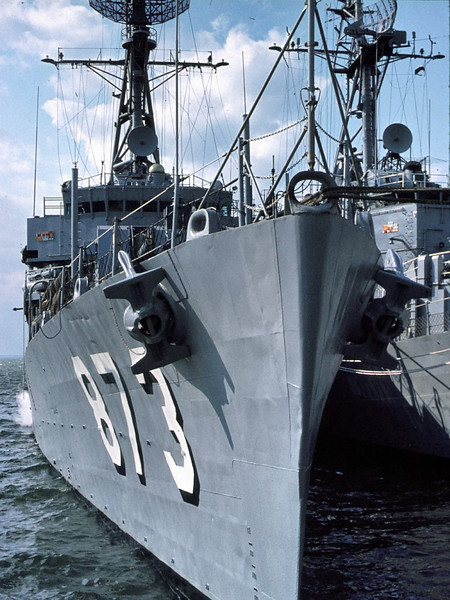
My first ship was the USS Hawkins (DD 873). After getting my commission from OCS in early February 1968, i attended the Anti-Submarine Officer’s two-month course in Key West and then flew to Rota, Spain, on to Malaga where i joined the Hawk on her way out of the Mediterranean en route from a nine-month deployment. i immediately became the First Lieutenant in charge of First Division, the deck gang, as we crossed the Atlantic to our homeport of Newport, Rhode Island. i became the ASW Officer as we entered our ROH (regular overhaul) in Boston in September. After a six-month overhaul, we went to GITMO for refresher training (for non-Navy folks that was Guantanamo Bay where Atlantic based ships went through two-month period, getting underway every weekday for certification as operational after overhauls.
By the time we returned to Newport, i had qualified as one of four OOD’s (Officer of the Deck underway) in four section watches and one of four CDO’s (Command Duty Officers, who stood twenty-four hour duties and acted as the captain’s representative, responsible for the ship when the captain and the executive officer were ashore.
The Gloekles were not some small islands in faraway sea. Nor were they some dangerous passage close to some foreign shore. i had some first hand knowledge of the Gloekles. They were nice, friendly, sincere young men. Twins. They were SA’s (Seaman Apprentices) when they reported aboard and were assigned to First Division, the deck division, the one headed up by the green officer, one Ensign Jewell. They were of the old Navy.
i had experienced that Navy on my Third Class Midshipmen cruise aboard the USS Lloyd Thomas (DD 764). There were sailors on the Thomas who thought of their ship as their home, their parents, their world. They lived on board for their entire careers. There was a fireman who had made it to second class BT (boiler tender) at least three times (and then would get busted at captain’s mast) with eighteen years in service on the Thomas. There was a second class cook with 17 years of service who also lived on board, and there were more. They would not have been considered the brightest bulbs in the light fixture, but they served that Navy well and that Navy served them well.
The Gloekle’s were not in Mensa by any stretch. But they were sincere, well meaning, and as mentioned before nice young men. From somewhere in the Midwest as i recall.
They also had a penchant for getting themselves in predicaments and at least on two occasions dragging me with them.
In the summer of 1968 after our return from the Med, we went out to the op areas for several aerial gun shoots where our two twin gun mounts (5″ 38) fired at a aircraft-towed target sleeve. i was assigned as check sight observer for Mount 51 on the forecastle. i sat in a seat up in the left front of the mount with a sight. My job was simply for safety. Before the mount captain could fire either gun, i looked through the sight to ensure we were shooting at the right thing, the target. i would tell everyone on the JS or JP sound powered phone circuit (as best as i can remember) if the guns were aimed “on target,” “clear,” or “cease fire” if they were aimed incorrectly, like at the aircraft rather than the tow . The mount had 12 personnel cramped inside including me. It was hot and it was loud (and this was long before anyone had come up with hearing protection). i loved it although i wanted to be more a part of the action rather than as a safety observer.
The hot case man in Mount 51 was one of the Gloekles. i don’t know which one. But i well remember looking back and watching him working at his task. The hot case man squatted at the rear of the mount underneath where the mount captain stood on his raised platform. He wore his regular dungarees, a battle helmet, and large asbestos gloves. His job was to deflect the powder casings as they were ejected from each mount after firing a round to ensure they went out of the mount through the hole in the bottom of the mount and onto the forecastle deck. It was an assignment coveted by no one. But this particular Gloekle twin obviously was enthralled.
His look of concentration was beautiful to watch as he swatted the brass casings. He knew his job was important, and he was completely focused on the task at hand — after a gun shoot, another job was to “police the brass.” Any of the casings, about a yard in length with diameter of five inches, that had not rolled overboard were collected and tossed into the sea. i often wish i could have saved them all, stored them, and then sold them for the brass; i would be a rich man today; we have a three-inch brass casing used to hold dried flowers by our living room fireplace; for a long time, i had the base of a five-inch casing and used it for an ashtray. i don’t know where it went. But Gloekle was not concerned with that. He was doing his job.
At that time, the First Division chief was BMC Jones, an incredible Navy chief and a superb boatswain mate. Just before the noon mess, he and i were walking the main deck, checking on how the painting of the ship was going.
Chief Jones turned to me and asked, “Have you ever seen a one-armed Gloekle?” At first, i thought he was talking about a unique piece of equipment used in deck evolutions. Then i began to consider he was pulling my leg. Finally it dawned on me, he was talking about one of the twins.
“Yeh,” the chief continued, “Gloekle was in the mess line (on the port side of the main deck) and he got frustrated with something. He turned and hit one of the grates on a air duct. His fist and arm went through the grating.
“He broke his arm and the doc put in several stitches. Won’t be good for much of anything for at least a month.
“Damn one-arm Gloekles,” he mused.
The Gloekles also were known by shipmates as good guys. One struck for the radioman rating while the other was a DK (disbursing) striker while we were in the yards for overhaul. The disbursing striker didn’t make it and returned to the deck division as a seaman.
In May of 1969, Hawkins went to the Portsmouth Naval Shipyard for a month. There the fantail deck was strengthened and a special davit was installed. The ship had been designated as the Atlantic recovery ship for the Apollo 12 mission in July, a backup to the planned return in the Pacific where the aircraft carrier USS Hornet (CV 12) had the primary recovery assignment.
Taking advantage of a month in the shipyard, the deck division cleaned and repainted the paint locker. To do so, they had moved all of the paint into a large conex box on the pier. One afternoon before liberty call, the new first lieutenant came to me and said, “You aren’t going to believe this, but Gloekle locked himself inside the paint locker. He was in there for about two hours until someone discovered him there just before knock off. We have no idea how he did it.”
i had been qualified as OOD (officer of the deck on the bridge watch) in late February 1969 and as CDO (Command Duty Officer, responsible for the ship during an in port 24 hour period) shortly afterwards. i had the CDO duty one night in August while the Hawk was in a maintenance period and Hurricane Blanche was building southeast of Norfolk (in June, Hawkins’ home port had been changed from Newport to Norfolk; i was not thrilled with the change). i read the message board after eight o’clock reports and there was no radio traffic that addressed Blanche as a threat to the Naval Base.
After making my rounds before taps, i went back to the wardroom and caught the 10:00 o’clock news. The lead story was how the ships at Norfolk Naval Base were preparing to sortie because of the approaching hurricane. i had heard nothing from higher commands. i called radio, no answer. RMSN Gloekle, the other twin, was standing the evening watch in radio Somehow, he had locked himself out of radio and had spent a couple of hours trying to get back inside the radio shack. Finally, he woke up the duty radioman who had another set of keys.
When the dust settled, Gloekle brought me the message board again. The radio message from SOPA (Senior Officer Present Afloat) had ordered the sortie preps about two hours before and each ship was required to report if it could get underway within twenty-four hours. i called the captain and the chief engineer at their homes. The engineer confirmed the main engines were open for maintenance, requiring more than a day to button them up and get underway. The captain confirmed the radio message response i had written and i sent it out immediately, later than other ships but apparently okay with the chain of command. A disaster had been averted.
One of the best things about the draft was Navy ships were melting pots of the United States. Sailors were from everywhere in the country and with all different kinds of backgrounds. Many i have known went on to successful careers in a variety in the civilian world. Many stayed in, like moi, and had good careers. Back then, some stayed in because it was a safe place to be, like i said earlier, it was their home, their world. i enjoyed knowing all of them except for the small number of miscreants i ran into through twenty-two years.
And then there were the Gloekle’s. Sadly, i don’t know what happened to them. But i remember them fondly in spite of some problems with them locking themselves in or out of things.