Category Archives: Sea Stories

Fairly self explanatory, from what I can remember that is.

Marty Tales

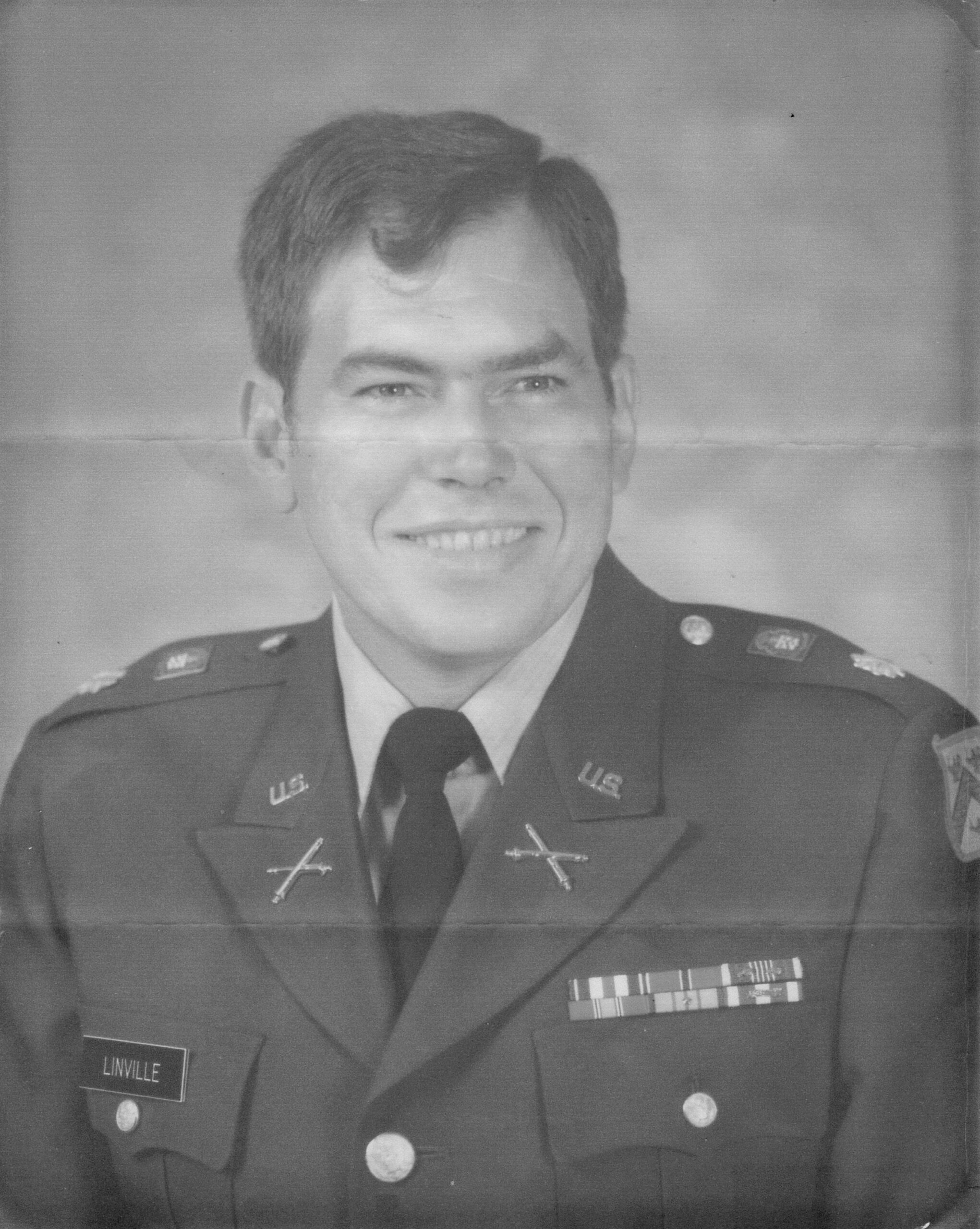
Marty Linville on active duty in the Army.

i have written two posts about my friend, an inadequate description for the relationships we had and what many other folks had with Marty Linville after he crossed over the bridge. i plan to post more of stories about him. They are meant to honor him. This is one of my favorite ones:

After Marty finished the Army’s Officer Candidate School and artillery training, he reported to Fort Carson and was in charge of a 105 mm Howitzer unit. A large exercise between Marty’s side and the “Orange” opposition.

On the first day, Marty’s unit was directed to set the battery and conduct a non-live firing operation. As it began, a gas attack was simulated and Marty and his unit donned protection against gas warfare, including gas masks. When Marty began to give his unit orders for operating the system, the soldiers could not understand him, and he couldn’t understand them. Finally, in frustration, he yanked off his gas mask so his troops could understand his direction.

An exercise umpire overseeing the howitzer unit, halted the action. He then proceeded to chew out the second lieutenant, vividly pointing out that all exercises should be treated as if they were actual conditions, not simulated. Marty saluted and snapped, “Yes, Sir,” taking the admonition to heart.

The operation continued the next day. Marty’s unit was ordered to move into a position to fire on the orange forces. They proceeded down a rough road headed for the position when they were confronted with a problem. The orange forces had downed several trees and blocked the road with the logs making the passage through the road impossible. The unit would have to detour, a significant added distance, which would prevent them from reaching their objective on time.

Remembering his chewing out and the direction to treat the war game as if it were real, Lieutenant Linville called his top sergeant to his side. He asked Top what he thought about clearing the blockade with the howitzer. The top sergeant was excited about the opportunity to shoot the howitzer in live fire.

The backed up the big gun up and blew away the blockade.

Marty relates the next morning, he had breakfast with the commanding general. Or rather, the general had breakfast while Marty stood at attention while between bites, the general let Marty bear the philippic in no uncertain terms.

A letter was entered into Marty’s service record noting the general’s reproof of the incident. i’m sure the letter kept from Marty from being promoted beyond major. He proved his mettle and leadership in Vietnam, receiving the Silver Star and Purple Heart for his actions when a North Vietnamese company conducted an attack on Marty’s 13-man Howitzer unit.

Marty is one of the finest military officers i ever met.

The general made a huge mistake.

A Tale of the Sea and Me: the Old Navy

One of the requirements shortly before entering the yards was a complete inspection of our four 600 lb. boilers’ interiors. The inspection was to be done by an boiler expert accompanied by me. He came aboard when the ship was moored along the quay wall at the Long Beach Naval Base. He was a big, gritty, old Navy sailor. i wish i remembered his name. I do remember vividly he was the first of the Boiler Repair rating i had ever met. He was a Boiler Repairman Master Chief (BRCM). Before we donned our coveralls to crawl through the interior of the massive boilers, we hit it off.

The inspection was critical. It was done thoroughly. i was a bit surprised the four boilers were in as good shape as they were. Of course, there was considerable work to be done on them in the yards. The BRCM documented the needs very well.

As we crawled through the stuffy and sooty boilers, the master chief didn’t really complain but decided to tell me what is was like in his Navy.

“You know, sir” (it seemed to me him calling me “sir” was almost silly, that i should be calling him “sir”), he said, “back in the old days, all the sailors on the ship were required to wear their undress blues everywhere on board except in their work spaces. The firemen had to change from their dungarees to their undress blues in the fireroom before they came out of the hatch in the ship’s main passageway.”

“Really,” i said with amazement. i knew it was a rough life but i was surprised dungarees weren’t allowed throughout the ship.

“Yes, sir,” the BRCM continued, “I was on one can assigned to the after fireroom. Our chief was a tough old goat. He would make sure all of his BTs conformed to the uniform requirement. When there was a change of watch, he would stand over the hatch in the main passageway holding a dogging wrench for the hatch. If a BT emerged still in his dungarees, the chief would whack him on the head with the dogging wrench, knocking the BT down the ladder back into the fireroom.

“We learned real quick,” he laughed.

i’m pretty sure my mouth was agape when he told me that. i wish i could have spent more time with him.

That, my friends, is the real “old Navy.”

Old Style Football

This is one of my favorite stories about Marty. It is a story that could never happen today.

Marty went to Pittsburg State, now a university, to play football. He had been an extremely good quarterback in high school. His coach was an old school football coach named Carnie Smith. Carnie deserved to be called old school. He became the head coach in 1946, two years after i was born. He coached Marty’s father, Big Don Linville.

Don appropriately had the nickname of “Big” as he was huge, about 6-4, 6-5, with hands that would make mine disappear when i shook his hand. He went to Pittsburg State after serving in the Navy during WWII on a submarine. i am still trying to figure out where he could sleep in those cramped quarters. After the war, Don played lineman for the Pittsburgh Steelers for a number of years before becoming a teacher because it paid better. He is a marvel of his own.

Before Marty matriculated, this other guy named Rod Stark went to Pittsburg State and played for Carnie Smith as a lineman (Rod is one of the finest golfers with whom i’ve ever played). Carnie, as i have alluded, was old school: three yards and a pile of dust was the game he coached. Marty was a superb quarterback and started his sophomore year (freshmen weren’t eligible until 1972). Carnie had two rules for his quarterbacks: 1) Do not throw a pass inside your 20 yard line, and 2) Do not throw a pass if you are inside your opponents’ 20 yard line.

In his first game as a starter, Marty threw an 80-plus yard touchdown pass. That was inside his own 20 yard line. Carnie took him out of the rest of that game and the next one. On the third game of the season, the Gorillas had driven down inside the opponents 10 yard line. Marty threw a pass for a touchdown. Coach Carnie sat Marty down for the rest of that game and the next one.

Three yards and a pile of dust. Don’t mess with Carnie.

More than twenty years later, Major Marty Linville reported to the Naval Amphibious School, Cornado. Where he met another Pittsburg State football player, Rod Stark, who, at the time, was the Director of Amphibious Training. They had never met previously. They became friends. Their families became close. Their children grew up together, and Marty and Rod played golf together for forty years. i was lucky to be a tag-a-long for thirty-nine of those years.

i didn’t play for Carnie Smith, but i did play for Stroud Gwynn at Castle Heights Military Academy: single wing. Three yards and a pile of dust.

A Hero and a Friend

James Martin Linville was Kansas through and through. His father, Big Don, was a pro football lineman for the Pittsburgh Steelers in the 1940s, quitting to become a teacher because it paid more money. He taught Marty a lot about football and baseball (more about that later).

Marty spent a good deal with his grandmother, a full-blooded Cherokee in Oklahoma. i was always engrossed when Marty talked about life on the reservation.

Like most boys in those days of our youth, we worked in our summers, usually at manual labor jobs. My friends in Lebanon rode bush hog tractors to clean road sides. Marty and Rod rode tractors in Kansas. I laughed when the two of them talked about days in the hot summer Kansas sun ploying the fields, reaping the hay, and hoisting it into the haylofts. When i confessed i never drove a tractor, that i was assigned to be a grave digger by the City of Lebanon staff because i was too small to drive a tractor, Marty would chuckle his famous deep chuckle.

Two of Marty’s stories about high school sports always amused me. Marty was the catcher for the Kansas American Legion team that won the state tournament. i was the second team catcher for my Lebanon Legion team that went to the state tourney but did not win. The kicker is Marty was the catcher for Mike Torrez. Mike went on to be drafted by the Cardinals before winning 20 games for the Baltimore Orioles in their 1975 World Series championship.

Perhaps the best story from Marty’s high school athletics was in track. Marty made it to the finals of the Kansas state high school track meet in the mile.

Marty told me he finished second. Then he confessed he was lapped by the guy who won it. Jim Ryan was that guy. In case you don’t remember, Ryan was the first high school runner to run the mile in under four miles in 1964. i’d say finishing second was just fine.

♦︎ ♦︎ ♦︎

This past Thursday, i was watching the Padres in the middle innings. The Mets pitcher was beind in the count, 3-0, to the phenomenal hitter Luis Arraez. Arraeze watched a straight fastball split the middle of the plate to bring the count to 3-1.

i immediately thought of Marty. For a major league hitter to take a 3-0 pitch never made sense to me. This guy is one of the premier hitters in the majors, and he should hit that fat of a pitch anywhere he wanted to place it. Marty and i would have discussed that for hours…

i miss him.

A Tale of the Sea and Me: Adjusting to Being a Reserve Ship

i was just into the saddle as CHENG when the Hollister began its transition the reserve fleet. She was now a member of Destroyer Squadron Nine, with all of the tin cans also reserve ships. Basically, this meant the ship and engineering in particular would be manned to thirds of the ship’s complement with reserves filling the empty billets one weekend a month and two weeks of active duty for training (ACDUTRA).

As earlier noted, Engineering went from a grunch of master and senior chiefs to on BTCM. Period. And one third of the department was transferred. The big problem was there was a fuel shortage for the regular active duty ships. Due to many operational obligations, the reserve ships were going to sea like 37 days per quarter, a high rate.

After i had gone through all of the engineering spaces, i realized the good ole ship had been beaten up in the high tempo and combat duty in Vietnam. My predecessor’s fixes applying casts for broken bones to fix auxiliary steam leaks were everywhere, requiring standard fixes. Leaks of lubricants, water, and fuel was rampant. The bilges were shiny with oil.

It was early in 1974 when i came up with my goal, which was to get the engineering plant to Regular Overhaul in September without missing an operational commitment or getting anyone killed or injured.

We did that except for one final operational underway a couple of weeks before we entered the yards. i’m proud of that.

But we had problems, unique in many ways, through that eight or nine months. That spring, i put my troubles behind me, i thought, as we headed to Pearl Harbor on the Hollister’s two-week ACDUTRA cruise. This is when the reserves assigned to the ship boarded and gave us almost a complete complement of crew. However, many of the reserve snipes were not qualified to stand many watches and a few were downright dangerous if left alone. So we were still essentially steaming with two thirds of an engineering department. We arrived in Pearl with no problems.

i was ecstatic, not just because we had only minor problems, but i was taking leave while we were there. My wife, Kathie was bringing our daughter Blythe, about three months shy of three, with her. We had reserved a cabin on the inshore side of Fort DeRussy on Waikiki Beach. It was a wonderful week.

My leave prevented me from attending a squadron picnic, which included the British ship, HMS Jupiter (F-60), which had joined us for exercises on our transit west. Among the attendees was the Jupiter’s communications officer who just happened to also be Lieutenant Prince of Wales, now King Charles III. Our comm officer, LTJG Wendell Parker, met the prince at the picnic. They t and talked about the comms during the exercises and joked around with each other. Right after the two ships got underway, Jupiter continuing west for Hong Kong, and Hollister heading east for home port, the two exchanged wire notes:

Wire Note
Commo to Commo
LTJG W.E. Parker to LT, Prince of Wales
ITS BEEN A REAL PLEASURE KNOWING AND WORKING WITH YOU AND YOUR RADIOMEN. WISH YOU GOOD COMMS UNTIL YOU REACH HOMELAND. BUT IN CASE THINGS DON’T GO AS WELL AS THEY HAVE IN THE PAST WEEK, REMEMBER: YOU WIN SOME, YOU LOSE SOME, SOME GET RAINED OUT, AND SOME SHOULD HAVE NEVER BEEN SCHEDULED IN THE FIRST PLACE, BUT YOU HAVE TO SUIT UP FOR THEM ALL.
UNTIL WE MEET AGAIN, GODSPEED.
BT

The Prince’s response:

TO: W.E. PARKER
FROM: LT. PRINCE OF WALES
THE COMMUNICATIONS HAVE BEEN A SENSATION. MANY CONGRATULATIONS AND MAY WE SEND APPRECIATION FOR MANY EXCELLENT FORMATIONS CONCLUDED DURING OPERATIONS HIGHLIGHTING THE COOPERATION BETWEEN TWO NAVAL NATIONS.
IN ENGLAND WE ALWAYS GET RAINED OUT. BEST OF LUCK.
BT

My wife and daughter flew back to LA, and i reported on board to find a big problem.

The main evaps, our distilling plant to make water, had quit. No water, not feed water for the boilers, nor fresh water for the crew.

Or at least not much as the smaller plant in the after engine room didn’t produce to provide both on its own. As i recall, the main evaps was rated to produce 700 gallons per hour. When it was running effectively, it could put out over 720 gallons per hour. The smaller evaps was rated to put out 120 gallons per hour. Once we knew the smaller evaps were in working order and could produce enough water to give us feed water for the voyage back to Long Beach, we got underway with the rest of the squadron.

It was tough going. i was up for about three days, catching a bit of sleep when i could. i spent hours in the hole listening to my remaining master chief machinist mate explaining what they were finding and what the next action would be. i would sit in the log room checking the hourly measurements of the feed and fresh water and reporting to the bridge the status. Our captain, CDR George Phelps would relay four “SITREPS” (situational reports) daily to the commodore on our flagship.

As it was, we were on water hours for almost four complete days before the master chief and his boys got the big evap running again. Our captain sent a flashing light message to the commodore on the destroyer flag ship reporting we were going off water hours. The commodore responded, “Congratulations to CHENG. Please remain downwind for the next couple of days.”

The adventure continues.