The opening, in green, was written last night with the expectation of concluding this post then. But the day caught up with me and finished with my edit only half-way through. My sister continues to improve. But there is a long road ahead, and it is raining again tonight. i reread the poem.
It is dark, with rain outside. i lie back in a recliner, my sister’s in her family room. i need to be near in case she needs someone in the middle of the night. The day was not harrowing, but it was tense and difficult in many ways. i should be sleeping. Tomorrow is the day we will have a good inkling of what is to follow. Right now, it is just a guess. Just a guess.
But i’m not sleeping. i need to rest my anxious mind. i often do so by remembering being on the sea for amidst the chaos of watch standing, administrative duties, doing the other jobs, going to sea was always calming for me. Three hundred souls wrapped in floating metal riding on the sea.
So tonight, i found a version of what i wrote about watches. i’m not even sure if this the current version. One or two versions have been published here before.
But i read it, and i found solace, calmness, remembering the sea and living away from the rest of the world.
Bridge Watches on a Destroyer, circa 1969
I. Sea Detail:
engineers man their stations
in the bowels of the tin can
hours before sea detail is set
with the sun arising
while
wisps of vapor mist off the harbor waters;
the bridge is manned,
while
the OOD begins his check-off list
while
captain and the xo huddle in the wardroom
over coffee, small talk
as if getting underway is no big deal
while
the boatswainmates
shinny up the six crisscrossed mooring lines
removing the rat guards
and
remove the dressing off the lines
(not ropes, you landlubbers: lines)
while
first division forward and third division aft
unrig the bird nests around the bollards
while
the bridge is manned in white sparkling purity
with dixie cups and garrison caps,
enlisted wearing black oxfords
while
the officers and chiefs gleam noble white
down to their toes
while
the boatswainmate’s pipe hits the high note
before he passes the word
over the 1mc;
while
the women and children stand on the pier
while
shore steam and phone lines are secured
while
the public affairs officers and the brass,
act like they are responsible
while
the boys on board get the work done
while
the pier master from port ops
hustles about with
line handlers from the other ships\
standby to let go
when it’s time to get underway;
springing on line three,
slacking four, five, six,
port ahead slow
until
the bow nudges toward the pier
and
the stern swings out
and
the conning officer
with deft touch
at the right moment
backs all engines
and
the order is received
to let go all lines
when the last line;
falls from the dutch bollard
to the water;
one prolonged blast for underway,
three short blasts for backing down,
the pipe again
and
“shift colors”
and
“underway”
while
the ship backs into the channel,
swinging the bow
to stand out
while
the women cry
and
the brass walk away
and
the ship is underway;
standing out the channel,
sailor men all in a row
on the forecastle
and
fantail:
dress whites with dixie cups,
impressive in their splendor
while
the men on the bridge
take the bearings on navigation points,
receive the radar fixes from combat,
plot the track and report:
“navigator holds us on track,
fifty yards from center of channel;
nearest shoal water
six hundred yards from port beam”
while
the bridge watch stands
taut and erect,
ready to respond to helm and lee helm orders,
while
the boatswainmate of the watch
makes his pipe sing
before passing the word
while
the conning officer shoots the range
nervously checking over his shoulder,
making small degree course changes
for the helmsman to steer
while
the captain stands behind
the conning officer’s right shoulder,
confidently checking
while
the xo, the navigator bends over his chart,
or
in less tense moments
checks the formations
on the forecastle and fantail
for correctness
until
the sea buoy is cleared
and
the boatswain pipe shrills
its song again
and
the word is passed:
“Secure sea detail;
set the normal underway watch.”
II. Midwatch (0000-0400)
the thin steward in his official white frock
timidly whispers,
then murmurs almost fearfully,
“get up, get up, sir; midwatch;
time to relieve the midwatch;”
the oncoming OOD
can see the steward beyond the flashlight’s red rays,
and
is pretty sure the Filipino is grinning at the thought
of waking him from a sound sleep
and
will grin again when he makes up
the rack in the morning,
before turning it into a sofa
by lifting it up into the bulkhead.
before departing the stateroom –
they, these stewards, are careful
in awaking the oncoming watch
since one once rustled the shoulder of a burly lieutenant,
catching a foot in the temple
from the violent awakening –
so the OOD struggles to rise
with the ship rolling:
“’bout ten degrees, steady,” he thinks,
knowing it’s a good sea
for the midwatch;
the red lighting for darken ship
casts eerie shadows
as he lift his legs into watch khakis,
fumbles with the shirt buttons,
splashes his face with cold water
from the stateroom sink before
unsteadily lurching from after officers quarters,
to head forward,
up the narrow passageway, dimly lit red,
to the wardroom;
the speckled gray-haired xo and the hulking, bald captain
sit in their appointed places of rank
as they do nightly at twenty-three fifteen,
to relish mid-rats:
midnight rations which might be
soup from the noon mess
or
stew from the evening mess;
or
perhaps tonight,
tomato soup with a grilled cheese sandwich,
the oncoming OOD leaves them waiting for the off-going watch
before they all hit the rack
while
the new OOD stands alert, semi-comatose on the bridge,
binoculars hanging by a halyard from his neck,
olive green foul weather jacket keeping him warm:
in control for four hours
of pretty much nothing
unless
there is sea traffic mucking up his quiet time
or
bad weather in an open sea with no evening stars
III. Morning Watch (0400-0800)
one sleeps hard in the middle of the night
until the messenger taps upon the metal rack
and says,
“morning watch relief, sir,”
and
the junior officer rustles awake,
jumps into his khakis
before taking a leak
in the red-light washed head
to stumble down the passageway,
up the ladder
for the short three-hour watch
and
relieve the OOD
and
take the conn:
steady course, steady speed;
no contacts
because the battle group
is calm
before the flag
arrives upon his bridge
after a substantial breakfast
to kick things into gear
with exercises and formation changes,
but now,
the OOD
hangs across the bulwark
of the starboard wing
to the aroma of pancakes, eggs, bacon, coffee
wafting up from the galley below
until
the murmur of first light
suffuses the night
and
yields to the coming dawn’s
pink glow on the eastern horizon
until
the reliefs show up
after a quick breakfast
and
the relieved dash to the wardroom
for a late breakfast:
a draining watch
which will catch up around
ten hundred hours
and
the junior officer will struggle to make it
to the midday mess
where he will hit his rack
to recoup.
IV. Forenoon Watch (0800-1200)
the gray ships scattered precisely on the deep blue green.
tinny radio commands
accompanied by signal flags hoisted
half-mast for understanding,
two-blocked for receiving and understanding,
hauled down for execution,
while the extra signalmen
stand tall on the signal bridge
with white dixie cups
at a jaunty tilt atop their heads ,
converse with their counterparts
on the ships close by in semaphore
and
combat and the JO’s scamper to find their maneuvering boards,
fourteen-inch squares of paper pads
with a paper-wide circle with spokes extending
to use their compasses and parallel rules
to calculate course to station
and
the OOD takes the conn
and
relays to the lee helmsman
to kick up the speed to twenty knots;
right standard rudder to three one five
and
the wake spume aft, a highway of white
to the horizon of the blue-black sea
and
the other ships appear pell mell
in some macabre dance of destroyers
heading to station;
when there,
the OOD barks
left standard rudder to two two zero;
all ahead standard, turns for 15 knots;
and
the helmsman obeys
and
the lee helmsman sends the speed
with the engine order telegraph
to the watch standers
in main control in the bowels of the engineering spaces below
and
the ship falls into station
like a horse reined into a trot;
and
the OOD checks his position
and
smile if he was no more than 100 yards off.
V. Afternoon Watch (1200-1600)
in relieving the watch it seems
the day has slowed down;
the captain and xo take their chairs, starboard and port respectively
and
the OOD, knows the xo will soon tilt his head back and sleep
and
the captain will talk of small things or perhaps career decisions
until
combat reports a contact zero four zero, ten miles,
on course two seven zero
and
the OOD begins to watch when the starboard lookout reports
contact 084 relative, hull down
and
the OOD spies it also
and
he knows it will pass close astern if you both
retain course and speed
and
the OOD knows he is “privileged”
and
he knows these Mediterranean merchants will
do what they please,
so
he watches with caution
knowing he is obligated to maneuver
to avoid a collision
and
the proper thing to do is slow
turn to starboard
to pass astern
and
he slows, turns starboard to pass astern
by a large margin
and
the captain says,
“good job.”
VI. First Dog (1600-1800)
16-18 they call it now,
the oncoming watch, officers and men,
knocked off the working day early
changed into clean khakis and dungarees
and
head to the bridge
for the short watch.
quiet time; the sea seems to cooperate
even though grey is becoming the tint before sunset:\
the navigator may have problems shooting evening stars.
before the meal time
cutting the work day short,
but making it longer
with the two hours on the bridge,
usually quiet as the other ships
are knocking off, relaxing
before the evening meal on the mess decks
and
in the wardroom.
VII. Second Dog (1800-2000)
the second dog watch,
or
what the new-fangled sailors
have come to call eighteen-to-twenty,
climb up the ladders
to the bridge from the quick evening mess;
after all, the off-going watch needs a hot meal
and
while relieving the watch,
shades of gray:
no blue, no brightness of the sun,
gray ship on a gray sea
with a gray horizon under gray clouds
define your world
and
the OOD settles into what should be a quiet two hours
on the port bridge wing, arms akimbo,
one draped around
the gyro-compass repeater:
staring abeam at the dull, fleckless sea
to the horizon, lines of gray variation;
feeling the wind stir,
watching the low dark clouds
looming close to the sea;
the sea itself stirring:
wavelets forming with
white beginning to
flick at the top
when
on the horizon,
the low cloud projects a finger down
while the sea responds
with a finger pointing up,
all a swirling, growing,
until they touch,
until the sea and sky join
in a water spout;
until the gray
becomes an ominous seascape,
a water spout;
yet the bridge watch is not perturbed
standing on the port bridge wing
as the storm rushes past
on the horizon.
VIII. Evening Watch (2000-2400)
as the watch relieves,
the carrier prepares for flight ops
and
the destroyer is ordered to lifeguard station
five hundred yards dead astern
in the wake of the ugly thing with flat decks
and
the motor whale boat is swung out on its davits
manned with the rescue team;
although it could be no problem with a good wind;
any wise OOD knows it is dicey
steaming dead behind that behemoth
that doesn’t understand superheat
or
alerting the lifeguard destroyer what happens next
and
sure as shit, just as the watch settles in
without the required signal,
the carrier starts a turn to port
and then
announces a new course one eight five degrees to port
from the current course
and increasing speed from five knots to twenty-five
and
the OOD calls the captain who is watching
Roy Rogers, the evening movie in the wardroom,
on the sound powered phone
while he’s telling main control they need superheat
and
ordering the helmsman “left standard rudder”
and
the lee helmsman “all head full”
and
he’s so relieved he got it all right
except for the swinging of the motor whaleboat in the davits
with the lifeguard team on board
except the carrier
with the aviator trying to qualify as flight ops OOD
begins a turn back to starboard one nine zero degrees
and
slowing to five knots
and
the OOD calls the captain again
and
warns main control of the slowing,
promising to fish tail the ship
while the engineers come out of superheat
and
finally,
the carrier steadies up
and
the OOD and the bridge watch
watch the aircraft pass directly over them
to catch the tailhook
and
none take a dive in the drink
until
flight ops are secured at 2200
and the watch can wait for their reliefs,
partake of midrats
and
hit the rack.
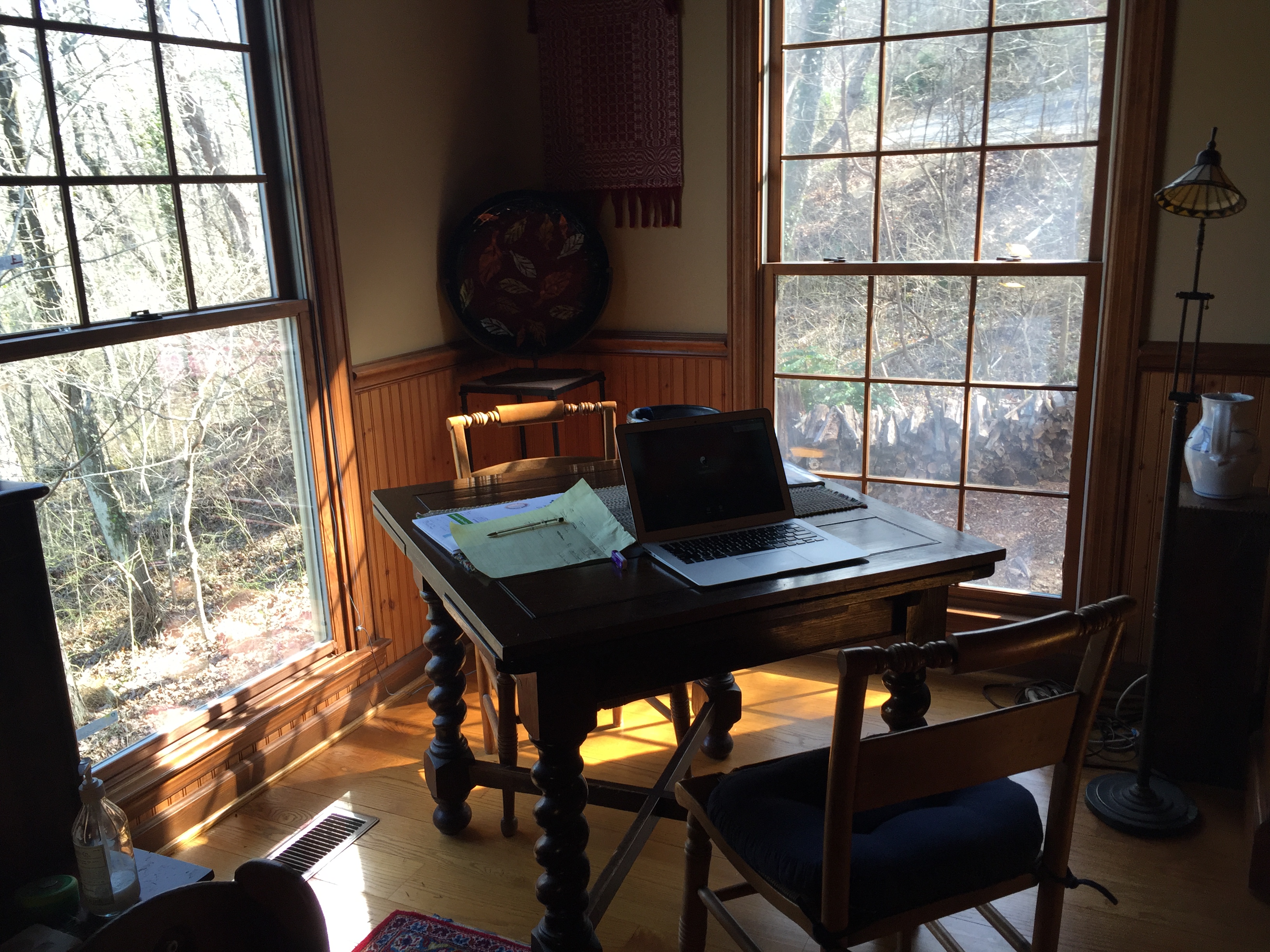 So this morning as my sister rests and my brother-in-law runs errands, i chose this spot as my office for the day. The firewood stack is outside one window. A lone hemlock is prominent looking out the other window. Both windows let the sunlight filter through the pines, bare gray oaks except for green moss and vines.