Category Archives: A Pocket of Resistance

A potpourri of posts on a variety of topics, in other words, what’s currently on my mind.

Morning Glory in the Southwest Corner

San Diego autumn weather vanished this morning with the hot, dry air blowing in on a high from the desert: a Santa Ana we call ’em out here, highs reaching toward 90 and humidity no higher than 30% all day: fire season as we reckon out here.

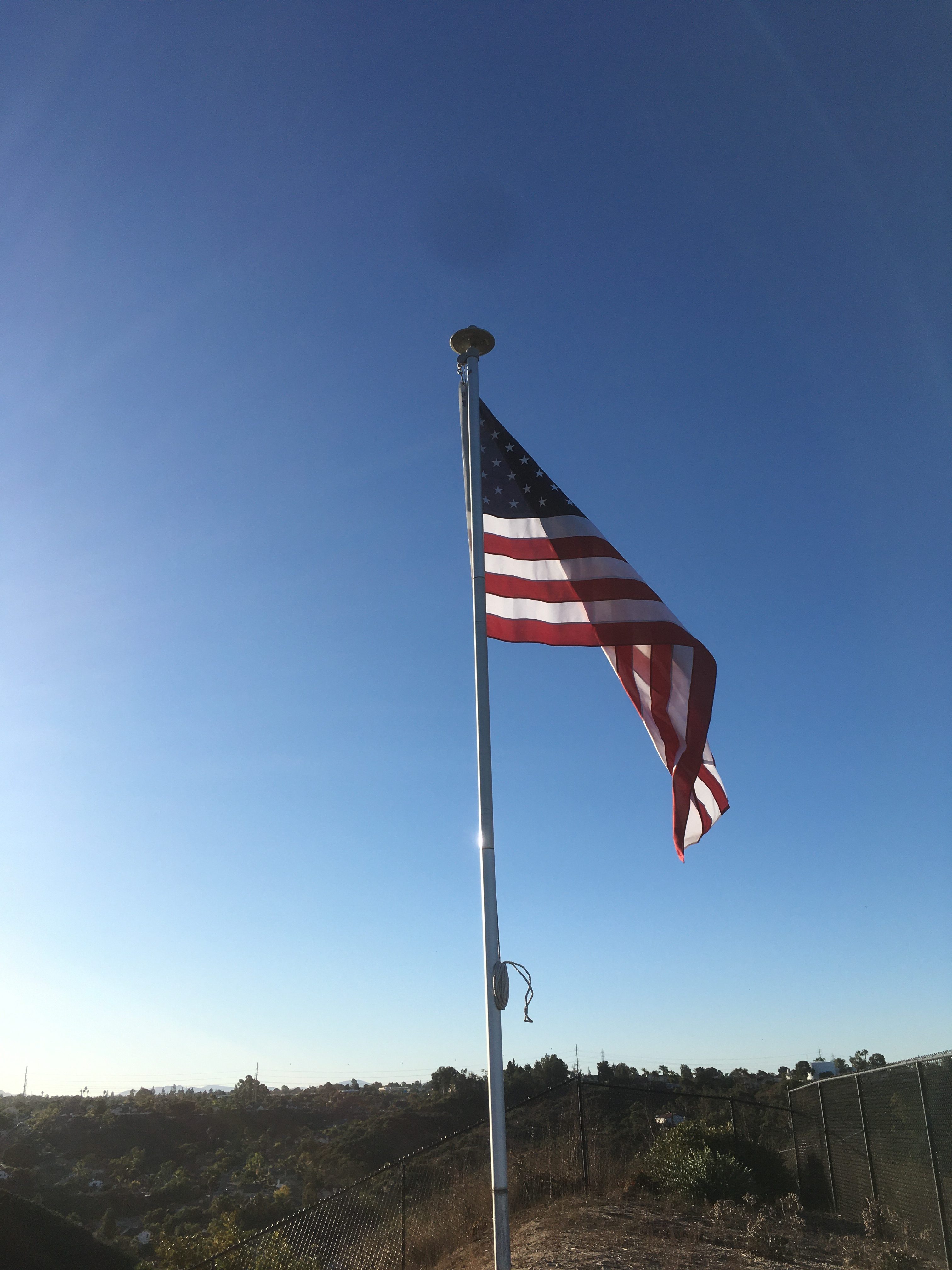
But yesterday was the usual from mid-September to May. i slept later than usual and ran my morning routine just after sunrise, not around first light. i put up a new flag in that routine, something i’ve dismissed since i installed a light to observe the rules for flying it 24/7, something a number of neighbors have asked, principally because they like to see it on their way to work. i told myself i needed to get back to that as walking up the hill and raising the flag (at 8:00 a.m. as we did correctly in the Navy for oh, about 22 years and still observe, stopping on about the fifth or sixth hole on the North Island golf course almost every Friday when the base observes colors with the playing of the National Anthem). My flag raising is the capper on morning glory.

Maureen and Paul Shipley’s front yard project is filling in and promising.
The sage will cover most of the mulch left of the river rock bed. The lantana will do the same on the right side. It should be filled in by the end of next summer.
It is already looking great.
Someday, i will get a better camera to capture my view of San Diego and Point Loma from my hill, or perhaps get someone like Walker Hicks to take a real good photo without getting my shadow in the foreground.
Mount Miguel to the east. It looked like a Roman candle, a big Roman candle, the night of the 2007 wildfires. It is a majestic view from our home without fires.
Our neighbor’s back yard. By far, the best next-door neighbors we’ve had in this home or or first one in the Southwest corner.
Our home with at least 7,858 more projects to complete, especially the slope, which i intend to take on in 2078.
The morning ritual complete: Morning Glory.

A Lesson From My Father

Except for a good round of golf yesterday, a really good time with my wife and my friend, Pete Toennies; my usual Friday Morning Golf; some reorganizing; and trying to get back on track with Sarah’s help (and Sarah really knows how to organize and work the current technology),  i’ve been pretty much useless since we got back from San Francisco.

Down? Don’t know. But it was sort of like limbo. Still i reconnected with more folks on Facebook, like Don Jones, who was raised in a home about two homes down from where my father was raised on West Spring Street in Lebanon, but his and my father’s rearing took place about fifty years apart.

Then i went to my rather amazing counselor, Martina Clarke, and attempted, as usual (as the captain of the prison (Strother Martin) in Cool Hand Luke demanded) “to get my mind right.” i told some stuff about me and wandered into my youth.

i recount here a lesson from my father i related to Martina:

Jimmy Jewell taught me many lessons, but most of them were by example. i watched; i learned. He was the force behind my mother’s discipline. i tried very hard to avoid that force while i watched him go about living and learned. Like his brothers and sister, he was a story teller, but he only really got into that with his three children later in life. Growing up, he was really pretty quiet, but i remember his lessons well.

When i was 14, he began to give me driving lessons.

In the autumn of 1957, a young man (whose name i shall not divulge here) was in my eighth grade class. He had failed a couple of grades and had just turned 16. He took the tests and got his driver’s license. i think one of his older friends gave him a ’54  Ford. He played hooky (this is the way i remember it, and although my memory is no longer as good as i thought it was, this is my story and i’m sticking to it). He invited two friends to go on a joy ride in the Ford. They drove around for quite a while. Much later that evening, they drove west out Leeville Pike, an old railroad bed turned country road.

Then they turned around.

Apparently, that is when the young man decided he would see how fast he could go. He was doing about 95 when the Ford hit a bump and launched into the air, coming down in the field to the south of the road. Unfortunately, there was one lone tree, a maple i think, which the Ford decided to hit coming down from its arch.

The guy riding shotgun on the bench seat was thrown out the window. i recalled he eventually succumbed. In thinking about it more, i have decided he lived but spent a long time recovering from a broken back.

The teenager in the middle was launched through the window and died instantly.

The driver was literally cut in half by the steering wheel.

My father, who was a partner and service manager of Hankins, Byars, and Jewell, was also the alternate wrecker driver when the regular driver wasn’t available. Daddy had the duty that night. They, the police i think, called after we had all gone to bed.

i did not learn what happened until they told us the next day at Lebanon Junior High School the three boys were dead. i learned the details and my father’s role from classmates and the rumor circuit. Daddy was one of the first to arrive, and he had to extricate the two dead boys. He pulled one off the tree and he pulled the two parts of the driver out of the car, passing them to the ambulance driver before he hauled the wreck away.

Daddy never said anything about what happened to his children. But he knew i knew.

That Sunday after church and our Sunday dinner, he told me to get into the driver’s seat of our new ’58 Pontiac Star Chief with the biggest GM engine and three two-barrel carburetors. He gave me directions. We went south on Castle Heights Avenue and turned west onto Leeville Pike.

After we turned, Daddy told me when i passed a car, i should not move back into my lane until i saw the head lights of the passed car in my rear view mirror. That was my first lesson about driving. It has stayed with me throughout my driving.

i was about to get my second lesson.

Roughly a couple of miles down the road on the other side of the road was what was left of the tree the Ford hit in the wreck. Lonely and eery looking in the grassy field, the limbs were shorn off but had been cleared by then. The tree, now really just a long trunk ascending toward the heavens was  bent away from the road. The bark had been skinned off the tree.

i knew what had happened there.

Daddy instructed me to pull off onto the shoulder of the road. i would like to think he nodded toward the tree. i don’t think he did. He didn’t have to say anything.

Then, he said, “Remember this when you are driving.”

That was it.

Best driving lesson i could have had…ever.

Robert Coles’ Admonition

The following was an item in today’s “The Writer’s Almanac.” As i was going about my morning routine thinking about friends right and left of me and our citizens today, i saw good ideas gone bad because of excess and lack of consideration of the end result. i saw bad ideas becoming the guidelines for political maneuvering. i felt hatred. i felt fear. i even felt glad because i recognized i am too old and too little known (thank god) to have an impact if i tried. And, ultimately, i felt sad. Then i read this entry and i felt akin to Coles, and wished, i’m afraid forlornly that somehow all these friends and all the haters and the fearful would adopt Coles’ recommendation in the bottom paragraph.

It’s the birthday of author and psychologist Robert Coles (books by this author), born in Boston, Massachusetts (1929). He’s the author of more than 60 books. Coles was in the South at the dawn of the civil rights movement, planning to lead a low-key life as a child psychologist. But one day, during a visit to New Orleans in 1960, he saw a white mob surrounding a six-year-old black girl named Ruby Bridges, who was kneeling in her starched white dress in the middle of it all to pray for the mob that was attacking her. Coles decided to begin what would become his work for the next few decades, an effort to understand how children and their parents come to terms with radical change. He conducted hundreds of interviews on the effects of school desegregation, and he shaped them into the first volume of Children of Crisis (1967), a series of books for which he won the Pulitzer Prize in 1973.
 
When Coles was 66, he co-founded a new magazine about “ordinary people and their lives.” It was called DoubleTake, and it featured photography and writing in the documentary tradition. The magazine was printed on fine paper with big, beautiful photo reproductions, and it won lots of awards.
 
Robert Coles said, “We should look inward and think about the meaning of our life and its purposes, lest we do it in 20 or 30 years and it’s too late.”

A Slice of Home and Half Baths

As usual, my fat fingers and Southern heritage messed me up at least once. Wonderful man, Hays Mershon, pointed that out in response to my posting this with this comment, which has to be repeated: “I believe it’s Forest Hill, not Forrest–to my knowledge, Nathan Bedford never carried his abundance of laundry to the City by the Bay. 😉 We mostly see the “double r” south of the Mason-Dixon.” Thanks, Hays.

In San Francisco, way up on a hill, there is a home that feels like home with hospitality as smooth and Southern as George Dickel’s Barrel Select.

In fact, it’s a lot like home, my home back in Lebanon, Tennessee, 127 Castle Heights Avenue. Oh, this home is quite a bit larger in that being on a San Francisco hill it has two cavernous stories of a basement with a garage. But the living space is similar. There are two bedrooms upstairs with a full bath and a landing area. There is the master bedroom and bath, nice kitchen, a breakfast room, a den, a living room, dining room, and a half bathroom.

i claimed the half-bath. There is a reason. In that home back in Tennessee, my father had a half bath. It was a man’s bathroom. It was practical, no frills. It was just inside the backdoor. An electric razor on a three-tier shelf he had hung by the mirror. The one on the hill in San Francisco is more elegant featuring a wood cabinet and much to my liking a wonderful Japanese wood print reminding me of one i bought in Kyoto about a million years ago. Back in our Southwest corner home, i also have a half bath. It too is more fashionable. Of course it is because i have a wife like Maren with impeccable tastes. I have to clean up in both of these. My father did not have to clean up his because no one else used it. But, being him, he did.

What i’m trying to get across is this place in the Forest Hills section of the City by the Bay gives me the feeling of home. But it is not just the house. It is the people who live there.

Alan Hicks and i go back quite aways: Vanderbilt, fraternity brother, NROTC classmate, a shared love of the sea and the ships that sail those seas. We are also avid followers of Vanderbilt athletics, especially baseball nowadays, going to Vanderbilt’s trip west in the early season each year. Been going to that series for over ten years, dragging other Vandy friends like Cy Fraser, Alan’s brother Jim, and Bill Oliver.

Maren is also a Vanderbilt graduate. She is the leader of that Southern hospitality. Her home is comfortable and artistic. Her meals are incredible. Her caring is beyond the pale.

Alan and Maren have become close friends for both Maureen and me. We also visit their other wonderful home in Sonoma.

Alan, Jr. is one of the most well-read people i have ever met. It is a joy to talk to him. i learn something every time we talk. He is also a nice young man.

What i mean is this wonderful home up on the hill in San Francisco is a lot like the home where i grew up. The house reminds me of that Tennessee home, but it is the people who make it really feel like home.

And i left out one:

Eleanor is the daughter. I could discuss Eleanor’s attributes for about a year and not stop. She is smart, caring, attentive, wonderful partner to discuss anything. i consider her my other, third daughter. She is part of Alan’s and my team (and sometimes Cy Fraser) to stake out our territory at Hardly Strictly Bluegrass, the three day mad house of 300,000-plus people in Golden Gate Park, the reason for our visit this past weekend. The early settlers at HSB dine on breakfast burritos and coffee and read and talk while waiting for the rest of our troupe to arrive and the performances to begin. Eleanor also likes folks who save extra paper napkins, like me.

So thank you beautiful people for your beautiful home, your beautiful family, your beautiful hospitality, and our beautiful friendship.

Since Eleanor was the photographer, not the photographed, this year, i decided she should represent the family here.

Thank you, Alan, Maren, Eleanor, and Alan, Jr. See you next year and hopefully before.

To Judy Collins

Today (Sunday, October 6), on our annual weekend at Hardly Strictly Bluegrass in Golden Gate Park with my college friends, Alan and Maren Hicks, and their daughter Eleanor Hicks, who, along with Alan, Jr. are just damn near incredible people, Maureen and i left the Porch Stage and went back to the Banjo Stage to listen to Judy Collins. i am glad we did. Judy moved us both, and i thought of when i first heard Judy Collins, which inspired this:

To Judy Collins

i was a warrior at sea
when i heard her first,
not a song of protest,
her original claim to fame,
but
a song i had heard earlier from
Nova Scotia couple, Ian and Silvia
long time ago,
but
it was about love for a rodeo man
just out of the service
looking for some fun
when
i was not just out of the service
but
in a war
of which she protested
but
i didn’t care because
her voice carried me off to different places;
i rode, or rather sailed
to and through and out
of the combat zone
with her songs in my soul.

i am no longer a warrior of the sea;
a score and a half of years gone by,
but
i have not forgotten
and
remain proud of defending our country,
recognizing she would not agree
but
she was not there
when i stood at the gunnel on the port side of the well deck
off the shores of Vung Tau in seventy-five
with my after-breakfast cup of coffee before quarters
for five days watching thirty-five thousand and more
folks like you and me
flee in crafts i would not put in a Tennessee creek
coming over the horizon when they had only heard
redemption from their tormentors was at hand,
rumors someone might be beyond their horizon
of the South China Sea bordering the Gulf of Siam,
and
those folks, risking life and limb not only of themselves
but
their old folks and infants as well in those rickety crafts,
and
with a sip of coffee before the sun would scorch the ocean,
i thought
whatever the hell we did, pro or con
didn’t matter
except we should have done something different, better,
not “pro” or “anti”
to let those people stay at home
like my home, my folks in Tennessee
but
we didn’t
and
now, damn near a half century later
i stood in a hollow
to hear her again:
her songs still moved the warrior of the sea
and
i was moved again
and
when she sang
“Amazing Grace,”
i sang
and
then i cried.

Perhaps we should all sing Amazing Grace
with
Judy Collins.