All posts by Jim

A Legend Gone

His services are tomorrow.

They will be held in a church in Chattanooga, his hometown and one of my favorite places on earth.

Many folks who are my friends will be there. i will not. It’s just too far away, one of the penalties i pay for my choice of home in the Southwest corner. It’s a wonderful place out here, just too far away from my origin at times.

The folks who do make it there will be saying goodbye to a legend. i will say goodbye to my friend, the legend, Charles Oren Hon, III, in my own way far away.

i have enough legendary tales about Charlie Hon to fill a book, and i’m sure i know only a minuscule number of those tales. “Escapades” does not adequately describe Charlie’s adventures and misadventures, a couple of the latter having me involved. It’s not time to bring those tales out of my memory. That will be for later.

It is time for me to honor a legend.

Charlie was a success, a contributor. i cannot say enough about how he and his beautiful and wonderful wife Ann Eliot Hon have made me feel like i belong.

Most of all, Charlie was one of the best life-long friends a man could hope to have. i was lucky to have spent enough time with him for us to call each other friends, actually much more than that.

i will go up on my hill tomorrow, probably midday, and take a beer. i will look out on the vista of the California hills of high desert, the blue sparkle of the bay, the gray of the Navy ships berthed pier side on the Naval base, the deep blue of the deep Pacific, think about the land of Chattanooga he and i both love, and i will toast Charlie with that beer. i will remember him and that chuckle that would envelop me in the good things about this world.

And i will scrape away all of the stories and the legend, and give him my highest complement. For Charlie, like my father, was a good man.


The Big Shift

The following was written a number of years ago and another version was published in my Lebanon Democrat weekly column shortly afterwards. Good memories:

SAN DIEGO, CA. – Several weeks ago, I had my truck’s air-conditioning repaired before a golf outing in the desert. Driving back, I recalled learning to drive a standard transmission.

Jimmy Jewell, my father, had a career as a mechanic in Lebanon. In 1920 when he was six, he stoked the wood-fired boiler of the mobile sawmill my grandfather, Culley Jewell, operated for Wilson County farmers.

Jimmy Jewell started working for Donald Philpot’s Ford dealership in Lebanon in 1933, located where McDowell Motor Company, owned by J.P. McDowell, later occupied the northwest corner of North Maple and West Main. . He later worked for Bob Padgett’s Dodge-Chrysler dealership until he went to work for Jim Horn Hankins at Hankins and Smith Motor Company on East Main in 1940.

In 1955, he and my Uncle, Alvin “Snooks” Hall started their automobile repair business. Bill Massey later joined them and the business became the Jewell-Hall-Massey Garage. I remember the Mobile “pegasus” above the storefront on West Main. In 1957, my father and his life-long friend, H.M. Byars bought into Jim Horn’s business. Hankins and Smith became Hankins, Byars, and Jewell.

My father, as most fathers do, taught me how to drive. He showed me the rudiments of standard transmissions, but he didn’t teach me how to drive a “stick” shift. I practiced in a used car he brought home on occasion. But it was difficult coordinating shifting with the clutch, and I pretty much gave up on the concept. My driving lessons were in my mother’s 1958 Pontiac Star Chief or in my father’s 1955 Pontiac, both automatics.

H.M. was responsible for me learning to drive a standard transmission. He really didn’t teach me, but he was certainly responsible. In Height’s 1960 spring break, about six months after I had turned sixteen, I was working at Hankins, Byars, and Jewell, mostly pumping gas, checking tire air pressure, and washing car windows.

One afternoon, H.M. came out and announced he had to pick up a Johnson Dairy milk truck and bring it back for repair. He asked me to accompany him. As we came out of the Johnson Dairy office, H.M. tossed me the keys, stating, “I know you can drive a standard transmission, right?”

As my parents can tell you, I was a bit stubborn and thought I could do anything well. So I acceded I could drive a “stick.” H.M. tossed me the keys and left without another word. I vividly recall getting in the seat and looking at the ominous gear shift rising from the center of the floorboard with a black knob on the end.

I was faced with a rather significant dilemma: start the milk truck, learn to shift on the fly, and drive back down the busiest street in town, around the square, and back up East Main to the dealership. Or I could admit defeat, call my father and have him come and get the milk truck.

As usual, I chose the worst option.

I bucked and stalled my way from West End Heights, past Castle Heights Avenue, and over the railroad tracks and onto the square. On the square to a symphony of bleating car horns, I stalled twice and bucked continuously, until I emerged on the east side and reached the shop.

Miraculously, the milk truck and I made it unscathed without wiping out one vehicle, pedestrian, or storefront. In fact, by the time, I got the vehicle to the service bay, I felt like I might have gotten the hang of driving a “stick.” I thought I was ready for a GTO. I don’t recall anyone agreeing, but I don’t recall any significant problems driving a standard transmission after that.

I was adamant about teaching both of my daughters to drive in a vehicle with a standard transmission. Both are admired by many of their friends because They can drive a “stick.” Both had cars with standard transmissions and appear to be glad, maybe even a tad proud, their father taught them.

When their grandfather started driving, it was a bit different. They didn’t have automatic transmissions, and they didn’t have drivers’ licenses. Jimmy Jewell was grandfathered when they began issuing those symbols of big government. It is a big shift from when he and I started driving and my daughters’ driving experience.

I’m glad they didn’t have to learn on a Johnson Dairy milk truck. I am also glad H.M. Byars made me learn in that way. It taught me a lot of lessons.

103

It seems almost impossible.

He would have been 103 today.

It feels like he and i were working on a project yesterday.

Last year, i honored him with a photo of him and his wife in front of their new home in 1943.

i included a poem i wrote about him. He liked it. i intend to do that every year as long as possible to honor him.

Happy Birthday, Daddy.

Jimmy Jewell with his son, Joe, two of my four best friends (his wife Estelle and daughter Martha are the other two) in 2009.

Hands, circa 2009

When most folks meet him,
they notice steel blue eyes and agility;
his gaze, gait and movements
belie the ninety-five years;
but
those folks should look at his hands:
those hands could make Durer cry
with their history and the tales they tell.

His strength always was supple
beyond what was suggested from his slight build.
His hands are the delivery point of that strength.
His hands are not slight:
His hands are firm and thick and solid –
a handshake of destruction if he so desired, but
he has used them to repair the cars and our hearts;

His hands are marked by years of labor with
tire irons, jacks, wrenches, sledges, micrometers on
carburetors, axles, brake drums, distributors
(long before mechanics hooked up computers,
deciphering the monitor to replace “units”
for more money in an hour than he made in a month
when he started in ’34 before computers and units).
His hands pitched tents,
made the bulldozers run
in war
in the steaming, screaming sweat of
Bouganville, New Guinea, the Philippines.

His hands have nicks and scratches
turned into scars with
the passage of time:
a map of history, the human kind.

Veins and arteries stand out
on the back of his hands,
pumping life itself into his hands
and beyond;
the tales of grease and oil and grime,
cleaned by gasoline and goop and lava soap
are etched in his hands;

they are hands of labor,
hands of hard times,
hands of hope,
hands of kindness, caring, and love:
oh love, love, love, crazy love.

His hands speak of him with pride.
His hands belong
to the smartest man I know
who has lived life to the maximum,
but in balance, in control, in understanding,
gaining respect and love
far beyond those who claim smartness
for the money they earned
while he and his hands own smartness
like a well-kept plot of land
because he always has understood
what was really important
in the long run:
smarter than any man I know
with hands that tell the story
so well.

A Sports Story

Although this is second hand information, i believe it to be true. i think i discussed it with the main character, Kenny Gibbs, but it was a long time ago, and my memory can play tricks on me. However, Kenny, if you read this, this is my story, and i’m sticking to it,

It was March 1965. i had become an integral part of The Nashville Banner’s sports department after beginning the previous September as an office boy and very cub reporter.

Waxo Green, or Dudley Green if you prefer the more formal, told me this story on a Monday after a most incredible weekend. Waxo covered Vanderbilt sports and golf. He was an old time sports reporter straight out of a Damon Runyon short story. His desk in the large room was directly across the door from Fred Russell’s office. He had just completed covering the NCAA Regional Basketball Tournament at the University of Kentucky Memorial Gymnasium (long before Rupp Arena replaced it) in Lexington, Kentucky. It was the state of the art basketball arena, seating a what was then a whopping 13,000.

Fred Russell was there likely in a premier seat. Waxo and the Banner sports photographer (sadly, i cannot remember his name as i write as he was a good guy and had taken me under his wing) were posted at the scorer’s table for all four games.

i was there also. i was there because i solved a dilemma. Obviously, this was long before we could send photos by email and social media. The dilemma was how to get the photographer’s photos to the Banner in Nashville before it went to print. There was some leeway because the Banner  was Nashville’s afternoon newspaper, but there was no way to get the photos back to the office before the deadline…except for driving the 180 miles immediately after the game.

Kenny Gibbs is third from the right on the back row.

In a brilliant move, i volunteered. i drove a 1959 Vauxhall sedan i had purloined from my sister. It was not a mechanical marvel except it would get me where i needed to go…most of the time. But most importantly, it would provide me a ticket to what i considered the biggest sporting event of my life (it still ranks way up there). i had been friends with most of the members of the team. People would laugh when they saw me walk across campus with our All-American center, Clyde Lee. John Ed Miller, the point guard, and Bob “Snake” Grace, the power forward, and i took architectural drawing together. Keith Thomas, the shooting guard, and i had spent some good times together. i considered myself friends with the entire team.

But i was closest to Kenny Gibbs and Jerry Southwood. Both were fraternity brothers. Jerry was the point guard behind John Ed, and Kenny was the center behind Clyde. The next year, they were both stars. Both were great guys and remain that way. i don’t see either of them enough. They were an integral part of one of the best teams in Vanderbilt history. They had won the SEC championship (there were no conference tournaments back then: college athletics was not quite as money hungry back at that time), a rare feat, which included winning both games against Kentucky, then as now a perennial national basketball force.

After the Vanderbilt tournament games, i picked up the negatives from the photographer and headed south for roughly four hours including getting to the car and out of the parking lot. For the semi-finals (There were only four teams from the field of 16, less than a quarter of the teams in the tournament today), the task was relatively easy as the Commodores beat DePaul in overtime, and it was relatively early in the evening. i got back to the Banner’s office around 1:00 in the morning, dropped off the negatives, and slept for about six hours before checking in with the managing sports editor, Bill Roberts and then driving back to Lexington.

Saturday was the big day. And i mean big. On Friday, at the Vandy-DePaul halftime i had wandered from my seat on the opposite side of gym from the scorer’s table to arrange for the negatives hand off with the photographer and say a few words with Waxo. i started back to my seat with the teams came out to warm up. As i turned to walk back up the stairs and over to my seat, i discovered the Michigan team,  awaiting to play in the second game, had come out to see the teams, one of which they would play in the finals. Michigan was ranked number two in the nation behind John Wooden’s UCLA Bruins. When i turned, i found myself looking into the belt buckle of Cazzie Russell, the Wolverine’s star forward. Flanking him and just as imposing were his two main supporters, Oliver Darden and Bill Buntin. i slithered through the troika of basketball hugeness and headed for my seat.

My instructions for the end of the game were to ignore the craziness of the game’s conclusion, head straight for the end of the scorer’s table, get the negatives, skedaddle for the exit, and shoot toward Nashville as fast as that little malfunctioning Vauxhall would carry me.

It was an incredible game. It seesawed back and forth and Vandy had a two-point lead with less than two minutes to go. John Ed brought the ball down the court, stopped and in a move he used frequently, took a stutter step but not moving his anchor foot. The ref called walking. It was not. The team invited me to see the replay with them, something unavailable to the general television audience in those days, on Sunday night at the WSM studios, and we ran the footage again and again, pointing at the TV monitor and shouting, “you didn’t walk, you didn’t walk.” We all knew it but now we had proof. Michigan scored two goals and the Commodores lost 87-85.

Michigan lost to UCLA in the NCAA championship game, and i still believe with all my heart, Vandy matched up much better against the Bruins and Gale Goodrich, and might have won the championship that year if it hadn’t been for that blown call. Of course, it’s the right of a fan to revise history.

Although disappointed, i did not forget my mission, headed to the scorer’s table, picked up the envelope with the negatives, and headed for Nashville, cussing all the way. i arrived after 3:00 am. Made it.

But the Monday recollections with Waxo Green made it even better. About half-way through the second half after Clyde had picked up a foul, Coach Roy Skinner had put in Kenny to give Clyde a rest. On the first play after substituting, Kenny fought and claimed a defensive rebound off that huge Michigan threesome. On the next shot at the other end, they all went up, and Kenny came down in a heap, writhing on the floor and grabbing his head in anguish. The trainers and coach came in and Kenny was helped to the bench. The pain was temporary.

But when Waxo asked Kenny after the game about what happened, Kenny replied, “That damn Darden kneed me in the crouch.”

“In the crouch?” Waxo reacted, “But you were holding your head head?”

Kenny wisely responded, “Well, i was damn sure not going to grab my balls in front of 13,000 people and a nationwide TV audience.”

As i said, that’s my story, and i’m sticking to it.

A Near Collision…Not

With this post, i  have added a new category. i am going to try, i emphasize try to work on putting my posts in the correct category.

“Willie Nod” will continue to be children’s poems and poetry, which i now intend to self-publish within the year. i hope to continue to add to this category as time passes. Although my grandson Sam has almost outgrown such children things, i have six grand nieces and nephews i hope will enjoy them.

“Jewell in the Rough” is the wonderful phrase for a category Walker Hicks created as the title for this website. i am considering making this category about golf, my thoughts and golf stories.

“Notes from the Southwest Corner” was initially used to rerun my weekly Lebanon Democrat columns before the paper’s website made my columns more accessible. i have plans to revisit them and post columns from that era, which i intend to collate and edit into a book, primarily for folks back home.

“Steel Decks and Glass Ceilings” is a category i am thinking about adding later as my work on the book of that title gets some purchase. My idea is to publish chapters here after i conclude the first draft. In case you missed it, this is my take on the USS Anchorage (AD 19) deployment in 1983, the first for a US Navy ship to spend extended out of port time with women as part of the crew and wardroom,

And of course, the “Pocket of Resistance” category is for all things jim jewell with his rather bent, contrarian point of view.

i plan to go through previous posts with sea stories and move them to this “Sea Stories” category.

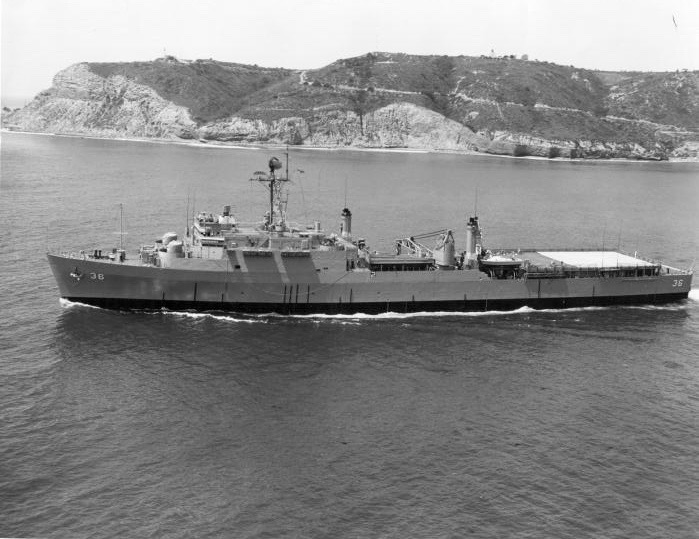
It was late summer 1975. The USS Anchorage (LSD 36) had just completed an unplanned month-long maintenance period in India Basin at the US Naval Base, Sasebo, Japan due to a stern gate mechanical failure. i had enjoyed Sasebo for that month almost as much as i enjoyed it when it was the re-supply port for the USNS Upshur (T-AP 198) and USNS Geiger (T-AP 197) when i was the executive officer of MSC, nee MSTS Transport Unit One, carrying ROK troops to Vietnam and back. We  spent roughly six days a month there throughout 1970.

But now, the Anchorage was underway again. It felt good.

My job as first lieutenant was the best job i ever had. Period. The first lieutenant on a landing ship dock is involved in almost everything. He is in charge of the deck department, which is responsible for most of the ship’s decks and spaces. The two ship boats, a motor whale boat doubling as the captain’s gig, and an LCVP, a small landing craft are also the first lieutenant’s. Add the two 60-ton cranes, the four 3-inch/50 caliber gun mounts (removed in 1980 after i was long gone) to the list as well as the well deck, the mezzanine deck, the magazines, and troops spaces for 600 marines. Any embarked craft such as LCM8’s and LCU, the embarked Beach Group  unit, and embarked UDT were under my responsibility, and i was in charge of all amphibious operations, including the well-deck loads, unloads, ballasting and deballasting and troop embarkation and debarkation. Oh yes, i was one of four Officers of the Deck (OOD) underway, the sea detail, and general quarters OOD, and because of previous Chief Engineer experience, filled in for ours when he was not available. Our CO, Art Wright, once declared the reason the operations officer billet was for a lieutenant commander is to ensure he was the senior watch officer so the first lieutenant wouldn’t have that job as well.

On numerous operations, i stayed on deck for 24 hours or more, the most being the 43 straight hours during the on-load of marine vehicles and equipment at Numazu before “Frequent Wind,” the evacuation of Vietnam off Vung Tau.

There were all sorts of weird assignments and loads. And you know what? i loved every minute of it.

But back to the story: the ship left Sasebo and headed north. i don’t remember why but as she closed on the Straits of Shimonoseki, between the islands of Kyushu and Honshu, i was relieving the OOD to stand the mid (0000-0400) watch, the operations officer, the OOD i was relieving who was damn near catatonic.

“She’s got all her lights on. All of them,” he almost screamed.

We were standing on the port bridge wing, and the lieutenant commander (who shall remain nameless here) was frantically pointing aft.

“She could hit us, she could hit us!” he declared in a higher pitched tone than normal, “Should i call the captain? What do you think?”

“i relieve you,” i said, “You don’t have to sweat it.”

i took a bearing on the ship, a very large cruise or party ship, from the gyro compass repeater on the bridge wing.

“I stand relieved,” the off-going OOD almost sighed.

“Mr. Jewell has the deck,” the boatswainmate of the watch announced.

i called the captain, told him i had the watch, that there was a ship aft not observing the Rules of the Road and looked like a party ship with all of the lights shining. i stated we were the “privileged vessel” and she was “burdened.” i explained this meant i should maintain course and speed and anticipated she would pass on the port side fairly close. i told him i would call him again after i took another bearing but combat (CIC) had already reported a slight right bearing drift with a CPA (closest point of approach) within 1000 yards. i asked him if he would like to come to the bridge.

“Ordinarily, I would come up,” Commander Wright replied, “I was getting dressed to come up as John Doe (the anonymous operations officer) called me three times and seemed distressed.” He continued, “I won’t come up now unless you need me or the situation changes. I trust you.”

“Aye, sir,” i replied dutifully and headed back to the port wing gyro compass. i took another bearing.

The bearing had increased about a half degree. i remembered one close call in the Mediterranean on the USS Stephen B. Luce (DLG 7) when a “burdened” freighter crossed our bow (Luce was “privileged) within about fifty yards. That’s when CDR Richard Butts, the CO whom i had called to the bridge, said, “See, you are not going to collide if you have bearing drift.” He and i had taken bearings alternately for the past two miles of closing with the freighter and we saw  less than half a degree of bearing drift at about 100 yards (obviously, it increased rapidly as she moved closer and passed just ahead of our bow. . He was correct, but man, was it too close for me.

i explained this to the off-going OOD who i discovered was standing behind me.

We stood on the port wing together and watched the party ship as she passed just over 500 yards from our port side (500 yards at sea is close, very close, and usually dangerous, but not as dangerous in a passing situation). John Doe, obviously relieved in two ways went below.

i could hear the Japanese music and the shouts and laughters of those embarked. They were having a good time and the ship was doing about ten knots faster than we were. i continued to watch as she moved past our bow and slowly begin to pull ahead of us. About an hour later, she disappeared over the horizon.

My point is near collisions at sea happen. They all could and should be avoided. That lieutenant commander, although senior to me and better schooled in many ways, had not spent the time at sea i had. Nearly all of my training for driving steam ships at sea was from, guess what, driving ships at sea under experienced senior officers, especially the very best CO’s: Art Wright, Richard Butts, and Max Lasell at the time. i also learned what not to do from one or two bad CO’s, obviously not to be mentioned here. I did not have very much school house training for driving ships.

Ashore training is good, very good and should be with all of the technical tools we have now. But nothing, nothing can replace being at sea and OJT learning from capable and responsible seniors. All of this posturing about too much time at sea and not enough time spent with the family is hooey. When i joined the Navy in the 1960’s, there was the saying, “If the Navy had wanted you to have a wife, we would have issued you one with your seabag. If you are a mariner, you love being at sea. You and your spouse should work that out. Hard? Yes, it’s difficult, but a Surface Warfare Officer’s duty is to be at sea.

And not sweat the small stuff…just the close calls.