All posts by Jim

A Lost Walk

i drove by it the other day, but it was gone. It was a different time, a different world. It was lovely.

We had been one of the first ones in the development. Our first house was the first inhabited on the cul-de-sac, and one of the first overall. It was the first home we owned.

Our home was on the corner of Red Oak Place and J Street, a comfortable 1600 square foot, single-level with a fireplace in the family room. We might still be living there except this wonderful daughter came into our lives four years later. We needed more space with a baby and my retiring (sic), so we moved.

The back slope bordered a farm and J Street did not go further west than our property. It was like living on the edge of two cul-de-sacs. Our development was at the eastern end of the urban spread. About a mile east was a small development from the 1960’s built next to the community college. About three miles dead south was the 100,000 acre Scripps Ranch. That was about it. In high school, my brother-in-law and friends used to bike from Lemon Grove to these high desert, scrub brush hills for squirrels and rabbits. When we moved into that first home, the big ranch still existed and there wasn’t much else.

My dog loved it – i say “my dog” because even though Maureen and i got him while we were in Florida, he quickly became my dog, or to be more accurate, i became his special human. There was no master involved. He was my best friend.

His name was McCaslin after Ike McCaslin, the young boy in Faulkner’s story, “The Bear.” We called him Cass. He weighed between 70 and 75 pounds and was all muscle with a heart of gold. He loved children and practically everyone else. He was technically a yellow lab, but his coat was golden like a golden retriever’s.

He was also a runner, like “if i can get out that door, i’m going to run as far as i can and you can’t catch me until i’m ready…or you drive the mini-van close and open the door.” He also could collapse, like “i don’t really care where you want to go, i am tired; i ain’t going; and i’m gonna lie here, right here, until i’m good and ready or you pick me up and carry me.” This was all right when he was a puppy coming back from the beach at Ponte Vedra, which was about half a mile, but it was a bit more difficult at 75 pounds and around two miles from home on the high desert in eighty-degree weather.

He body surfed at Coronado’s dog beach and would do so until he drowned if i didn’t make him stop. He chased and played with coyotes. He rolled o’possums. He damn near yanked my arm from its socket when a roadrunner darted out of the scrub brush and took off down the trail with Cass, the rope leash and my arm with him, right on its feathery tail. Oh, the stories we can tell. But this wasn’t supposed to be about my buddy.

This was supposed to be about the lost walk.

You see, that place i passed by the other day, now people, cars, streets, and houses upon houses used to be Cass’ and mine. Civilization sort of ran out about a quarter block east of our house until you reached the community college about three miles further east.

When we hit the end of the road literally, i would take the leash off of his collar and we would slowly ascend to the mesa. In less than a couple of minutes, we could feel like we were completely alone. We were. There was all sorts of game. When we reached a canyon filled with acacia we could watch the hawk leaving and returning to his nest: a big, red-tailed hawk.

Not quite a half mile into the mesa, we would turn left and walk down the slope into a deep arroyo. As with most of them, the stream at the bottom was not much more than a trickle, but trees and bushes abounded compared to the high desert scrub of the mesa. We could hear many birds chirping away. It was cooler.

One holiday morning (i think it was Easter but i don’t remember well), Cass and i headed out. As we got to the top of the mesa, there was a large manzanita along the path. It had grown up leaving room underneath the low hanging canopy. i sensed something as i walked by and realized there was a person curled up asleep underneath, a pretty good hiding place from the Border Patrol. i’m sure he or she was an illegal. After all, we were only about five miles, if that, from the border. I called to Cass and put him back on the leash as we walked by. i wondered what kind of conditions, what kind of hope for a better life would drive someone from their home, their family to cross the border in fear of being detected and with no real means of sustenance, walk to somewhere unknown.

We let him alone. After all, it was Easter, and i’m pretty sure Christ would have let him be.

i saw others, some walking brazenly down the path with a cheery “Hola” for me, which i returned. A few asked for food or water, but on my walks i had none.

And Cass and i kept walking. After all, this was more like no-man’s land. It was ours to enjoy but also to share.

On the south side of the mesa, about a mile from our start, there was a concrete slab about eight feet square. i surmised it was likely an out building for the folks who owned the property years before. Back then, there were a few cattle raised here, but not many. Perhaps it was a feeding station.

When my nephew, Tommy Duff, came out with his mother, Cass and i took him for our walk on the mesa. When we reached the slab, i told him it was a way station for cowboy elves, who still roamed the mesa. i made up some stories about them. i don’t know if Tommy really believed me or not. Funniest thing is i began to believe in cowboy elves and hoped they still were roaming the mesa.

But no more, not the other day when i drove by.

The development men came back and built and built and built. There was another development just east of us. J Street jutted further into the mesa. My father would walk up and watch the huge machinery level the land, filling in the arroyos and the valleys, and watch the large water sprayers cross and re-cross the leveled areas, spraying their water to cut down the dust.

It’s all houses, single family detached, town homes, condos, apartments. People. Then they added schools and green parks and watered and watered, but it was desert and the water wasn’t enough and the wildfires came and the new folks were sore afraid. And we moved about two miles as the crow flies where i would watch the fires from my hill and look upon the development.

Cass lived until just past fifteen. We had open space and hiking trails to walk at our new home. We did exactly that until his hips became stiff and his eyes became cloudy and our walks were confined to a short circle around the back of our neighbors’ homes bordering on the open space. Then one night at bedtime, he rose from his prone position to walk in our bedroom with me for the night. He stopped and looked at the one step up to the front entry landing. Then he turned his eyes up to me and told me in no uncertain terms he was ready to go, that his quality of life was no longer worth it.

I cried then. i cried when i put him down. i cried when i buried his ashes in the flagpole at the top of our hill where he could look down on the realm of open space and the once high desert mesa he ruled.

When i walk up to the top of the slope and stand by the flagpole where he lies, i no longer cry. I actually get a feeling of joy knowing he’s there in his place.

But when i occasionally go out of my way to go by our old house and pass what used to be our playground, i feel sad we just keep adding people and water and somehow take away the joy of this high desert land.

i wrote a poem about Cass relating to this tale and it is below:

Cass Done Gone

a part of my soul left today.
the stubborn, ole cuss of a lab was more me than him
i worshiped the way he defied the world
until it no longer mattered.
some people told me
i would know when it was time.
i did not believe until
that silly old dog told me two nights ago and
told me last night it was okay.
he has been my mirror, my dreams, my soul
fifteen years.
i could tell him me like i can tell no other.
i am not ashamed of crying, feeling lost.
my granddaddy would scoff:
it isn’t the way it was back then.
there is an emptiness in my soul.
i am really not sure i’ll recover.
yeh, the pain will go in time;
the emptiness will be covered by events passing by,
but the hole will never be filled,
he was one of a kind to me.
he was me
he is gone.
i will bury his ashes at the top of the hill behind the house.
you can see the beach where he body surfed;
you can see the trails where he ran with abandon,
scaring hell out of coyote, rabbit, possum and birds alike;
if you turn around you can see the home he ruled
welcoming unknown people as if they were long lost friends;
taking on all dogs who foolishly entered his territory:
the doberman, the big shepherd, and all other intruders
stood clear after one encounter .
my feet feel cool now.
For most of his life, he would lie under my desk,
while i read, contemplated or typed with
his head resting on my feet.
the silence is awkward:
even in his sleep, he would grunt, wheeze,
kick the walls, chasing something in his dreams,
my dreams.
run sweet dog again;
pant with delicious tiredness after chasing the blues away;
scan the field with those keen sparkling eyes that
always read joy to me;
catch the next wave to bound into the bubbling surf
shake the misery with the salt wetness
from your coat of gold;
lick the face of someone
to give them unmitigated joy.
goodbye, sweet Cass.
goodbye, you joyful part of my soul.

A Wonderful Father’s Day Movie and Something Else Incredible

It was her idea. Really.

We were at Hanaoka’s Saturday night. An early Father’s Day outing. The best gyoza ever. Anywhere. Their sashimi plate is my go to. Been that way for about thirty years. She and her mother asked me to pick a place for Saturday night. She was scheduled for a boat ride with friends the next morning.

While she and her mother discussed what movie they might see when she got back from boating, i was excluded as they know i’m not a movie going fan unless it’s one i really like (and they are very, very few unless they are old, like me). They brought up “Ocean’s 8.” Maureen admitted she had already seen it. i prodded Maureen could go again because she liked it. But they agreed on “Incredibles 2.” i surprised them when i said i wouldn’t mind joining them for that one. A bit stunned, she recovered and reserved our seats in The Lot, a movie dining/movie experience in Liberty Station at the foot of Point Loma.

So Sunday, the appointed date for Father’s Day, Sarah hosted Maureen and me for a second outing. i loved it. i didn’t eat food but i did have a .394 IPA. That’s the IPA made by AleSmith, a San Diego brewery in conjunction with Tony Gwynn, Jr. honoring his father’s batting average the year his pursuit of hitting over .400 could have — and i believe, i believe he would have reached Ted Williams’ status. But that’s another story. The movie was enjoyable. The fact Sarah wanted to treat us made me feel about ten feet tall.

Since i don’t go to movies and only watch my favorite ones from the past on television, i should not be considered a critic. But i liked the tongue-in-cheek fun of the “Incredibles 2.” It was fun to watch. And the theater was cool. Perhaps when i turned onto Truxton Road just past the Marine Corps Recruiting Depot, MCRD, or “M-Crud” as we Navy folks call it, was when i got into what this area used to be.

For those who are not familiar with San Diego, the Navy Recruit Depot, San Diego covered this large and valuable piece of land on the waterfront. About half of the recruits in the Navy were trained here. If you saw the movie “Top Gun,” Tom Cruise and Kelly McGillis drove the sports car through what was then the main gate of the base where Tom’s squadron commander, Tom Skerrit, supposedly lived.

Then the budgeteers and the politicians all got together to commence “Base Realignment and Closure” (BRAC) beginning in 1988 and whacking and pasting bases through five iterations, which changed the face of San Diego (and other places as well). With the misguided aplomb politicians, including top military brass, seem to boast about, they closed the recruit depot here and the one in Orlando and moved all of the training to Great Lakes. i guess they thought there was an ocean there instead of Lake Michigan, and that the weather north of Chicago was more hospitable for training than the Southwest corner. Go figure…oh that’s right, it was politicians involved — they also put Marine Aviation at Miramar (where “Top Gun” the movie was filmed, and moved the Navy’s crack fighter training to Nevada, obviously because Nevada is so much closer to the ocean and Navy carriers than San Diego…oops, forgot: politicians.

Regardless, the development men frothed at the mouth and moved in on what had been the Navy Recruit Training Center, San Diego. Actually, they did a pretty good job. There is some housing development, but the attraction is a lot of neat places to go like the “Stone Brewery World Bistro and Gardens:” big place, good food, nice atmosphere for a big place, and beer, lots and lots of all kinds of beer made by…yep, Stone Brewery. Among many other attractions, there’s The Lot.

In the back of my mind, i was missing the recruits marching; the USS Recruit, actually used to train the recruits about Navy ships with the major exception of going to sea. It’s still there, but just a toy now.

i enjoyed the recruits being here. One of my best memories was in 1982. A bunch of single officers in the USS Okinawa wardroom, including moi, decided for a late night adventure to visit Crazy Eddie’s Booby Trap.

Crazy Eddie’s was just like you would think a place called Crazy Eddie’s Booby Trap would be. It was a dingy bar and a strip joint with greasy cheeseburgers. The joint’s big calling cards were the strippers (obviously) who also served the burgers and beer and then stripped to country music. Go figure. For some reason, it attracted all kinds of men. i enjoyed going there for the people watching. No, not that kind of people. i’m talking about the other men that attended: Old biker guys with chains hanging off their black jeans, silver chains holding keys, tools, and old car bumpers, big chains; men in $1,000 business suits with pointy-toed shoes and slicked back hair; old men in Irish tweed caps, white shirts, and khaki pants with suspenders; all kinds. And they all got along just fine, swigging their beers, smoking cigarettes, and watching the women, laughing with each other.

But my favorite happened that night the Okinawa officers were out to just enjoy themselves. We were standing in a small area to the side. i sidled up to the square bar seating with a dance stage in the middle because the waitresses…er, strippers were quicker to serve there. George Jones singing “White Lightning” was blaring at top decibels from the sound system. i wedged my way between some old guy and a very young sailor sitting at the bar to order a Bud (this was before “craft beers” and our standing position did not seem adequate for a pitcher).  An older man in a wrinkled polyester suit sat on the other side of the sailor. He spotted me.

“This is my boy Johnny,” he proudly and loudly boasted over George claiming his “daddy kept a cookin’…whoosh, white lightning” and the young lady on the stage lost another piece of strategic clothing.

“We’re from Indiana” he explained, “but came out here for Johnny. He graduated from recruiting school today,” he beamed.

i rendered what i thought was the appropriate congratulations.

Finally, one of the young ladies asked me for my order. Johnny’s father looked at the skimpily clad waitress and asked, “Miss, would you mind bring us another couple of bourbons and coke, please?”

Taking the order, she provocatively sashayed away. Johnny’ dad slid a ten-dollar-bill into his son’s hand. “Now son, when she brings us those drinks, you slide that sawbuck into her panties (as i said her outfit was pretty skimpy) and tell her there’s more where that came from,” the father instructed.

He looked at me with a sly grin, “Yessir, Johnny graduated today. He’s a man, and i’m gonna introduce him into manhood tonight.”

“Well, congratulations again,” i sputtered and walked back to my friends as soon as my beer came.

i had decided not to tell him his intentions were unlikely to occur at Crazy Eddie’s. There were a lot of legal restrictions about joints like this one and Crazy Eddie walked a straight line to avoid getting shut down. i had seen some big, bad, drunk bikers, and some of those slick businessmen fail at such attempts. It wasn’t likely a seaman recruit still wet behind the ears was going to score at Crazy Eddie’s Booby Trap. Maybe in Indiana, but not in San Diego.

But who knows? We didn’t stick around to find out.

But like the movie i watched on Father’s Day, it was incredible.


For Father’s Day: a Salute to an Ordinary Man

As i have said many times before, i am not a big fan of government sponsored holidays or most holidays in general. Most are commercial boons to make people feel good about having fun, not working, or buying a lot of stuff we don’t really need — and ironically, i acknowledge this buying stuff is essential to the way our economy works. Then, i keep disproving myself like i did at Mother’s Day.

i am uncomfortable with “Father’s Day,” perhaps embarrassed is a better adjective. i don’t desire having my daughters, grandson, and others acknowledging me because some yahoo many years ago, jealous of mothers having their “day,” coming up with this idea of “Father’s Day.” i want people to express any gratitude they might have, any inclination to praise me, or give me something because it’s their idea when it’s their idea, if they have such an inclination, not because it’s mandated to be done on the third Sunday in June. Bah, humbug.

Then, damn near out of nowhere while Maureen and i were returning home after buying a new washing machine, coming up the hill to our turnoff into Bonita Long Canyon, this random thought comes rushing into my head as i shifted down from sixth to fifth. The thought was how i wish i could be fishing with him, this ordinary man.

After spending about seventy years with him, i think he would like me calling him an ordinary man.

i don’t think he had any aspirations other than having a good life with his wife and his children, all of his children, not just his daughter and two sons…and fishing, of course.

He was not a scientific fisherman although he eventually bought a sonar to determine if there were schools of fish beneath his boat. His secret locations for the best fish catching were mostly superstitious, i think. But he did catch a lot. It was his pursuit, void of the latest fish-catching equipment (except perhaps lures: he bought into the latest lures). There are about one hundred fishing stories i could relate here, but not now. No, not now. He always, always, caught more fish than me. Perhaps that is symbolic.

i have many photos of him i could post here. In fact, i have posted many of them. But there is an image in my mind i prefer.

He was a good-looking skinny man, five feet, nine inches of 135 pounds of skinny for most of his life, whose strength was belied by the thin frame. i have watched him lift a 300-pound barrel of oil onto the back of a pickup bed by himself using only that strength and practical, no nonsense know-how.

He  was not alone. He was like many men of his generation: loving husbands, good fathers, primary wage earners, no nonsense, caring men who served their country to defend their way of life, religious, community-supporting, workers in trades that served the community, not asking for more than a secure and safe lifestyle. His love for his wife was total and worked to make the relationship a compatible, synergistic existence. He was the strong one, the provider, the defender, the handy man, the buck-stops-here guy, the go-to man, the final decision maker.

i don’t remember him ever mentioning politics. i know he voted Southern Democrat for many years, but i never heard say a word about them or any other politician.

On the grand scale of advertising and marketing folderol of today, he was not a hero.

My image of him was captured in a couple of seconds of an 8mm home movie from the 1950’s. He had come home from work sometime after five (he might work later, but i don’t recall him ever getting home before five: he went to work at seven, a ten-hour workday, not counting lunch; this included evenings when he would leave around eight to go night fishing, getting home at three or four in the morning but still not missing the six-thirty o’clock departure for work the next morning).

The image was captured on film by my mother, who never quite caught the hang of movie making, jumping from subject to subject like she was taken snapshots from the old Kodak box camera. His time for movie fame was about two seconds. He had come home from work on a summer weekday. He is still in his work clothes, blue cotton pants and shirt with his first name on a white patch bordered with red stitching over his right shirt pocket. His sleeves are rolled up. He is mowing the front yard at our home on Castle Heights Avenue. His hands have grime and oil from working on cars all day, before he washes them with lava soap, which still doesn’t get all of the dark from under his fingernails. He might use his pocketknife to clean them later.

That’s it. That’s my image of this man. He was pretty special even if he wasn’t a plastic, false-image hero to the masses of social media.

He was my father. He was my best friend.

And even if i never caught as many fish as he caught, i wish to God i could go fishing with him again.

Even though i wish no special acknowledgement on this government proclaimed day, i do wish to thank you, old man.

Thank you, Jimmy Jewell, for being the father i needed.

every man; no man

i was just sitting here not doing all of the things i should be doing and several of the things i shouldn’t be doing wondering why i think i shouldn’t be doing them, and in general screwing off in a funk. Then out of the blue, a thought from two nights ago came rushing into my abused and not frequently used mind. i finished it just a few minutes ago. Now, i’m going to work in the yard, do some finance stuff, fix a couple of things on this demonic machine. Things i should be doing.

every man; no man

i am every man;
i am no man;
i have been everywhere;
i have been nowhere;
i have seen the heights of joy;
i have seen the depths of despair;
i have laughed; i have cried;
i have found the world and its inhabitants inspiring;
i have found the world and its inhabitants depressing;
i have been loved, and i don’t know why;
i have been hated; and i don’t know why;
i have failed;
i have been successful;
i have watched the generations following mine and become disgusted;
i have watched the generations following mine and been in awe;
i am older than the limbs of a wizened oak;
i am younger than a babbling brook;
i have lost loves;
i have found love;
and
i marvel at my life, the world, the people while sitting on my perch of older:
it’s a pretty good view.

An Evening with a Code Talker

My good friend Jimmy Nokes in a recent email to the 1962 graduates of Lebanon High School noted the passing of a code talker:

Samuel Tom Holiday a member of WWll Code Talkers recently passes away shortly after his 94th birthday.  He was a Marine who served in the South Pacific and helped in  many battles. He was one of less than 10 who still survive.  He will be buried in The Navajo Nation next to his wife. 
This group of Americans should always be remembered for their dedication and service to “their country”. 
Just wanted to pass this on.

In 2008, one of my earlier “Notes from the Southwest Corner” weekly columns for the 
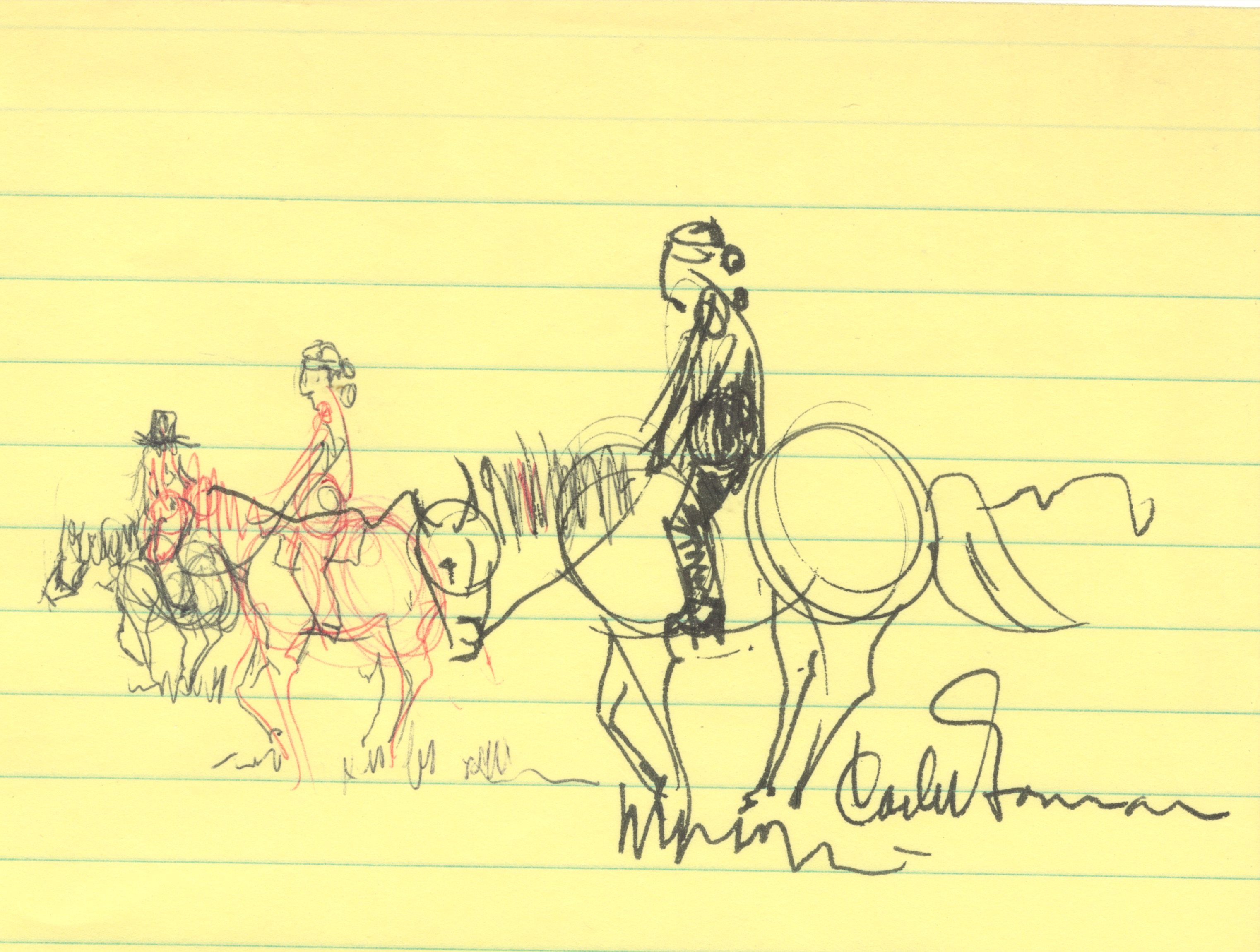
Lebanon Democrat discussed my meeting a code talker. i think the column pretty well covers it. It certainly was one of the most delightful and interesting evenings i’ve had in my life. the drawing leans against the wall behind my desk.


An Original Code Talker

SAN DIEGO – The Navy sent me many places I would have never seen otherwise. I have always been grateful. “Join the Navy and see the world” was not an empty slogan.

One of the most unlikely places I visited was the New Mexico and Arizona desert, a long way from San Diego, Middle Tennessee, and the ocean.

My thoughts turned to this abnormality when I read an article in The San Diego Union-Tribune this past week. Members of the Kumeyaay tribe in San Diego County are attempting to save their native language from extinction.

My travels to the Navajo Nation also had a connection to Native American language. The Navajo language did not need to be saved. To the contrary, their language contributed to the United States winning World War II in the Pacific.

In the spring of 1989, my command, the Naval Amphibious School in Coronado, asked me to chaperone a trip through New Mexico, Arizona, Utah, and Nevada. The tour group consisted of approximately 25 foreign senior officers who were attending an amphibious planning course. The public relations tour was a ten-day whirlwind trip through the Navajo reservation of Four Corners, the Navajo reservation; the Grand Canyon; Brian Head, Utah; and Las Vegas. The farewell dinner to the Navajos in Window Rock, AZ, the capital of the Navajo nation, was by far my best time on the tour.

The Navajo Veterans of Foreign Wars sponsored the dinner. The speaker was the embattled Navajo council vice-president, Peter McDonald, who was eventually forced out of office and sent to prison for fraud and corruption. My special time was not the dinner or the speaker.

Being a chaperone, I waited until the foreign officers and the VFW members had found seats. When the organizers discovered no seats were left for me. they set up a card table and said someone would join me. Soon, the picture of noble warrior came to my table, accompanied by a young lady. He introduced himself as Carl Gorman.

As the meal was being served, this craggy faced man, long white hair pulled back and tied in a pony tail, made me feel comfortable. He spoke with when pride introducing his daughter, Zonnie Gorman, who was working for Amtrak.

Gorman, a member of the Black Sheep clan of Navajos, was an original Code Talker in World War II. This group of 29 Navajo Marine recruits created the code for radio communications in the Pacific theater from their native tongue. The language was not written and the Japanese could never break the code.

The Code Talkers grew to around 400 and their contributions were kept secret until the Vietnam War. They were finally honored through a congressional act in 2000 and all received the Gold Medal authorized by that act.

Gorman was not just a Code Talker. He also was an artist known for his depictions of life in Four Corners and a protector of Navajo history, lore, and culture. His son, R.C. Gorman, is an artist of equal stature in Southwestern art.

Carl Gorman projected a regal bearing. He talked energetically of his heritage and the Code Talkers. His anger at the white man’s prejudice against his people and himself was fervent without malice.

As we talked, he took his pen and began drawing on a scrap of notebook paper.

I wondered why he was not at the head table. Gorman spoke of how the VFW had refused to take a stand against questionable practices. I discovered later he had left the organization because of his ethical stance. Yet he was still held in the highest regard by the other VFW members.

He passionately railed against alcoholism, which had become a severe problem on the reservation. He pointed to the VFW members, many of whom were drinking heavily.

The evening was one of the most educational of my life. I left awed by Carl Gorman, or Kin-yah-onny beyeh, the Son of Towering House People.

The drawing on the scrap paper was completed at the end of the dinner. It depicted Navajo warriors on horseback. It was simple but haunting. He gave it to me.

In 1998, Carl Gorman passed away in Gallup, NM, at the age of 90.

I hope the Kumayaay can successfully reclaim their native tongue. It is rooted in Yuman, the root of dialects of Native Americans from this Southwest corner to Arizona.

Mr. Gorman would be proud of their efforts.

-30-

i thought i had written of my meeting Mr. Gorman and included a scan of his drawing. i gave my copy of Gorman’s book to someone who never returned it. i need to get another copy. It was intriguing. The Code Talkers gave an incredible service beyond the call of duty to our country even as they were being mistreated in the worst possible way. Carl Gorman was above that, and i suspect all the Code Talkers were of that ilk. The passing of Mr. Holliday is another marker of the great generation of all the Americans regardless of race, creed, or color remains a bright spot in our history. It is sad to see them go. i am not optimistic we will have another generation like that one again.