All posts by Jim

Let Freedom Ring

i had a good day today. With the help of daughter, i touched my toe in the water of the cyber world, learning how to survive there because for goodness sake one cannot live by bread alone: he must be able to navigate the “cloud” and new fangled no-chord technology. We aren’t talking about Philco radios or RCA Victrolas any more.

i wrote quite a bit. i did some home projects. i created a post or two i liked. i did some work outside and in my garage. i like to tinker and i tinkered away. Good day.

Then i tired from those enjoyments and decided to end the day sorting and throwing away office stuff and cleaning up my documents. There i found the below file i had almost finished but put aside.

i think it captures my mood about our country today:

Thomas, John, James, Abraham, and Mose

In 1776, Thomas Jefferson penned the draft for the “Declaration of Independence.” His words: 

We hold these truths to be self-evident, that all men are created equal, that they are endowed by their Creator with certain unalienable Rights, that among these are Life, Liberty and the pursuit of Happiness.

The idea had far deeper meaning than Jefferson and the fifty-five other British colony representatives who signed the document could have imagined. The idea is no less powerful for their lack of understanding the depth and breadth the meaning of those words would come to hold for everyone, and i mean everyone, who would become, one way or another, citizens of this country, and to the world at large.

*     *     *

James Madison is credited for being the major writer of our Constitution, from which our country formed the best governing system, which remains so today. It begins:

We the People of the United States, in Order to form a more perfect Union, establish Justice, insure domestic Tranquility, provide for the common defense, promote the general Welfare, and secure the Blessings of Liberty to ourselves and our Posterity, do ordain and establish this Constitution for the United States of America.

Madison likely had no idea how impactful his words were to become to the country, but his lack of knowledge of the future does not detract from the power of his concept.

*     *      *

Abraham Lincoln spoke to a large crowd it the Gettysburg Civil War battlefield to honor the fallen Union troops. It is known as “The Gettysburg Address:”

Four score and seven years ago our fathers brought forth on this continent, a new nation, conceived in Liberty, and dedicated to the proposition that all men are created equal.

Now we are engaged in a great civil war, testing whether that nation, or any nation so conceived and so dedicated, can long endure. We are met on a great battle-field of that war. We have come to dedicate a portion of that field, as a final resting place for those who here gave their lives that that nation might live. It is altogether fitting and proper that we should do this.

But, in a larger sense, we cannot dedicate — we cannot consecrate — we cannot hallow — this ground. The brave men, living and dead, who struggled here, have consecrated it, far above our poor power to add or detract. The world will little note, nor long remember what we say here, but it can never forget what they did here. It is for us the living, rather, to be dedicated here to the unfinished work which they who fought here have thus far so nobly advanced. It is rather for us to be here dedicated to the great task remaining before us — that from these honored dead we take increased devotion to that cause for which they gave the last full measure of devotion — that we here highly resolve that these dead shall not have died in vain — that this nation, under God, shall have a new birth of freedom — and that government of the people, by the people, for the people, shall not perish from the earth.

As our forefathers before him, Abraham Lincoln did not fully grasp the breadth and depth these words have come to mean to us. Abraham Lincoln was not ready to accept racial equality. Where he lived when he lived was not ready to accept races as equal. That was true of all races. The dominant powerful races ruled, but had the “Native Americans,” the Negroes, and all of the other races had the technical superiority and power of the Caucasians, they too would have considered themselves superior, and quite likely did. Yet Lincoln’s words, especially the last part of the last sentence from that address: “…that this nation, under God, shall have a new birth of freedom — and that government of the people, by the people, for the people, shall not perish from the earth” captured the essence of equality we not only continue to strive for, but believe in all of our hearts, at least those who try to be pure of heart.

These forefathers’ worlds were different than ours today. But their ideas captured what we should be still attempting to achieve in the true, complete sense of the words they wrote and spoke even though it was not a complete, perfect thought in their minds. It was their ideas of freedom and equality that has made this country great.

It seems to be we have forgotten their ideas of freedom and equality for all humans.

Mose Allison recognized this in his song “Mercy:” 

Everybody crying mercy when they don’t know the meaning of the word…
Everybody crying justice, just as long as they get theirs first…
Everbody crying peace on earth just as soon as we win this war… 

i am sad.

Veteran’s Day

In 1970, i had a cup of coffee seventeen times in Qui Nhon, Nha Trang, or Cam Rahn Bay, Vietnam; was caught in the crossfire of .50 cal rifles between mistakened U.S. forces once, friendly fire i think it’s called; thought i was shot at five other times; and at night from my ship’s weather decks, watched tracers from firefights several miles away.

About 0200 in Qui Nhon, a cargo ship moored aft of the USNS Geiger (T-AP 197) on the DeLong pier had a zapper charge blow through her cargo hold. i watched from my stateroom porthole as she took on a list, held upright by her mooring lines with the huge tire fenders between her and the pier being blown up in the air and bouncing down the pier while the crew from several Asian countries running down the pier avoiding the bouncing tires and some climbing our accommodation ladder to inquire about joining our Merchant Marine crew.

At anchor in  Nha Trang Bay after Army intelligence informed us we were a target for zappers in the area, i spent the night with Doc Miles Humphrey, standing by the safety lines on the 03 level, with my .45 cal pistol, the only one of five guns i knew were on the ship, feeling pretty hopeless, watching for any signs of underwater swimmers. The zappers must have been scared away.

In 1984-85 with USS Yosemite anchored off of Masirah, Oman, we were informed by Navy intelligence Iranian gunboats might attack us. We had ad hoc .50 cal rifle teams posted around the perimeter of the main deck and 02 levels for a week or so. Checking out these teams with almost no weapons training, the helpless feeling i had in Nha Trang Bay returned.

In my 15 years at sea, i experienced about ten near collisions and a half dozen or so storms strong enough to frighten the most experienced mariners. i don’t remember ever being scared in the Navy. I felt helpless those two times, i was concerned, especially when other ships were putting my ship and the crew in danger by not following the rules of the road. i have been frightened a number of times in my non-Navy life.

But then, the dangers i brushed near were nothing. Nothing. i have friends, close friends who died. i have friends who were horribly injured and brutally tortured — none of them talk about it, or regret it. Death, pain, long term disability are part of the agreement. They are proud of their service.

i’m proud of my service too, but my service was not so much service as a means to financial security and more so going to sea on ships. Still i am proud of my service.

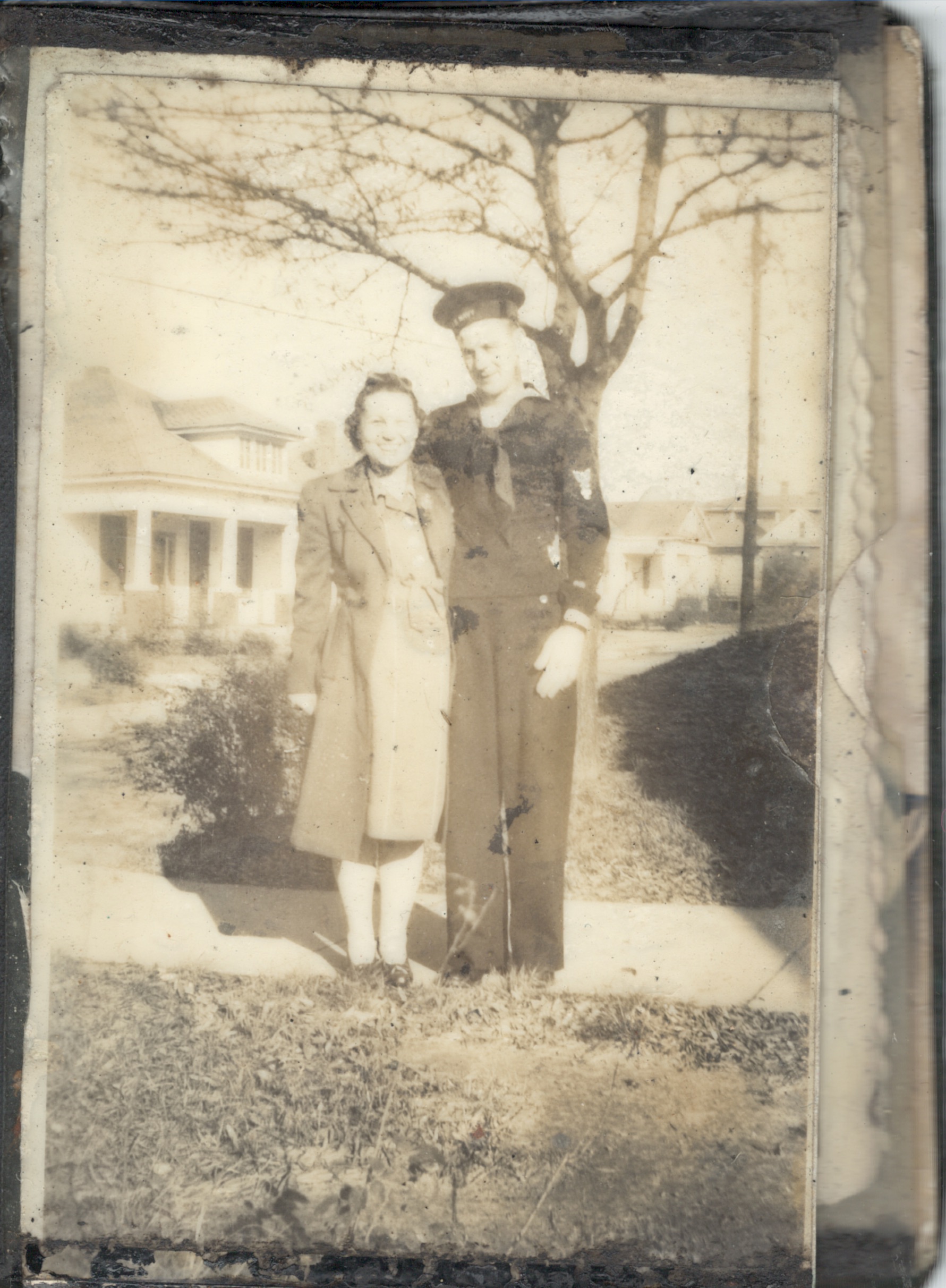
Jimmy and Estelle Jewell, autumn, 1943.

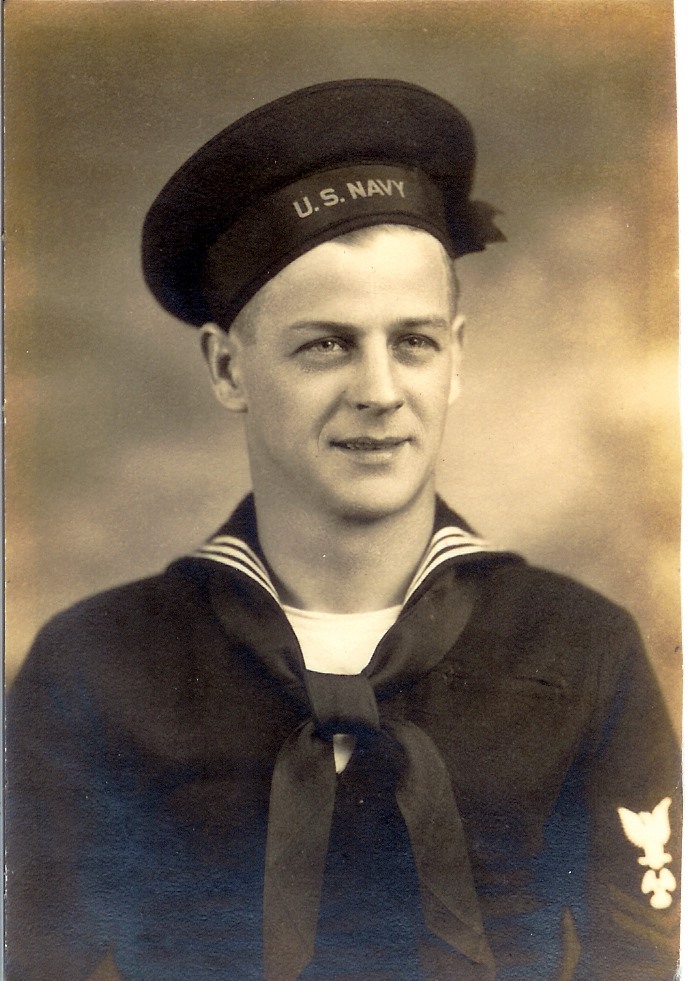
i think of my father’s service and the service of his generation. It is mind boggling to me: he and all of the other men in that generation who dropped the only lives they had ever known to fight a war in places they had never dreamed of much less been to.  Jimmy Jewell was a youthful automobile mechanic in small country town with his first child on the way. He decided to enlist before being called by the draft. He felt it was his best choice and would allow him to serve using his expertise, fixing things, like automobiles. With a pregnant wife and a sense of duty conflicting in his decision making,  he made his decision based on the inevitable service he knew would come to pass. He took with him a pocket-size faux leather album he kept in his pocket the entire time he was gone containing precious photos like the one here of his wife and him.

i try to imagine how he felt as he went to Parris Island, South Carolina for boot camp, and Davisville, Rhode Island for Seabee training, and Gulfport, Mississippi to wait for his ship, places in the states he had never been. Then, what was on his mind when, with 1 five-month old son and his wife on his mind, boarding that liberty ship, traversing the Panama Canal, picking up more 75th Battalion Seabees in San Francisco, crossing the Pacific, and spending almost two years, in the middle of a war like no wars in its expanse.

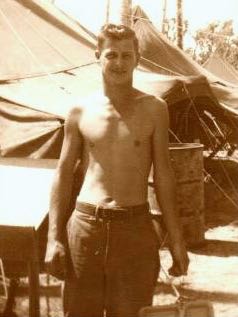
I try to imagine him watching kamikaze planes from his motor pool crashing before they reached him. i have been to several of the places in the South Pacific where he had been thirty or forty years earlier. i understand why many of his photos show him shirtless in the intense heat and humidity on those jungle islands.

The stories he told me about those times in the war at Espiritu Santo, Vanuatu, New Caledonia; Bougainville, New Guinea; an LST ride to Luzon, Philippines. He showed me photos as he told me the stories and gave me a box with those photos to keep. i fervently wish we had taken time for him to tell me more stories and also wish i had recorded those stories in order to get them right in the retelling.

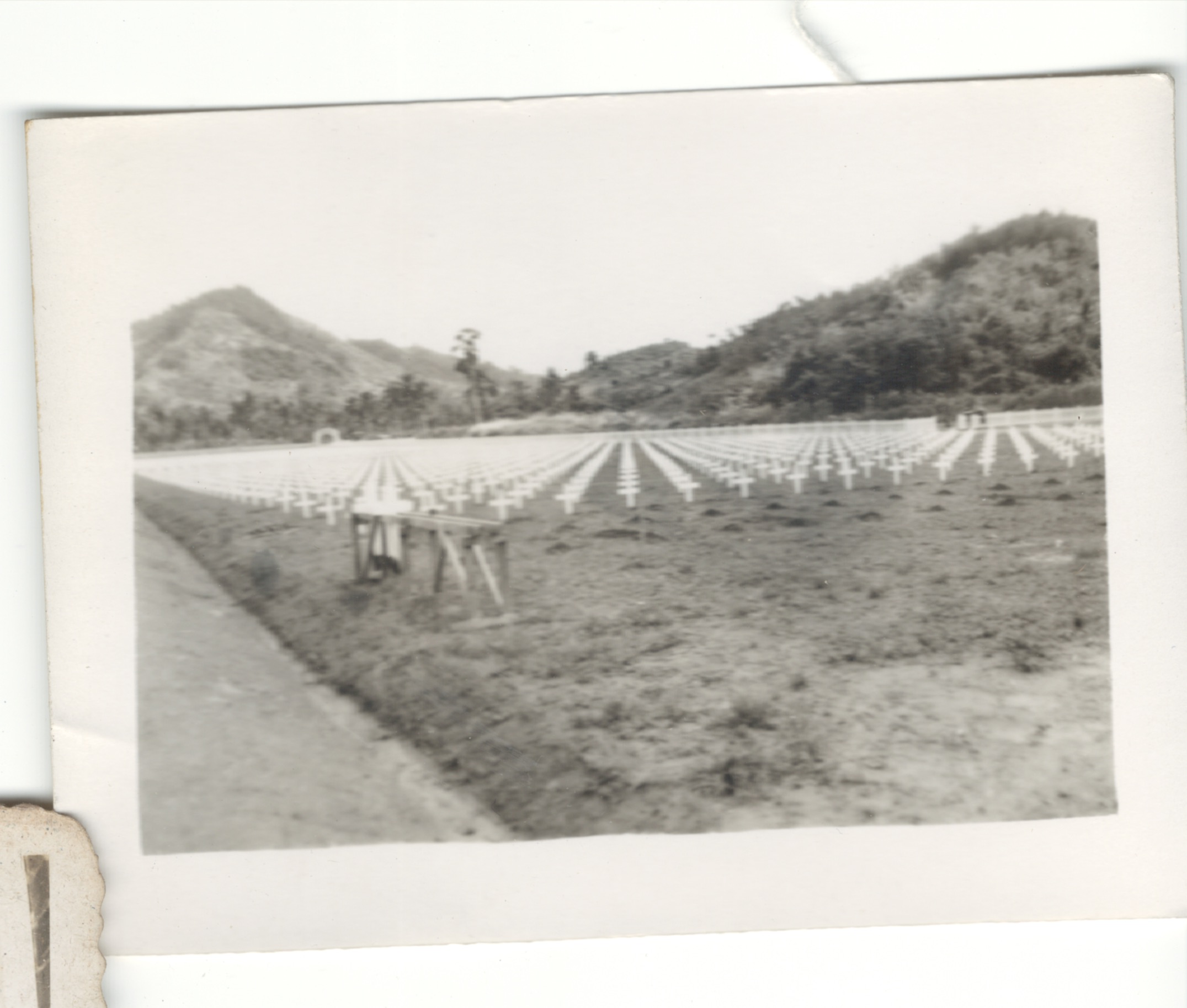
But there was one photo that tells it all for me. Today, Veteran’s Day, is not just to honor those who died in service. The ensign (U.S. flag to you non-Navy folks) is flown two-blocked, not at half mast for it is a day to be proud of our service, not sad. Still there are those who didn’t come back from their service. They remain in places their sons and daughters won’t ever visit. One of those who didn’t come back could have been my father. Heck, now that i think about it, i might not have come back from some of my service: just haven’t thought of it in that way before.

i am proud of all of my fellow veterans for their service. But there is a quiet awe i feel when i look at the photo my father gave to me:

U.S. Military Cemetery, World War II, Luzon.

A Microwave Story

Amy Beth Hale posted on Facebook this morning about getting a new microwave oven. She had put off doing so for about a year and a half after the old one went out, and did so mostly because the light over the stove died with the old microwave.

It brought back a memory of a microwave that wasn’t so benign in its passing. It is a second hand story, so i will attempt to keep it anonymous for i cannot vouch for the veracity. But it’s a good story.

Out west in a hilly region of the countryside, there is a wonderful golf course: tough, up and down among many pines with narrow fairways and small greens, and a small lake. Homes are built around the beautiful private course and many of the residents are club members.

Several of these members played a couple of rounds each week with each other with small wagers. One such wager was at the fourteenth tee at the back of the lake. The group had a standing bet they would all pay a hundred bucks if someone could hit a ball off the tee about sixty degrees right of the fairway line and reach the other side of the lake, about 290 yards away. Each time, they reached the fourteenth tee, they would take turns before their tee shots for the match to try and hit the other side of the lake.

One member whose home was behind the fourteenth tee was often close but still short of his goal. He knew the harder the golf ball, the further it would go. So he devised his plan of winning the standing bet. As they walked from the thirteenth green to the next tee box, he said he had to run inside his house and get something out of the kitchen. When he got inside, he placed his golf ball in his kitchen microwave and turned it on high, figuring microwaving it for a minute or so would make the ball hard enough to go longer and get his shot to other side of the lake.

He turned on the microwave.

The other golfers heard the blast.

The microwave exploded and ruined a good portion of the kitchen.

The golfer/house owner never found the golf ball. His future tee shots never reached the other side of the lake.

i’m not sure why, but i laugh every time i think of that story.

Thanks, Amy Beth.

Déja Vu, Only More So

Last Thursday evening, i attended an event, which produced déja vu for me but in spades. i began this post later that Thursday evening and have been trying to get my head wrapped around it since then.

The event was not as well attended as it should have been. But on the other hand, the few who attended experienced an impactful evening made more so because of the intimacy of just a few.

Sixteen folks were there.

Andrew Maraniss was the speaker. He told of a difficult time in our history and how one man faced it and not only endured but succeeded with very little support. In doing so, this man opened the door to a new and better culture.

The book is Strong Inside: Perry Wallace and the Collision of Race and Sports in the South.  i read the book shortly after it was published in 2014. It told of how Wallace became the first black athlete to play in the Southeastern Conference in 1967. He played for Vanderbilt. The story is almost overwhelming from many angles. Wallace endured severe racial prejudice, threats, and even violence. Those with best intentions did not provide him the support he needed and he had to grit his teeth and make it on his own.

Make it he did. And finally Vanderbilt made amends for the lack of support and Perry took his rightful place in the history books for being a pioneer who led the change for sports in the South and his rightful place of honor at Vanderbilt. Andrew’s two books, Strong Inside (the adult edition mentioned above) and Strong Inside: The True Story of How Perry Wallace Broke College Basketball’s Color Line (young readers edition),  provide a vivid portrayal much better than anything i could offer here.

But the Vanderbilt Alumni meeting was an experience.

i was there…i mean i was at the meeting and i was in Nashville when the Perry Wallace story  unfolded.

The meeting was unique. Although small in number, the attendees included two young boys, recent graduates, and graduates who attended during Perry’s time there. There were guests, my wife, daughter, and two neighbors included.

The reaction to Andrew describing the events in the book brought a palpable, emotional response. Andrew’s style is informal, casual and fit this event perfectly. Those who had not heard the story believed but it was hard for them to imagine it actually happened. Those who had heard the story and read the book, especially me, were taken back again.

The question and answer period was just about perfect. All of the questions and comments were pertinent and on point. Andrew’s discussion for each question left everyone feeling their questions were answered and their time well spent.

And i was taken back again. i was gone by the time Perry had matriculated. But i was around. i saw him play for Pearl High School, the first time a black school had played a primarily white school (Father Ryan, the winning opponent had several black students and athletes). i saw him standing just out of the foul circle, take one step, catch a teammate’s foul shot, which had hit the back of the rim and bounce up and back to the court, Perry catching it with his right hand at the top of the arc and slamming it back through the net. i heard of his feat at Vanderbilt practice picking quarters off the top of the backboard.

Although i was no longer a student at Vanderbilt, working my way through Middle Tennessee State, i spent a great deal of time in Nashville and was thrilled Wallace and Vanderbilt had broken the color barrier and were succeeding. i had no idea, none whatsoever what Perry was going through.

Perhaps i was just too naive. Looking back on my life my naiveté has been one of my problems throughout my life, even now. i have written here about wondering why folks with darker skin color were at a lower social level, wondered why i didn’t even seen youn black youth, much less play with them. i loved the blues and recognized blues was the propriety of black folks. i listened into the deep of night most nights during high school. As the youth representative for a church committee, i even made a stand for integration.

In college through the good graces of Kent Russ, i met Ralph Boston and remain impressed until this day. i also saw Bob Hayes tie the 100-yard world record. And Cy Fraser and i were frequent visitors to the New Club Baron, a black night club featuring blues and rhythm and blues where we would be two white young men in the middle of a packed house of folks with darker skin, and we would stay into the wee hours.

i just didn’t get it. The protests and the sit-ins had reached a peak. i should have known. i tell myself i should have done more than one measly pronouncement at a church meeting. But i was working two jobs, commuting daily to MTSU, playing softball in a church league, and finding ways to get to my fraternity on the Vandy campus as often as possible. i was interested in getting my degree, going out with women, having fun, and moving on, on and out. That was it. Even with all of the news and the hubbub around the protests, i just didn’t know (as the late Bob Warren, a Commodore teammate of Perry’s said to him years later: “I just didn’t know”).

These kind of thoughts frequently play in my mind. In quiet moments, i try to remember how i missed it, how i didn’t know. i am glad Perry Wallace, “the Jackie Robinson of SEC sports,” did what he did. We needed someone to step forward. i’m proud of Vanderbilt for at least initiating the possibility and even though it was bumbling, giving Perry the avenue to make it happen.

Last Thursday, i went through all of those thoughts one more time: déja vu. As usual, i had no more answers. But i was moved by Andrew Maraniss and was gratified at the response of his audience.

A final note: We have progressed. Athletics is one avenue that opened doors for blacks (i’m using this term for folks of darker skin color than me because someone much more up to date than i told me that was the current preferred politically correct term: i hope i am not offending anyone). Our schools are, at least on paper, integrated. We have made strides through the efforts of many brave people willing to step forward for the first step. i believe both of my daughters and my grandson are color blind. Yet when i look around, i see progress but a long, long way to go before we are truly integrated.

As to how we do that, i feel much like i felt when i watched Vietnamese families escaping a terror, willing to risk the very lives of the families they loved so much by jumping on boats with no idea those boats would even float and heading to the sea with only vague promises and hopes, leaving their homes, their country by the thousands, coming over that horizon south of Vung Tau every day for more than a week. i said to myself then and i say to myself now, “i don’t know what we can do, i don’t know how we got to this point, but we should have done more to prevent this from happening.”

The question now is not what we could have done for Perry then, but what can we do for Perry now?

A Comment on “A Goodbye Long Ago”

One of the most special people in my life who remains one of my dearest friends sent me a comment on my post including my retirement speech. She and her husband are at the beach in autumn — i loved the beach or the coast in the autumn winds and frothing seas. i responded to her comment, and when finished decided what i had written to her captured my feelings about my time at sea. Here it is:

i wish i could spend an evening with you two discussing why i chose the sea, or rather how the sea chose me. There are not a hell of lot of things i believe in. The sea can do that to a fellow. But i believe in the sea. She told me to believe in her.

i wish i could go to sea again, not the graceful sea of the sails and gallantry or even the commercial success of bigger and bigger ships carrying bigger and bigger cargo. No, i wish i could go to the sea again in the clanking, wheezing steam and metal digging into her waves with men on the bridge and down in the holes to take my orders for all ahead full and fifteen degrees right rudder and steady on one four five degrees and ring up turns for twenty-two knots and walk to my port wing in the deep dark of the mid-watch with my cup of steaming black coffee in my hand and my cigarette dangling from my lips (yes, back then i didn’t know or didn’t believe it was a curse and i enjoyed them in the dark of the mid-watch with my coffee) and on the port wing looking abeam to check to see if i could determine the horizon in the black lit by millions of stars and a crescent moon, knowing there were no contacts because Combat Information Center had divulged through sound-powered phones their radar repeaters sweeping green across the black screens had shown no blips within their range, and sipping my coffee, drawing on my smoke, and looking, not up at the impressive array of light in the heavens but down, down deep into the dark, dark blue of the sea flecked with white foam of bow waves, and she would talk to me, tell me i was her own, and ask me if i knew her secrets below and of the storms and the doldrums. And in the cold of the wind abetted by twenty-two knots with the collar on my foul weather jacket up, i never knew but could feel her secrets and fall in love all over again with a warmth in my gut from her knowledge that was almost mine.

Enjoy the beach and feel the sea.