i’ve always been a bit ditsy and forgetful, but sitting here on the kind of day that allows the Southwest corner to put a spell on me: mid-70’s cumulus clouds hanging east behind Mount Miguel but none here and a sea breeze cooling me while i grill a steak, it occurred to me i think of myself as a practical and logical man.
But i’ve noticed in today’s culture, being practical and logical has become impractical and illogical.
Hmm…Well, Maureen’s salad, potatoes and green beans were great, and that steak wasn’t bad either.
i really wantedto include the names of the people who contributed to my growth as a Navy officer in this post. However, there were a couple of people who aren’t depicted in a good light. i did not publicly name them in such a fashion and, at least for now, have left most folks unnamed.
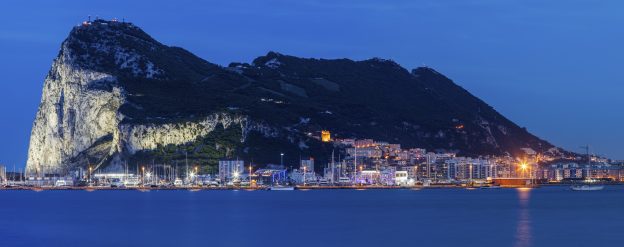
One of the most impressive sights i’ve seen in my life time occurred on the mid-watch the evening after the Hawkins had gotten underway from Málaga (the mid-watch was from 0000-0400). That, naturally, was the watch my section was assigned on my first night at sea on my first ship. The Bridge and Combat Information Center (CIC) were in four section watches. We passed through the Straits of Gibraltar around 0100. It was dark, but not dark enough to hide the massive Rock to the North, the Rock of Gibraltar (This image was copied from the “Spartan and Green Egg” website.)
i was blown away. My watch standing position was Junior Officer of the Deck, Underway, JOOD (UI). That is about a lowly of a watch position a Navy officer could have on the bridge of a Navy destroyer. i will never forget the rush i felt as we crossed the straits into the Atlantic Ocean and joined the other destroyers of Destroyer Squadron 24 for the transit across the “Pond” as we called it, and headed for our homeport in Newport, Rhode Island on a great circle route.
It may not sound like a good deal but standing the mid-watch was a good way to start your tour on a Fleet Rehabilitation and Modernization (FRAM) destroyer (These “FRAM cans” were modernized Fletcher, Gearing, and Sumners class destroyers that went through extensive upgrades in mission and armament including replacing large, if not all, steel sections of the ship’s superstructure above the main deck with aluminum that produced significant problems later).
Reason number one for a new ensign to enjoy the mid-watch was mid-rats or midnight rations. The oncoming mid-watch was awakened around 2310-2315 (11:10-11:15 p.m. for land lubbers), they would rise quickly and head for their respective messes. For my case, that was the wardroom. The stewards would prepare a super snack for the oncoming watch and the off-going watch after they had been relieved and struck below.
That watch had a few normal requirements like “shifting control” to after steering. This was done on almost every mid-watch to ensure the system was working and the watch standers in the small, cramped space above the rudders on the stern, could take control of the steering system.
After-steering as with many facets of a Fleet Rehabilitation and Modernization (FRAM) destroyers and their predecessors was devised before the FRAM upgrades to provide sustainability during an at sea conflict. Back up systems abounded in almost every aspect. If the electrical system was knocked out, most systems like the gun mounts could be fired manually. If a pump was hit in the engineering spaces, there was a manual or auxiliary steam backup. If a shaft, its fireroom or engine room were damaged and inoperable, the ship could still have propulsion from the other shaft. And if steering control at the bridge’s helm was rendered inoperable, the bridge could still steer the ship by shifting control to after steering.
In the case of after steering, the shift was made during the mid-watch but often other watches would shift control to after steering and let the watch standers there take orders from the conning officer and steer the ship.
Other than that, rarely did the tactical commander order any formation changes. During this transit, the squadron commander was the tactical commander. When steaming with a carrier, the admiral in charge of the “battle group” would order formation changes (except for the staff i was on much later in my career). So it was a relative quiet four hours. The first two hours of the morning watch (0400-0800) and the last two hours of the evening watch (2000-2400) were also pretty quiet. It was a great time to learn about being a Naval Officer and, certainly more enjoyable, hear real “no bullshit” sea stories.
The voyage to Newport was relatively serene with good seas all the way. i was introduced to the big, black rubber hood sitting over the radar repeater sitting next to the helm. During the day with light filling the pilot house, the hood allowed the watch standers to look at the dark green cathode ray tube with the white bar sweeping around, highlighting blips that most often were contacts. In the darkness of night, the hood was not necessary.
That repeater was a central character in one of the sea stories i was told on these watches.
The commanding officer was impressive and seemed to be a nice guy most of the time. He was a Naval Academy graduate and was selected for Captain before he was relieved the following August. He also was what officers and sailors called a “screamer.” For the uninitiated in the Navy world, a “screamer” was an officer who couldn’t control his temper and often would go ballistic, chewing out anyone who did not perform as he felt they should, or just go off on someone for no real reason.
The Damage Control Assistant who partook of one more drink (or more) in Málaga while i waited on the airport’s tarmac was a frequent target of the CO’s outbursts. i was told that on one night watch in rough seas, the DCA was the Officer of the Deck (OOD). The captain kicked him off the bridge in a screaming rage five times, only to call him back to the his watch. It was after the sixth time, the DCA/OOD was looking at that repeater to see if he could discern any weather anomalies and check for contacts that CIC might have missed.
Hung around the bridge were a number of battle lanterns. They were one of those backups for emergencies mentioned earlier. If power was lost, the battle lanterns were configured to detect the power loss and come on to provide emergency lighting. One of these battle lanterns was secured on the overhead directly over that repeater. As the DCA was staring intently as the scope, the captain begin another rant, cussing out the DCA for many supposed errors in hus ways. As the rants continued to ratchet up, the rough seas were building and the battle lantern was loosened by the bouncing from the waves. As the captain peered forward in an attempt to determine what the weather offered, his rant reached a crescendo. That is when the battle lantern broke loose and fell straight down, hitting the OOD/DCA on the top of the head, knocking him out.
As other watch standers went to the downfallen OOD to attend to his injury, the captain continued screaming at his officer without turning around. Finally, he turned and realized he had been yelling at a comatose Naval officer.
That was the sixth time the OOD left the bridge during one watch.
i hit the six-month mark two days ago: One half year from actually turning eighty.
i’ve got a feeling “Life Begins at 8)” was not considering me. i also wonder if it really does begin at eighty, then i’ve got one hell of a lot of fun left to experience. It should be interesting. But after another horrible round of golf during FMG (for those who not remember, “FMG” means Friday Morning Golf, something i’ve been doing with two good friends from our last tours at the Naval Amphibious School, MAJ James “Marty” Linville, USA (ret.) and CDR Rodney “Rod Stark, USN (ret.), since 1991. Yup, 32 years. My golf has never been more than average, but now, i play three bad holes, get warmed up, play better for six holes with the exception of a couple of holes that attain FUBAR status, then i continue fairly decent for a couple of holes…and then it really goes into the deep mire of golfdom (my word, apparently). As i stated to the FMG crowd, i cannot tell if i play bad golf because i’m tired or if i’m tired because i play bad golf.
Still playing with these two, Pete Toennies, one of the original curmudgeons, and a whole bunch of decent folks and better golfers than me is just flat fun. Camaraderie they call it.
But sometime after my long nap Friday afternoon, i swore to finish my first phase of organization of the first bunch of photos and memorabilia on the temporary table i set up in my home office.
As a result, i have spent most of my Saturday revisiting some things past: Eventually, many of these will be posted here, primarily for relatives who also can get wrapped up in walking down memory lane.
In this process, i found a few i wanted to post now:
Blythe at Easter Time in College Station, Texas. The photo on the left was in 1977 before she turned five. The photo on the right, same place, same time of year, one year later.
The Easter Bunny probably is still scratching his head.
Then, a few years before that when Blythe was on her way to being, i would take naps after getting home from my sports editor job at Watertown (NY) Daily Times. It was 1972. i know because that was the only time in my life my hair was long (or as long as it could be prior to my reporting for two-week active duty for training (ACDUTRA) when i would get it back to almost Marine regulation. Snooker was an absolutely great dog, and like Cass, the lab and Lena, the mutt later, we would take naps together. And yes, i did sleep like that. Blythe’s mother took this photo.
Finally, to close out today, the photos are in sorted by years and in containers for each of those years. The office is less piled with stuff than it has been in a month (but it will begin tomorrow).
This is the last one, not a photo but a can of a two-sided document from 1944. It is a letter my father wrote to my grandmother. The dateline conflicts with what i recall, or rather recall from my mother’s recounting that period of history when i was an infant. i am trying to verify that. It is the government “V-Mail” letter, required then for service members to use in their correspondence during that awful war. Daddy was either in Gulfport, Mississippi with the 75th CB Battalion waiting to get underway for the Southwest Pacific, or he was enroute.
Regardless, Daddy only wrote more letters to his wife. His mother, Mrs. Myrtle Orrand Jewell, “Mama” to us, had quite a few. i don’t know how many as those photos and memorabilia are not complete. Still, he cared for his mother, an amazing woman, and i absolutely loved her for the short time i was fortunate enough to have her in my life.
The front of the letter. It folded with directions to be the size of a post card.
You know, it can feel good revisiting some things past.
This is likely to be the shortest chapter in this book to be written. i have been writing on it for over a week when yesterday, i realized there was only one real “Sea Story” in all that i had written. There was a lot of personal history, which i have saved separately for my grandson
i left Key West, went to Atlanta, and then home to Lebanon, Tennessee before reporting to Charleston, South Carolina. i had no idea of what i was getting into. i didn’t have a great deal of guidance. i had service dress khaki, which i was wearing and still love in spite of it leaving the Navy in the 70’s some time; a complete set of Naval Officer uniforms; a cruise box; and a sea bag.
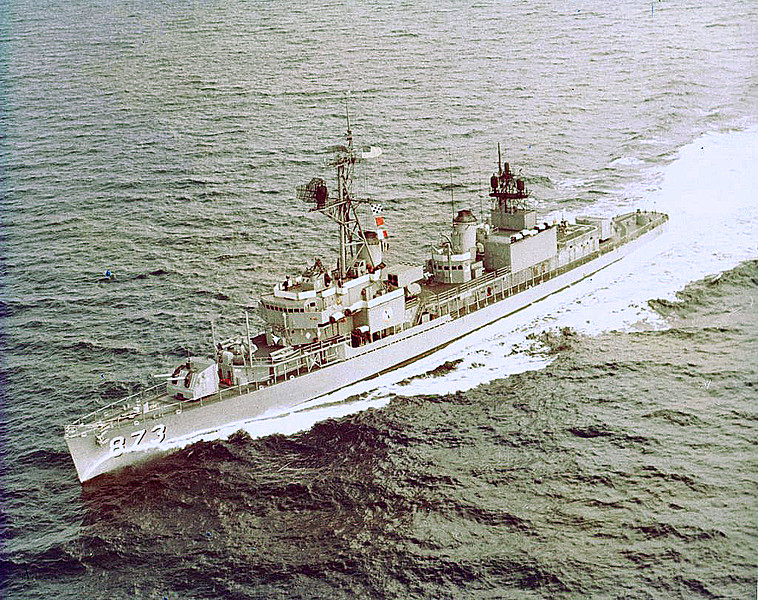
All i really knew was i had an airline ticket to Charleston, South Carolina where i should report to the Air Force Base, spend a night in the BOQ, and catch a flight to Rota, Spain the next day to await for a connecting flight to my first ship as a Naval Officer, the USS Hawkins (DD873). The cruise box was a 19x32x16 inch plywood box. The sea bag was a standard Navy duffel bag. They were crammed with my life.
My flight was on a Military Aircraft Command (MAC) transport to the Naval Base at Rota, Spain. Not yet accustom to military ways, i was assuming i would spend a night there and be flown to a Mediterranean port to meet my ship the next day. Nope. i sat in Rota while the Navy tried to figure out where my ship was.
i took a tour to Seville where i saw a rather poorly performed bullfight. i played golf daily at the dry, dusty course, and ate my breakfasts at the BOQ mess and the rest of my meals at the Officer’s Club.
It took two weeks for the Navy to figure out where my ship was located (it was way before GPS). i was notified by messages to the BOQ front desk, where i was berthed, my flight would be the next morning. Finally.
i caught an Air Force flight the next morning to the Aeropuerto de Málaga-Costa del Sol in Málaga, Spain, a flight under two-hours , arriving around 1000.
The crew offloaded about a ton of equipment and supplies onto the tarmac, covered it all with a cargo net and dumped me beside the pile. The crew signed some papers with members of the La Guardia, Spain’s security force who wore those strange hats that look like plastic with the square bills glued to the cap. Then, the plane took off.
There was no shade. It felt like it was nearing 100 degrees. i had no where to go. Thinking the Navy would pick me up soon, i sat in my service dress khaki and sweated.
i was pretty well drenched when my transportation arrived. The DCA had directed the hired truck to the airport, and he decided to hit Málaga one last time. His last drink(s) took about two hours while i sat with my sweat.
i had been excited about some liberty in Málaga. As the airport name suggests, it is part of the Costa del Sol, the Spanish equivalent of the French Riviera. The thought of hitting the night spots and going to the beach was intriguing. But as i sat down the shotgun seat of the van, the DCA informed me the ship would be getting underway for the States as soon as the cargo was loaded aboard.
My exciting time for my first experience in the Mediterranean was two weeks on base in Rota with a day in Seville, a short flight to Málaga, and the upcoming three-hour underway to the Atlantic.
i reported aboard the USS Hawkins (DD 873) , met the Executive Officer, CDR Louis Guimond, and my Weapons Department head, Steve Jones. i was escorted to my stateroom, the only one in forward officers country. i reported to the bridge and observed her get away from the pier.
And i was underway: a Navy ensign on my first ship, . i was totally unaware of what was before me.